Çağlar Genç aims to transform our relationship with nature through biomaterials and play

Academy Research Fellow Çağlar Genç finds that people have become disconnected from nature and natural materials.
“Just looking around me, I see so many elements that once belonged to nature. We no longer acknowledge that tables were once trees and our clothes were cotton growing in fields,” Genç points out.
This realisation inspired Genç’s current study titled “Playful Biomaterials (PLAY-BIO): Designing for More-than-Human Relations in Everyday Life,” funded by the Research Council of Finland from 2024 to 2028.
The PLAY-BIO study delves into biomaterials ranging from fungi and trees to bacteria and yeasts. The idea behind the study is to integrate biomaterials into product design, transforming everyday items into playful companions: ordinary objects infused with living organisms, evoking a sense of kinship.
One example from Genç study is a bedside lamp containing living bacteria. When these organisms cast shadows on the wall, people can engage in a game of guessing what the shadows represent. This fosters a deeper connection with the inherently animate nature of biomaterials, turning a lamp into something more than just a light source.
Genç, 36, originally from Türkiye, studied industrial product design and interaction design in Istanbul. Later, he joined research projects that combined technology and design with a societal perspective. His PhD thesis explored fashion through a technological lens, focusing on the computational features of different materials, such as textiles.
Genç moved to Finland after being offered a postdoctoral research position at the University of Lapland in Rovaniemi. Knowing that transitioning from a major metropolis in his home country to a small town in Finland would be a significant life change, he decided to visit Rovaniemi before accepting the job offer.
“I was instantly captivated by Finnish nature. The unique presence of nature in daily life was one of the reasons that prompted me to move to Finland.”
In his current study, Genç’s first step is to identify the potential for playful interactions between biomaterials and people. This can be achieved using ethnographic methods. In the second stage, biomaterials are integrated into everyday items, such as lamps and floor panels. With the help of technology, the animate nature of the materials is made more visible. Objects become interactive, inviting us to play.
For instance, floor panels made of fungi can be embedded with sensors and vibrating modules that react to air humidity or footsteps, making it easier to detect how the biomaterials respond to people and the environment.
In the final stage, the items will be placed in everyday contexts, such as homes and university campuses, to gain insights into how people perceive them. Do they still see the items as mere products to be consumed, or do they form a deeper emotional connection with them?
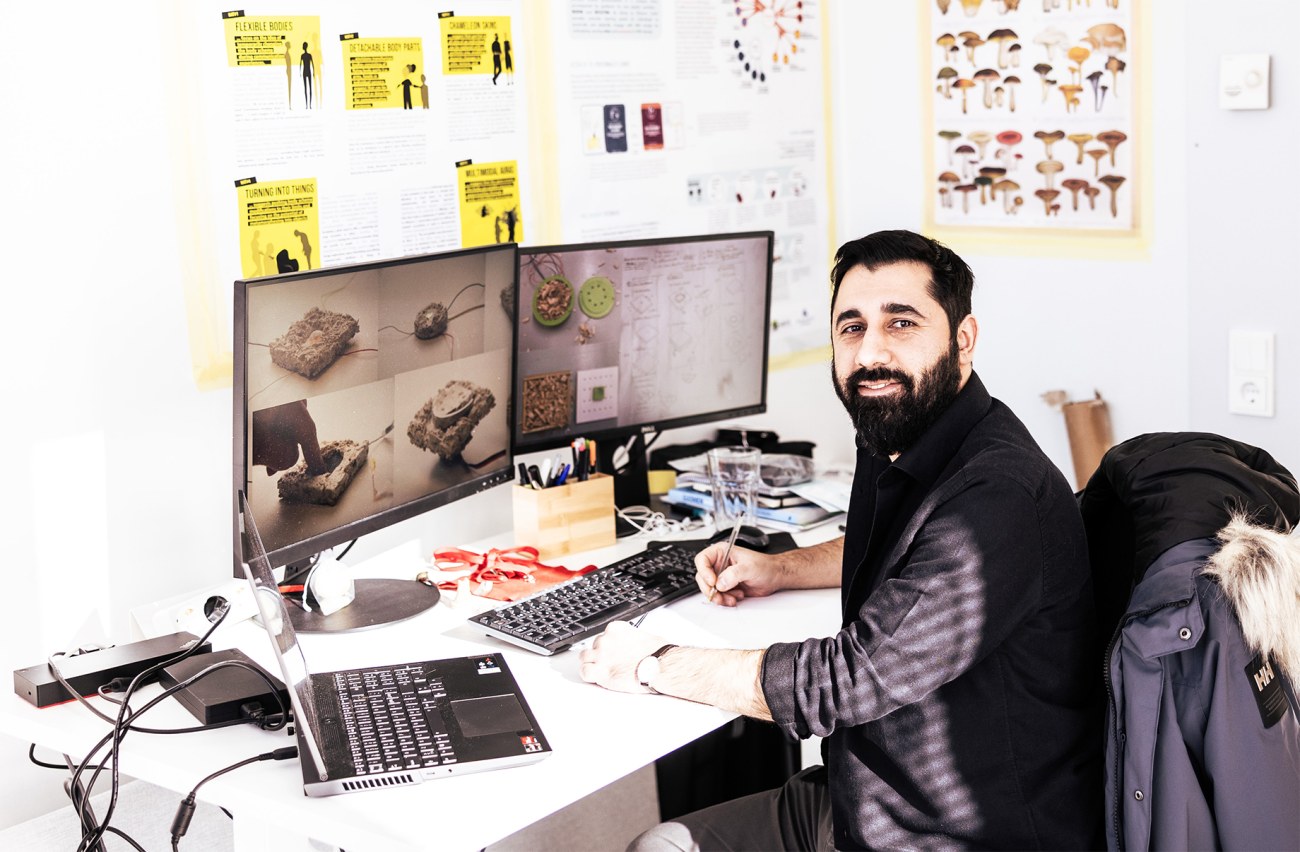 Photo: Jonne Renvall
In his PhD thesis, Genç studied a variety of materials, from textiles to electronics. He was surprised to discover that the materials did not always conform to his intentions, occasionally producing unforeseen results. This sparked Genç’s interest in the nature of materials.
“At the post-doc stage, my interests shifted to biomaterials. I studied materials that were clearly alive and growing. When I tried to shape fungal materials into specific forms, they ultimately yielded to my wishes.”
Genç found himself deeply curious about and emotionally attached to this post-doc project. The work felt almost like play, as he sought to gain a deeper understanding of the materials and his relationship towards them. This led him to consider how he could change people’s perception of materials and whether this could be achieved through play.
“When I bake sourdough bread, bacteria and yeast cause the dough to bubble. Sometimes the bread rises in surprising ways. Interacting and playing with the bread changed my relationship to it,” Genç explains.
Genç hopes his research will reshape people’s relationship with household objects and items. One of his broader goals is to influence, through biomaterials, how we experience and view the nature that surrounds us.
“This may be an ambitious goal, but perhaps the personal experiences created by my research could contribute in a small way towards promoting a change in our relationship with nature.”
Author: Anette Partonen


