
Sensitive and responsive parenting in the first 1,000 days: Nurturing Empowerment, Support and Training (NEST)-project builds on WHO’s recommendation that all infants should receive responsive care during the first three years of life. Sensitive and responsive parenting (SRP) is the foundation of parent–infant mental health and a key factor in children’s social-emotional development. It benefits both children and parents, but is often under pressure in vulnerable families.
In 2023, 25% of children in the EU were at risk of poverty or social exclusion. Growing up in stressed or disadvantaged families negatively affects early childhood development. Yet, current training for professionals often lacks the urgency and tools to support SRP effectively in practice.
NEST addresses this gap by developing:
1. A ready-to-use toolbox for professionals to support SRP in everyday care.
2. A vocational education and training (VET) trajectory to build knowledge, skills, and self-awareness in SRP.
3. A social impact framework to evaluate and raise awareness of SRP interventions across Europe.
The project aims to strengthen the capacity of health and social care professionals to support and empower SRP in vulnerable families during the first 1,000 days of a child’s life. Target groups include midwives, public health nurses, and early family support services. Parents are engaged as experts by experience and central stakeholders in the project.
The project is coordinated by VIVES University of Applied Sciences (Belgium). The partners include CESIE (Italy) and FLVS (France) as non-governmental organizations, and higher education institutions Tampere University of Applied Sciences (TAMK) in Finland, Babeș-Bolyai University (UBB) in Romania, and Harokopio University (HUA) in Greece.
The project is funded by the Erasmus+ Cooperation Partnerships in Vocational Education and Training programme and will be implemented during the years 2025–2028.
Background
The NEST project is based on the World Health Organization’s (2020) recommendation that all infants and children should receive responsive care during the first three years of life, and that parents and caregivers should be supported in providing such care. Sensitive and responsive parenting (SRP) is the foundation of parent–infant mental health and plays a key role in the intergenerational transmission of social-emotional development.
SRP benefits both child development and parental mental health and well-being. However, in vulnerable families, SRP is often under pressure. Parents may show lower emotional availability and feel less capable of responding to their child’s needs due to other stressors.
In 2023, 25% of children in the EU were at risk of poverty or social exclusion. Several of the project’s partner countries rank among the highest in this statistic. Growing up in a family under stress—due to poverty, isolation, or health issues—can severely impact early childhood development and place children at a disadvantage from the start.
Although investing in early childhood is one of the most effective ways to reduce social inequality and promote long-term societal well-being, European societies still underinvest in their youngest citizens. Awareness of the importance of SRP remains low, despite the fact that health and social care professionals have frequent contact with families during the first 1,000 days and are in a unique position to offer support.
Current training programmes often lack urgency and fail to equip professionals with the knowledge, skills, and practical tools needed to support SRP effectively. The NEST project addresses this gap by developing training and resources that are directly applicable in everyday practice.
Goal
The NEST project aims to strengthen the awareness, knowledge, and skills of health and social care professionals to support and empower sensitive and responsive parenting (SRP) in vulnerable families during the first 1,000 days of a child’s life.
The specific objectives are:
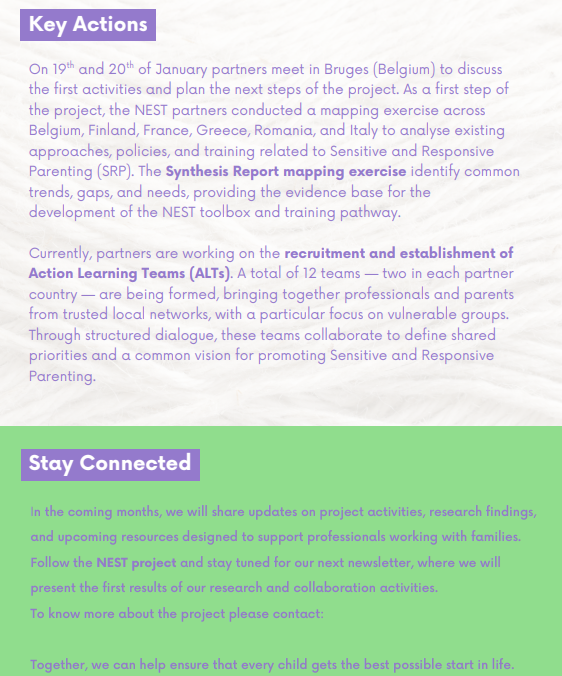
To assess the current situation in practice and literature regarding SRP, and to build communities of professionals and parents in each partner country. These communities will help identify shared needs and priorities across countries and disciplines.
To develop and pilot a practical toolbox with exercises that embed SRP support into healthcare encounters. The tools focus on “good enough parenting” and provide guidance for working with vulnerable families.
To create and pilot a vocational education and training (VET) trajectory that enables professionals to integrate SRP and parent–infant mental health into their daily work. The training also encourages self-reflection and awareness of one’s own responsiveness.
To integrate all NEST materials into the partners’ existing VET programmes and to develop a social impact framework that evaluates the long-term effects of SRP interventions.
Through these objectives, the project aims to bring about lasting changes in educational content, professional practices, and societal awareness of the importance of SRP.
Impact
The NEST project aims to bring about lasting change in health and social care education as well as in professionals’ everyday practices. Its impact extends from individual professionals and families to broader societal levels.
By strengthening professional competence and providing practical tools, the project supports parenting—especially in vulnerable families. As a result of the project, the importance of sensitive and responsive parenting (SRP) will be more widely recognized and integrated into vocational education across participating countries.
Parents’ own awareness and sense of empowerment are expected to grow, particularly among those in socially vulnerable situations. On a societal level, the project contributes to increased awareness of the importance of early interaction and parenting for child development and well-being.
In the long term, the project’s impact will be reflected in improved child well-being and enhanced parental resilience.
Funding source
Erasmus+ Cooperation Partnerships 2021-2027
Main funder
Euroopan komissio
Contact persons
Mari Laaksonen
mari.laaksonen [at] tuni.fi