
Our research aims to better understand the intricate relationships of violence and care involved in the connected processes of extraction, production, and exchange of commodities marked as new sustainable products and green living forms.
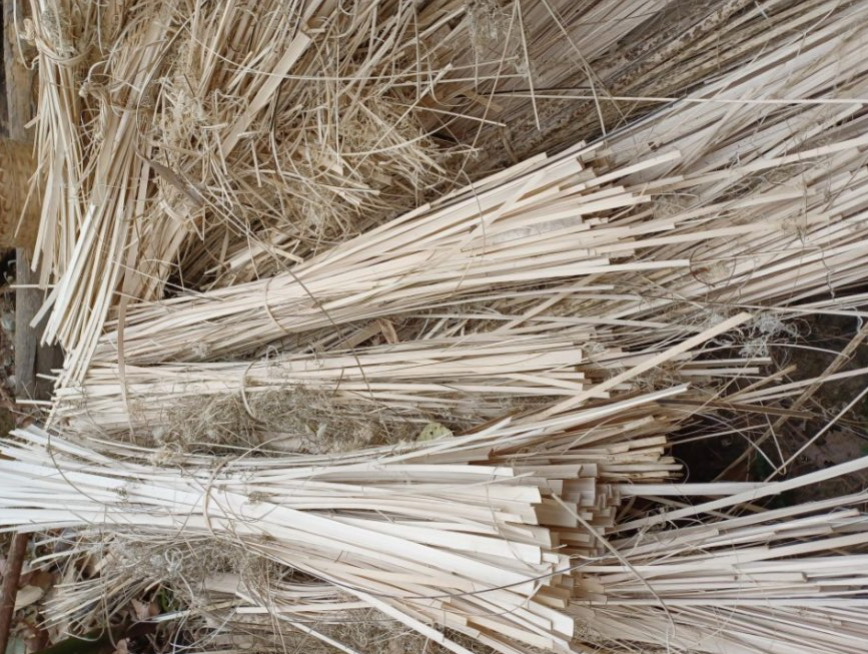
We ground the research project on four commodities: date palms, natural fibres, potatoes and digital platforms. Date palms and natural fibres, such as bamboo and sisal, are examples of commodity frontiers that have re-emerged as responses to reducing plastic use, shifting to functional ‘superfoods,’ and creating sustainable solutions using digital platforms. Yet, both sisal and date palm have thousands of years of relational history in people’s everyday lives with cultural, symbolic and political significance.
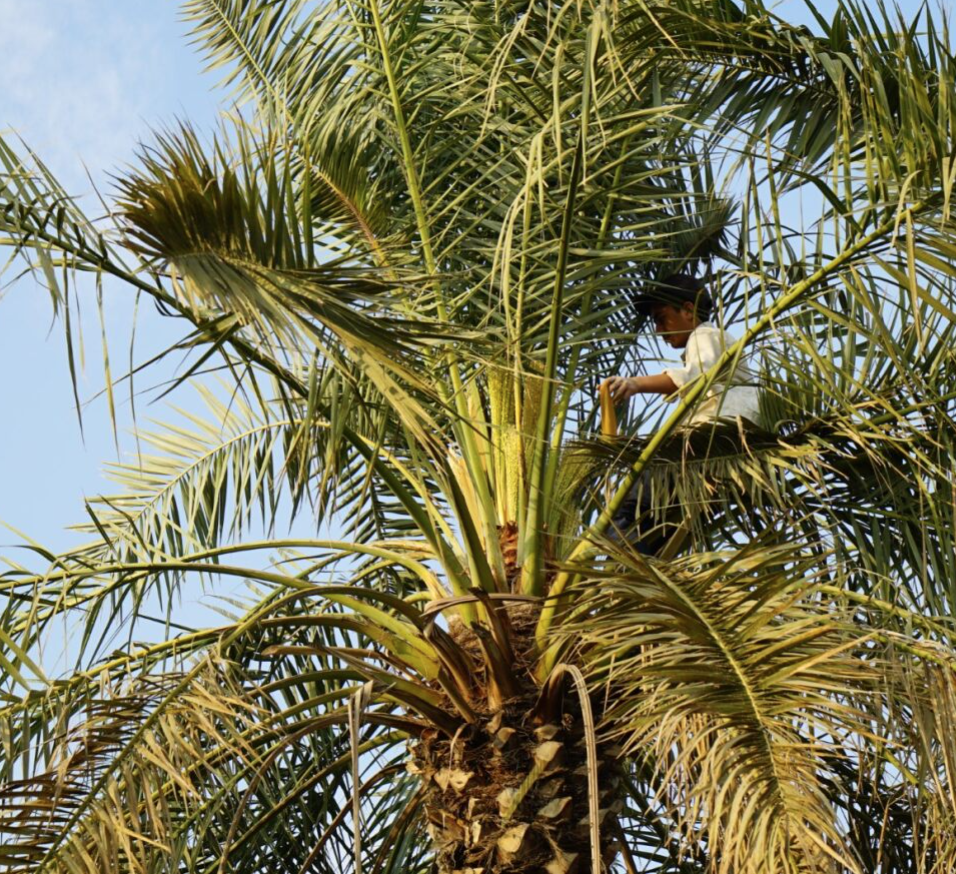 Photo: Marjaana Jauhola
Histories of these commodities are embedded with colonial expansion, racialization and drastic ecological changes in tropical rural landscapes. Similarly, expansion and proliferation of digital platforms fundamentally transforms global division of labour and resource extraction patterns.

Framed as sustainable solutions in green and digitalised capitalism, these contexts of commodities provide sites for studying how ‘living green’ and consumption are entangled with peoples histories, present and futures: collective and individual lives of those engaged in producing, manufacturing and consumption of such green commodities.
The project draws on and contributes to feminist peace and conflict studies, political ecology, and political economy. Our approach includes multispecies and intersectional analysis of contexts that at first sight are not considered as zones of violence.
Goal
We expand feminist peace and conflict studies into the sphere of commodity frontiers to highlight the multispecies violence of extractivist capitalism. We interrogate how commodities –date palms, natural fibres and digital platforms- -produce entanglements of violence and care. The project will offer new theoretical and empirical knowledge on the consequences and the unseen costs of ‘living green’.
We bring together three sites of commodity frontiers production network: the farmer, value-adders and commodity developers, and digital platforms in the online marketplace.
Funding
Funding source
Research Council of Finland 2023-2027
Co-operators
Advisory Board
Rosalba Icaza, Professor in Global Politics, Feminisms and Decoloniality, Institute of Social Sciences, Erasmus University Rotterdam
Phoebe Moore, Professor of Management and Futures of Work, Essex University, School of Business, and Senior Research Fellow, ILO
Tania Pérez-Bustos, Associate Professor in Anthropology, National University of Colombia
Shirin Rai, SOAS Distinguished Research Professor at SOAS University of London
Tiina Vaittinen, University Researcher, Tampere University
Who we are
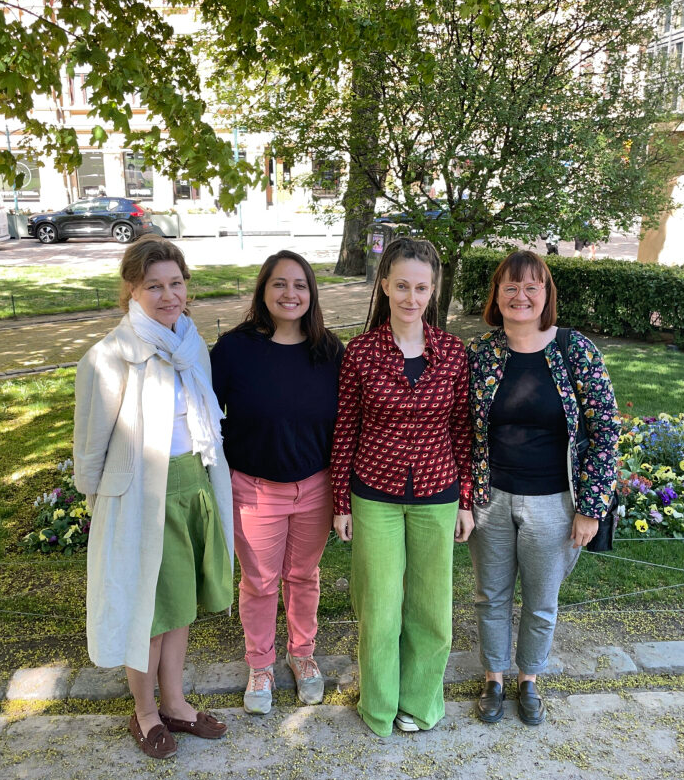 Photo: unknown
Dr Marjaana Jauhola (PhD in International Politics, Aberystwyth University) is the PI of EnVi(r)oCare. She is a senior research fellow in Tampere Peace Research Institute, Tampere University and adjunct professor in Global Development Studies, University of Helsinki. Her research, for nearly two decades, focuses on politics of intersectional inequalities of post-disaster and conflict contexts in South and Southeast Asia using collaborative visual ethnography and life histories. She has published three monographs, Post-Tsunami Reconstruction in Indonesia: negotiating normativity through gender mainstreaming initiatives in Aceh (Routledge, 2013), and Scraps of Hope in Banda Aceh: Gendered Urban Politics of Peace in the Aceh Peace Process (Helsinki University Press, 2020) and Emerging Feminist Peace from Below and Disaster Recovery. A Quilted Ethnography with Shyam Gadhavi Routledge 2025). marjaana.jauhola [at] tuni.fi; https://orcid.org/0000-0001-9974-0778
Ilona Steiler (PhD in Global Development Studies, University of Helsinki) is a postdoctoral research fellow at the Tampere Peace Research Institute (TAPRI) at Tampere University. Her research looks at transformations of work in the globalized economy, with a focus on informal, precarious and other forms of irregular labour; digitalization and automation of work; time and temporalities in labour processes; and aspects of social and global equality in sustainability transitions. Her research on informal work in Tanzania has been published in the Journal of Labor and Society and the Global Labour Journal. Currently, she is writing a monograph on the politics and governance of the informal economy (Routledge, forthcoming).
Violeta Gutiérrez Zamora is a Postdoctoral Researcher at the Natural Resources Institute Finland (LUKE) based in Helsinki, Finland. She holds a PhD in Social Sciences with a major in Environmental Policy from the University of Eastern Finland (UEF). In her research she focuses on questions over rural development, forest conservation and human-nature relationships, using qualitative research methods and perspectives from feminist political ecology and environmental sociology. She has conducted research in rural México and Laos. She is a member of the Finnish Society for Development Research (FSDR) and the collective FeminismosOtroas. Research interests: rurality and environmental justice; environmental policy and governance; gender and nature.
Satu Sundström is the research coordinator of the EnVi(r)oCare and a member of the research team. She is a doctoral researcher of World Politics at the Doctoral Programme in Gender, Culture and Society, Helsinki University, Finland. Her research, ‘Doing Global Feminism. Feminist Transformative activism in and around the World Social Forum’ addresses the dilemma of feminist resistance and solidarity building in a state of multiplicity and diversity through the empirical study of feminist activism within, along, and beyond the process of World Social Forum.
Shyam Gadhavi (Prakrit Foundation for Development, India) is farmer, a founding member and president of Kachchh-based Prakrit Foundation for Development Trust, an organisation dedicated to supporting free education, livelihood options and natural farming options for farmer communities. Besides being a student in sociology (Indira Gandhi National Open University), he has several years of experience in ethnographic and qualitative research having worked as research assistant.
Contact:
For further information, please contact
PI Marjaana Jauhola, marjaana.jauhola [at] tuni.fi (marjaana[dot]jauhola[at]tuni[dot]fi)
Research Coordinator Satu Sundström, satu.sundstrom [at] tuni.fi
EnVi(r)oCare Advisory Board:
Rosalba Icaza, Professor in Global Politics, Feminisms and Decoloniality, Institute of Social Sciences, Erasmus University Rotterdam
Phoebe Moore, Professor of Management and Futures of Work, Essex University, School of Business, and Senior Research Fellow, ILO
Tania Pérez-Bustos, Associate Professor in Anthropology, National University of Colombia
Shirin Rai, SOAS Distinguished Research Professor at SOAS University of London
Tiina Vaittinen, University Researcher, Tampere University
Entanglement of Violence and Care: Engaging with Interlocking Oppressions, Moving Towards Ecosocial Reproduction
EnviroCare article published in Social Politics, International Studies in Gender, State & Society, Volume 33, Issue 2
Link to the article:
https://academic.oup.com/sp/article/33/2/410/8759899
Centring feminist ethic of care in socio-ecological transformative movements
Book chapter by Marjaana Jauhola, Aslihan Oguz, Satu Sundström, Ilona Steiler and Violeta Gutierréz Zamora
Emerging Feminist Peace from Below and Disaster Recovery.
A Quilted Ethnography
Book by Marjaana Jauhola and Shyam Gadhavi
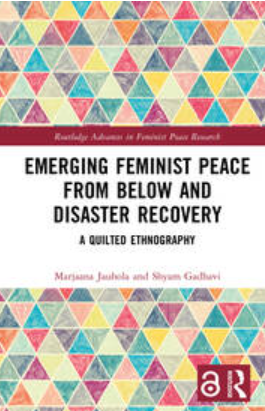
This book offers a critical contribution to feminist peace and disaster research by challenging the successful disaster recovery narrative of the Kachchh 2001 earthquake in Gujarat, India.
Engaging in a feminist intersectional analysis of complex cascades of violence, the book uses a theoretical and methodological approach to studying cascades of violence of populist post-disaster recovery, communal violence, and urban development - each with implications for intersectional social divisions, ecology, and thus, everyday peace. The book follows the mundane everyday and life-historical trajectories of the residents of the temporary shelter neighbourhood in Bhuj, drawing attention to an emerging feminist peace from below through silent resistance, care, and solidarity. It demonstrates that the impacts of disaster populism in the name of being "pro-poor" do not impact the marginalised segments of the society and disaster-affected communities, even within the same neighbourhood of the dispossessed, in the same ways. Combining underexplored newspaper and project documentation archives, the speeches of Narendra Modi delivered in Kachchh, and urban life historical ethnography, the book offers a rich analysis of gendered and intersectional experiences of how dispossession and mundane violence are embedded in the earthquake recovery – and how international humanitarian aid and urban disaster recovery are entangled with complex cascades of violence.
This book will be of much interest to students of feminist theory, peace studies, post-disaster recovery, and South Asian politics.
The Open Access version of this book, available at www.taylorfrancis.com, has been made available under a Creative Commons Attribution (CC-BY) 4.0 license.
Link to open access book: https://www.taylorfrancis.com/books/oa-mono/10.4324/9781003472933/emerging-feminist-peace-disaster-recovery-marjaana-jauhola-shyam-gadhavi?_gl=1*1ht5r7s*_gcl_au*MTgwNTQ2NzEzNi4xNzU1NTcyNzEy*_ga*MTYyODMwOTM4MC4xNzU1NTcyNzEy*_ga_0
Processes of Economic Informalization.
Reconfigurations of Law, Labour, and the State
Book by Ilona Steiler
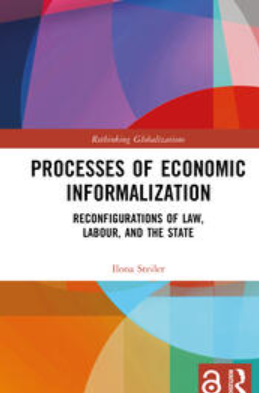
Grounded on an analysis of informalized labour in the urban economy of Dar es Salaam, Processes of Economic Informalization explores the conceptual politics involved in the political construction of the informal economy – diverse economic activities that are not regulated or protected by the state, now estimated to make up more than sixty per cent of all employment worldwide.
The author draws attention to the dynamic political, legal, and social processes shaping the formal-informal boundary. Fundamentally, the book argues that ‘informal economy’ presents a normative and essentially contested concept which is implicated into reconfigurations of legal institutions, labour organization and struggle, and practices of state governance. Based on interviews, ethnographic notes, and a review of policy documents and current academic literature, it illustrates how competing conceptions of the informal economy serve to normalize and justify but also contest specific forms of capitalist accumulation processes and social order. Highlighting the thorny role conceptions of the informal economy play in its construction as well as in its governance, the book makes a timely intervention that challenges conventional positions in the debate on the appropriate regulation of informalized labour.
This book will be of interest to students and scholars of global political economy, international relations, labour studies, and development studies.
Link to the Open Access: http://www.taylorfrancis.com
(made available under a Creative Commons Attribution-Non Commercial-No Derivatives (CC-BY-NC-ND) 4.0 license.)
‘I take to the streets because you have to listen to me!’
Latin American women protesting in Europe.
Article by Satu Sundström
Sundström, S. (2025). ‘I take to the streets because you have to listen to me!’ Latin American women protesting in Europe. European Journal of Women’s Studies, 32(1), 51-65.
https://doi.org/10.1177/13505068241312293 (Original work published 2025)
Article abstract: ‘A rapist on your path’ is a performance created by Las Tesis in Chile in 2019. The performance spread across the world and was performed by other groups of women in different countries. It is a rare example of a Southern-born protest making its way to Western contexts. This article highlights the role of women of Latin American origin in organising the re-creations of the performance and analyses their activism in two European cities, Helsinki and Brussels. It is argued that performing in the streets was about spreading the message of the performance and an act of solidarity with activists in Chile. The performance also enabled the performing groups to gain visibility and voice and to network with other groups. Performing in the streets was also a way of breaking away from the Western feminism entrenched in institutions and the academia, and to critically assess Western feminist approaches. Feminist protesting on the streets targets patriarchal structures as the root cause of gender-based violence. Spreading Southern perceptions on the streets of European cities challenges understandings of feminism as entrenched in the academy and in institutions and instead, opens feminist debates to all.
Scraps of Hope in Banda Aceh
Gendered Urban Politics in the Aceh Peace Process
Book by Marjaana Jauhola
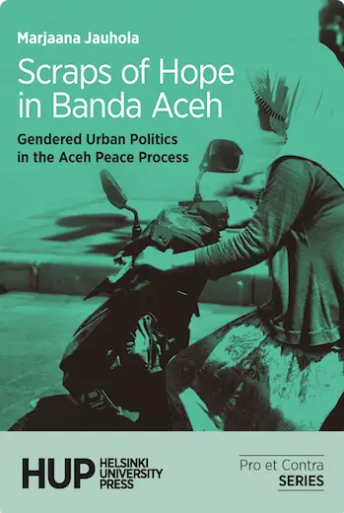
Scraps of Hope in Banda Aceh examines the rebuilding of the city of Banda Aceh in Indonesia in the aftermath of the celebrated Helsinki-based peace mediation process, thirty years of armed conflict, and the tsunami. Offering a critical contribution to the study of post-conflict politics, the book includes 14 documentary videos reflecting individuals’ experiences on rebuilding the city and following the everyday lives of people in Banda Aceh.
Marjaana Jauhola mirrors the peace-making process from the perspective of the ‘outcast’ and invisible, challenging the selective narrative and ideals of the peace as a success story. Jauhola provides alternative ways to reflect the peace dialogue using ethnographic and film documentarist storytelling.
Scraps of Hope in Banda Aceh tells a story of layered exiles and displacement, revealing hidden narratives of violence and grief while exposing struggles over gendered expectations of being good and respectable women and men. It brings to light the multiple ways of arranging lives and forming caring relationships outside the normative notions of nuclear family and home, and offers insights into the relations of power and violence that are embedded in the peace.
IPS Section of International Studies Association has awarded Scraps of Hope in Banda Aceh an Honourable Mention for the 2022 IPS Best Book Award.
Link to open access publication: https://hup.fi/books/m/10.33134/pro-et-contra-1
Post-Tsunami Reconstruction in Indonesia
Negotiating Normativity through Gender Mainstreaming Initiatives in Aceh
Book by Marjaana Jauhola
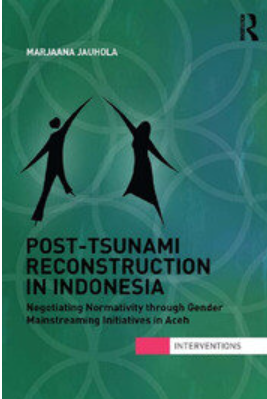
This book offers a critical analysis of gender mainstreaming initiatives in the post-tsunami context in Indonesia. Aiming to challenge the terms of the debate in gender mainstreaming and disaster reconstruction efforts, Jauhola offers an important contribution for the discussion of what ‘feminisms and disasters’ could be. The work provides an in-depth analysis of three governmental practices of gender mainstreaming: the use of the concept pair sex/gender; the use of gender analysis and the use of project management tools and local subversion that challenges the potential normative violence of gender mainstreaming.
Providing feminist intersectional reading of gender mainstreaming the book aims to illustrate that this framework does not lack political alternatives, but rather, it offers an alternative focus for feminism and for the re-conceptualisation of ‘political’, and provides tools for practitioners of aid aiming to come to grips with the complexity of gender equality policy agenda and its potential violent social consequences in global politics.
Drawing on extensive field research in Aceh, this text is one of the first book length studies, and thus provides a significant addition to Indonesian literatures on intersectional analysis of gender, religion, heteronormativity, and feminist subversive practice. It is a vital resource for those interested in understanding global interconnections of localised disaster and conflict reconstruction.
Link to the publication: https://www.taylorfrancis.com/books/mono/10.4324/9780203694411/post-tsunami-reconstruction-indonesia-marjaana-jauhola?context=ubx&refId=a6cb6988-15b1-457a-b88d-aa120cde7fed
In the project each team member has a dedicated time to visit campuses as visiting fellows where our international advisory board members are based
Marjaana Jauhola became research fellow at Department of Politics and International Studies at SOAS University of London in June 2025 visiting Professor Shirin Rai. The visit included time spent at SOAS library India collections, giving a talk with Shyam Gadhavi on direct farmer’s market, and getting professor Rai’s comments for another project team manuscript in preparation for submission later this year.
Link: SOAS: https://www.soas.ac.uk/about/colleges/college-social-sciences/department-politics-and-international-studies
8.11-24.11.2024
Ilona Steiler visited Dar es Salaam, Tanzania, with a TURNS Mobility Grant to learn about the use of digital platforms among street vendors. More here.
Ilona joined the Centre for Commons Organising, Values Equalities and Resilience (COVER)at Essex University as a Research Fellow in March 2025, visiting Advisory Board member Professor Phoebe Moore. Ilona gave a talk titled ‘A world of platforms: labour regime analysis of an online marketplace’ as part of the AI Rights & Wrongs 2025 Seminar Series organised by COVER.
News - upcoming and past events
Coming events:
Past events:
7-8 May 2026
Finnish Political Science Association's Annual Conference 2026
Presenting book proposal "Entanglements of violence and care in commodity frontiers: new frontiers
for peace research".
Friday 8.5. | Finnish Political Science Association’s Annual Conference 2026 | Tampere Universities
12-15 May 2026, Prague
International Forest Policy Meeting
Panel: Forest Policy and Forest Care – Actors, Practices, and Meanings.
Convenors: Violeta Gutiérrez Zamora and Jana Holz.
https://www.fld.czu.cz/en/r-9415-science-research/r-9537-conferences/r-15658-conferences-at-fld/6-th-international-forest-policy-meeting.html
26 June- 3 July 2026, Barcelona, Spain
Pollen 2026 conference: Diverse Origins, Multiple Futures: The Stories of Political Ecology.
Convenors: Violeta Gutiérrez Zamora and Sheila Rao, Marian Turniawan and Aksha Fernandez. Panel 110. A Patchwork of Care as Resistance, Resilience, and Transformation: Mending Territories, Bodies, and Knowledges.
Violeta Gutiérrez Zamora: Seeing through bamboo. Visual Narratives of ecological care work in human-plant relations. Paper presentation in panel 110.
https://pollenpoliticalecology.network/pollen-2026/programme/#17564
Webinar Just Disaster Recovery: Equality, Justice and Disaster Resilience in times of Cascades of Disasters
Dr. Marjaana Jauhola, Tampere Peace Research Institute, Tampere University, Finland
Mr. Shyam Gadhavi, Prakrit Foundation for Development, Kachchh, India
Dr. Mihir Bhatt, All-India Disaster Mitigation Institute, India
Dr. Emmanuel Raju, University of Copenhagen, Denmark
Ms. Rita Missal, National Disaster Management Authority, India
20th November 2025, Book launch: Socioecological Transformations. Linking ontologies with structures, personal with collective change
We will be introducing our chapter (with Aslihan Ogüz) Centring feminist ethic of care in socio-ecological transformative movements along the other contributors of the volume. Agenda and more on Just GLOBE Project event: Launching the Routledge book – Just GLOBE Project
25-29 August 2025, 18th Pan-European Conference on International Relations, University of Bologna
Marjaana Jauhola and Ilona Steiler
Marjaana Jauhola presented in a Roundtable ”Narratives of Hope and Yearning: Strategies and Lessons for Navigating and Disrupting a Broken World” reflecting upon the necessary unlearning of academic praxis to better respond to brokenness of world in the aftermath of entanglements of environmental disasters, armed conflicts and political violence.
July 2025 CPERN Mid-term Workshop
Marjaana Jauhola and Ilona Steiler presented work in the CPERN Mid-term Workshop “Critical political economy and the time of monsters: understanding the present, imagining the future” taking place in Helsinki, Finland from 30th July to 1st August 2025
Ilona Steiler presented her single-authored work in progress titled Behind enshittification and greenwashing: a labour regime analysis of a ‘sustainable’ e-commerce platform and Marjaana Jauhola presented the work Entanglements of care and violence: theorising on social reproduction and care through analysis of ‘interstructuring oppressions’, work in progress co-authored by Marjaana Jauhola, Violeta Gutiérrez Zamora, Ilona Steiler and Satu Sundström
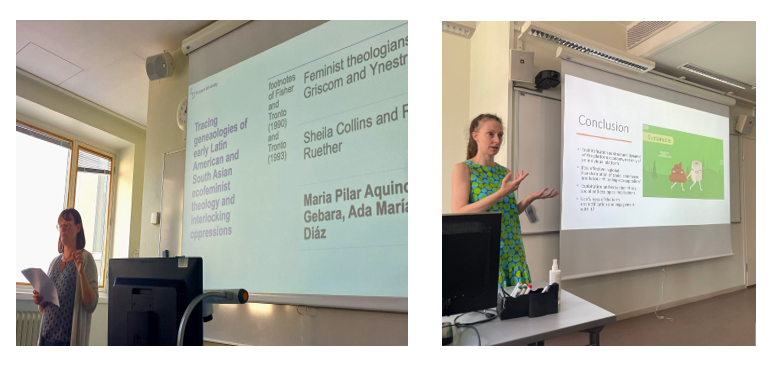
15th May 2025
The second EnVi(r)oCare Advisory Board meeting was held in Tampere / online.
14th May 2025
EnVi(r)oCare Mid-project Workshop was held in Lyhty, Tampere.
The research team introduced their ongoing work. We thank the commentators Tiina Seppälä, William LaFleur, Eeva Houtbeckers and Hanna Ylöstalo for their helpful and inspiring comments!
26th June 2025, 18th Conference of the International Society for Ecological Economics and 11th International Degrowth Conference
Violeta Gutiérrez Zamora, paper presentation “Ecological Care Work and (Re)productive Labor in Bamboo Value Chains: Feminist Political Ecology Insights for Just Forest Conservation”. Session SS198: Land use, labor, and care: Navigating transformative degrowth policies in forestry, agriculture, and subsistence.
28 July 2025
Marjaana Jauhola and Shyam Gadhavi participated at the international conference on
Technology Innovations & Sustainable Development of Date Palm 2025 in Bhuj, Gujarat, India. Shyam gave a talk from small-farmer’s perspective and Marjaana gave a keynote “Socio-Historical Changes of Date Palm Cultivation in Kachchh, Gujarat” – they also networked with date palm reseachers from UAE, Marocco and India.
Website of the conference: https://icdp2025.eventsdashboard.in/#:~:text=International%20Conference%20on%20Technology%20Innovations,to%20show%20case%20technology%20innovations
8.11-24.11.2024
Ilona Steiler visited Dar es Salaam, Tanzania, with a TURNS Mobility Grant to learn about the use of digital platforms among street vendors. More here.
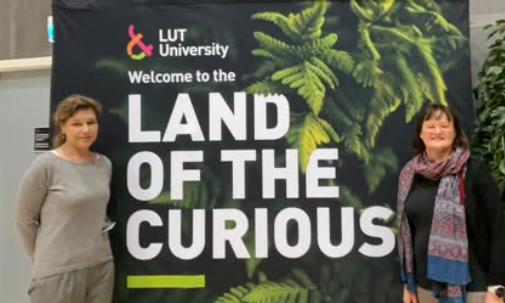
27.-29.9.2024 YHYS Colloqium ”The Anthropocene: Action and agency for preventing collapse” at LUT, Lappeenranta
Marjaana Jauhola and Satu Sundström presented the early results of the EnVi(r)oCare
29 August 2024
The project organised a panel "‘Living Greener’: linking agrarian transformations and urban sustainability with entanglements of violence and care" at Agrarian Orders and Transformations section of EISA PEC in Lille exploring the interconnections between urban sustainability and agricultural changes with a view towards climate change and the goal of ‘green transition. The panel was chaired by PI Marjaana Jauhola and the panel included two presentations of the ongoing research "Seeing like an online platform: imaginations of green commodities and labour on Etsy" and "Kachchhi small-farmers strike back? Between cyclones and uncertainty: 25 years of fresh date palm production (1998-2023) in coastal Kachchh, Gujarat" the latter was co-authored paper with the project's Indian partners for whom this was their first international academic conference appearance, although virtual. The panel got support from Sustainable Transformation of Urban Environments (STUE) Action Grants.
18-20 June 2024
BISA 50th anniversary conference, Belfast Ireland
Marjaana Jauhola presented the on-going theoretical work of the research project under the heading “Reproduction as an Entanglement of Violence and Care – Bridging Social Reproduction and Ecological Carework to address Multispecies Interlocking Oppressions”
6 May 2024
PI Marjaana Jauhola and coordinator Satu Sundström were organisers of the 2nd Feminist Peace Research Symposium at Tampere University.
15-16 February 2024
The project organized a working group “Green transition – pathway for equal and just planetary futures?” at the Development Research Day, and was chaired by Ilona Steiler and Satu Sundström. The team presented a paper “Seeing like a platform:
Imaginations of green commodities and care on Etsy” at the panel.
Kehitystutkimuksen päivät / Development Days – Kehitystutkimuksen seura (kehitystutkimus.fi)
27 November 2023
The project organized a panel “Green transition – an obstacle for just peace and planetary futures?” at Tampere Peace Day with Ruby van der Wekken, Member of Oma Maa food co-operative and Commons.fi, Sabaheta Ramčilović-Suominen, Associate Research Professor and Academy of Finland Fellow at Natural Resources Institute Finland (Luke)/Luonnonvarakeskus (Luke), Sonja Finér, Executive director at Finnwatch ry, chaired by PI Marjaana Jauhola.
TAMPERE PEACE DAY | TAPRI | Tampere Universities (tuni.fi)
16-18 November 2023
Team presented the paper “Centring Feminist Ethics of Care in Socio-Ecologic Transformative Movements” at at the 5th Marxist-Feminist International Conference in Warsaw conference
06-08/2023
The project team participated the El Cambalache workshop Liberatory Methods for investigating and generating non-capitalist / anti-colonial social power
El Cabalache: https://cambalache.noblogs.org/