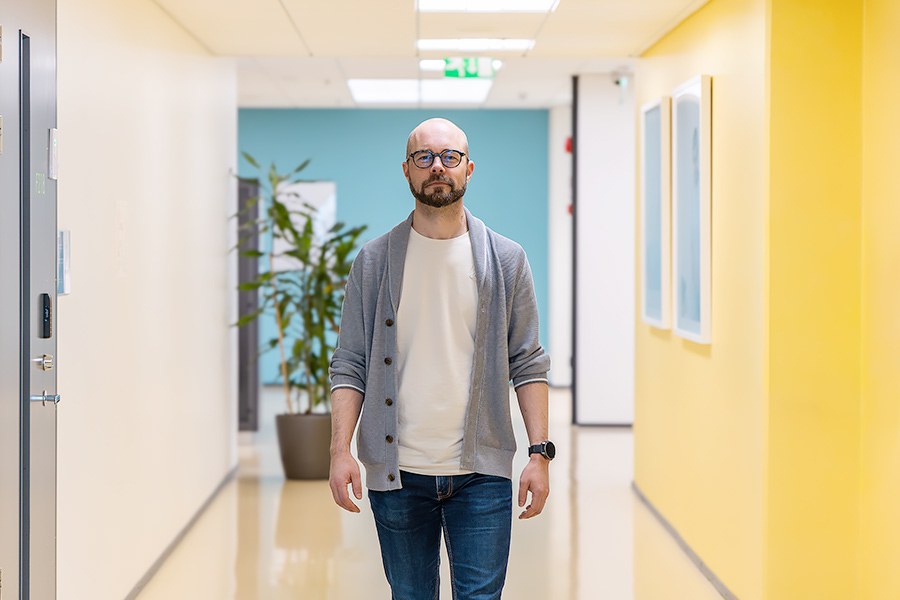
“We must learn to identify what is effective,” Professor Toni Seppälä says

What are your main research interests?
My research mostly focuses on cancer, especially colorectal cancer. I am particularly interested in hereditary cancers, and more specifically those associated with Lynch syndrome. Lynch syndrome is the most common cancer-predisposing genetic germline variant, carried by approximately one person in 300. There are thousands of people in Finland who are known to carry this genetic variant, and many times more who carry it without it having been diagnosed and who are unaware of it themselves.
What makes your research significant?
Cancer is a major national health problem. People in high-risk groups face not only a psychological burden but also an absolute risk, making these groups so important to study as they stand to benefit the most. I want to study major public health hazards because I want the time I devote to research to have as much impact as possible. The more prevalent a disease is, the greater the potential benefits if effective solutions can be found.
How would you develop your field?
I believe Finland needs expertise in surgical oncology. At present, we do not have this specialty although many other countries – such as North America and Estonia – have it. As a result, surgeons are not necessarily particularly well versed in molecular medicine and the deeper biological mechanisms underlying diseases. Surgical oncology brings together molecular medicine, oncology and surgery, and it is a bridge that we should be able to build.
I do not mean that we necessarily have to establish a new medical specialty, but we do need to increase this type of expertise. Some surgical specialties, such as urology, are somewhat closer to surgical oncology than some others because they also treat advanced cancers. In general, however, this kind of expertise remains limited in Finland.
What would you like to research next and why?
In recent years, my research has increasingly focused on de-escalation, which means investigating whether less can sometimes be more. In other words, can we achieve equally good outcomes by using less intensive and invasive approaches than those we have traditionally relied on especially in surgery?
Our healthcare system is currently coming to a point where we simply cannot sustain the system as a society unless we start asking which treatments are unnecessary or have only a limited impact. We must learn to distinguish between interventions that truly make a difference from ones that offer relatively few benefits.
Finnish researchers have been particularly successful in studying these questions in fields such as orthopaedics, and I would be very interested in continuing this research tradition. Even though my own field is different, every specialty has its own blind spots that warrant closer examination.
Outside cancer care, one excellent Finnish example is the non-invasive treatment of appendicitis. That approach is very much in keeping with the principles of de-escalation in cancer surgery.
What do you enjoy most about your job?
I enjoy the challenges, variety and the fact that no two days are ever the same. There is never a shortage of things happening! In a sense, I have several different professional identities in my role: I work as a practising clinician, supervisor and researcher, and I also have many administrative responsibilities.
As a research professor, I have never really had the identity of a teacher, but I do enjoy giving lectures and helping to shed light on complex topics. I also teach small groups of students and find it rewarding when I also become genuinely enthusiastic about the subject I am teaching. I also like seeing the perspective, expertise and attitude that young people bring with them. When those qualities begin to shine through, that is what I find most inspiring of all.
What do you do in your free time?
Tennis is my favourite sport and a hobby that is close to my heart. I would like to play much more golf as well, but in recent years I have not had much opportunity to do so. I also have a summer cottage on an island. It requires a great deal of work but provides an excellent counterbalance to my professional life. It is hard to think about work while you are hauling heavy materials from the mainland and using them to build something.
Toni Seppälä
- Graduated as licensed physician from the University of Eastern Finland in 2010.
- Doctor of Medicine from the University of Eastern Finland in 2012.
- A Fellowship in Surgical Oncology at Johns Hopkins University in the US from 2019 to 2021.
- Appointed Docent of Experimental Surgery at the University of Helsinki in 2019.
- Joined Tampere University Hospital as Chief Physician in 2022, with a responsibility for developing personalised cancer care.
- Deputy Editor-in-Chief of Scandinavian Journal of Surgery since 2024.
- Chair of the European Hereditary Tumour Group since 2025.
- Appointed Professor of Cancer Research at Tampere University in April 2026.


