Professor Asko Lehmuskallio is a Finnish pioneer in a research field that questions the obvious

While photojournalism research examines, for example, the evolution of war photography from the First World War to the war in Ukraine, visual studies takes this analysis a step further.
Professor of Visual Studies Asko Lehmuskallio provides an example:
“What is a camera if we move beyond the simplistic notion of it as merely a device with a lens for taking photorealistic images? When we step back from the mundane and the self-evident, we can focus, for instance, on a satellite orbiting the Earth. This satellite transmits images of the planet to the border authorities. It continuously filters which information about the Earth’s surface is important and what is not, but only as precisely as its internal technology allows. What is caught in this net? What remains unseen?”
By analogy, a camera is also an instrument of power on which authorities rely when making decisions. As the satellite camera captures images that can shape the fate of people crossing borders, it is not only a neutral recording device.
And what about gaze? Is the gaze of a human eye – or a camera lens – simply a receiver of visual information about the world around us? Lehmuskallio notes that, as far back as ancient Greece, the gaze was understood as something that reshapes relationships between people, animals and the gods.
Questions of visuality form a red thread stretching across millennia — from Jesus of Nazareth to the frenzy surrounding artificial intelligence.
When the early scholars of religion debated whether Jesus was a historical figure, they examined a burial shroud believed to bear the imprint of his face. They considered the strength of the link between reality and an image, just as we today may pause while browsing social media to consider whether an image is real or AI-generated.
The questions that occupy researchers in visual studies are endless. What unites the different approaches within the field is a willingness to rethink the obvious, such as what we actually see when we open our eyes.
“These are foundational questions that have persisted for a very long time,” says Lehmuskallio.
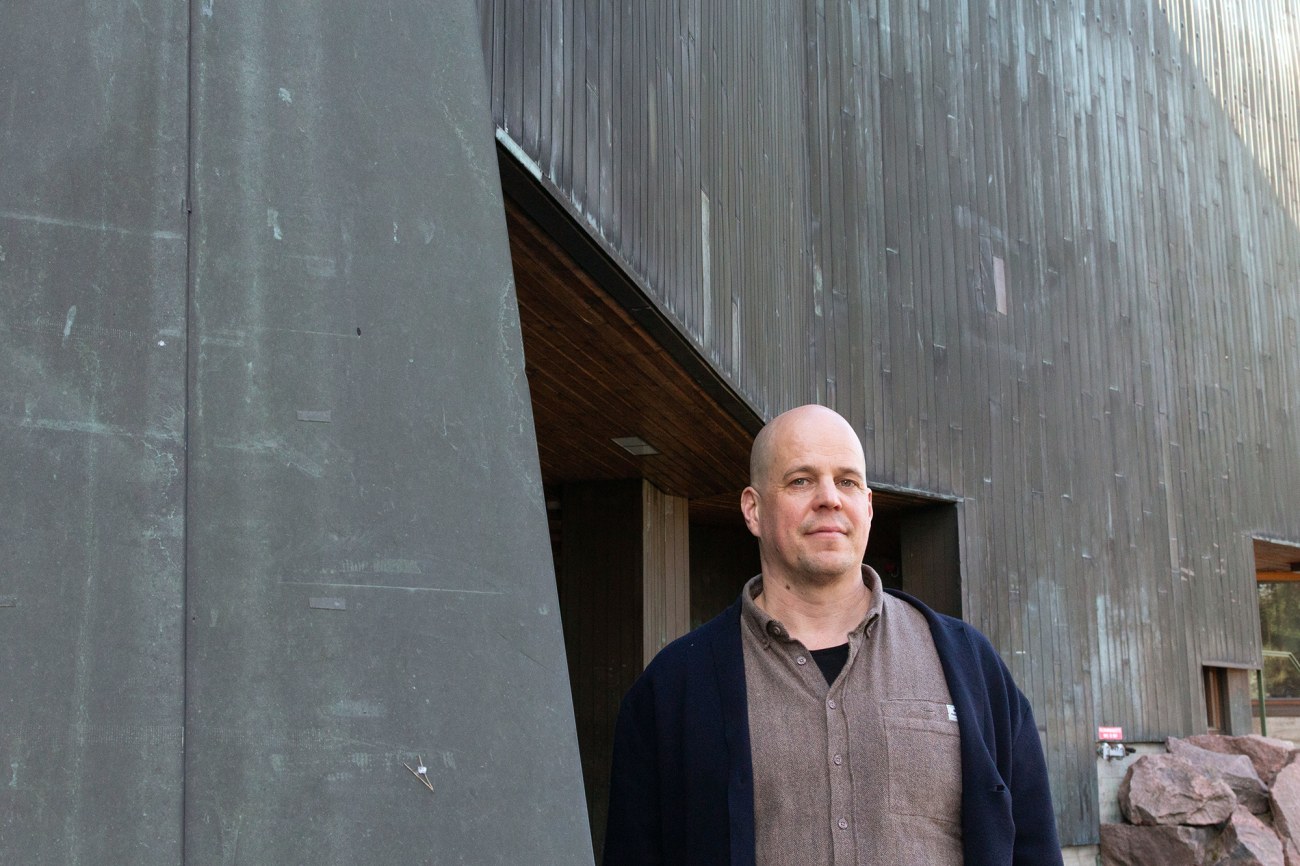 Photo: Eino Rissanen
Bringing visual studies to Finland
The interdisciplinary field of visual studies has made its way to Finnish universities, for example, from Central Europe.
“I believe I have played some part in building a culture of visual studies research in Finland,” says Asko Lehmuskallio.
During his research career spanning two decades, Lehmuskallio has been instrumental in the establishment of two new professorships at Tampere University. In addition to the professorship in visual studies, which he holds, the University has established a professorship in visual information, with Yanai Toister appointed to this role as associate professor.
Lehmuskallio has also been closely involved in founding the Visual Studies Lab (VSL), a research hub for visual culture studies at Tampere University.
One of the projects underway at VSL explores how social media professionals attempt to build trust through visual communication. This large-scale project is titled Trust and Visuality: Everyday digital practices (TRAVIS) and involves researchers from Tampere University, the University of Salzburg and the University of Oxford.
Another current project, Visions of the City, investigates the role of visualisation in urban planning and development.
“Images and visuality have become an increasingly important part of meetings and documents that seek to persuade others to support specific plans.”
Lehmuskallio has also contributed to the establishment of the Master’s Programme in Visual Journalism and Visual Studies at Tampere University. Launched in 2024, this programme combines the study of visual culture and photojournalism.
“The programme addresses not only the history of visual journalism but also broader approaches to imagery, visual technologies and the role of people in relation to them.”
A comparable master’s programme that integrates research traditions in visual journalism and visual culture studies is not available at any other university in Finland.
“I believe the master’s programme at Tampere University provides a unique environment for examining these questions.”
Lehmuskallio has an extensive network of international contacts, and he has left a strong mark on the European Communication Research and Education Association (ECREA). Lehmuskallio played a pivotal role in the establishment of ECREA’s Visual Cultures Section, and he serves on ECREA’s Governing Body. He has also actively participated in founding the Nordic Network for Digital Visuality.
Broadly educated in the spirit of enlightenment and intellectual curiosity
Visual culture studies is an interdisciplinary field at the intersection of multiple disciplines and perspectives. This same description applies to Asko Lehmuskallio’s academic career.
“I have pursued a traditional classical education: I studied for a long time and completed a very large number of courses out of pure personal interest.”
Lehmuskallio started his studies at Marburg University in Germany, where he studied cultural anthropology, with minors in comparative religion and in peace and conflict studies. He was especially interested in religions and distant cultures.
“As a teenager, a friend and I attended Open University lectures in Helsinki on shamanism, bloodletting rituals and the different ways that people try to make sense of, and maybe control, their lives on this Earth. After completing upper secondary school, I was surprised to discover that these topics could be studied at university.”
Lehmuskallio’s studies in Marburg, Madrid and other European cities deepened his understanding of cultures and human diversity. He noticed that people who attend art exhibitions come from all over the world but seem to find a shared language through art, with hierarchies dissolving and divisions between people fading away.
“Instead of dividing people by nationality, ethnicity, religion or colour, there are factors that bring people together.”
Lehmuskallio studied photography in Madrid, wrote his master’s thesis on visuality as a vehicle of ethnographic narrative, and continued his studies towards a doctoral degree in Karlsruhe, Germany. He finalised his doctoral dissertation at the former University of Tampere in Finland.
Before completing his doctorate, Lehmuskallio worked at the Helsinki Institute for Information Technology (HIIT), where research themes ranged from the evolution of the camera to the democratisation of communication and the decline of gatekeepers, among other things.
“HIIT was a completely different environment from what I was used to, and it taught me a great deal about information technology, which is an area that social scientists and humanities scholars do not typically explore in any great depth.”
Lehmuskallio’s experience of working at HIIT broadened his research interests to include technological perspectives alongside cultural studies, photography and visuality. Today, he pursues an academic career that brings together all these areas and perspectives at Tampere University and within the international research community.
“I still firmly believe that it is beneficial to read the humanist classics, visit art exhibitions, and talk with people who come from different cultures and backgrounds. They have different perspectives, perhaps ones that strongly conflict with one’s own. Many people find such encounters difficult, but they can be valuable learning experiences.”
Asko Lehmuskallio serves as Professor of Visual Studies and is director of the Visual Studies Lab.
Lehmuskallio focuses particularly on the intersection between visual studies and media studies, with a special interest in media anthropology and digital cultures. He is particularly interested in the interrelations between images, bodies and visual technologies, specifically between seeing and knowing.
Author: Eino Rissanen


