Pioneering hydrogen technology with global potential

The innovation was born out of the multidisciplinary expertise of its inventor, Associate Professor Imran Asghar. At Tampere University, Asghar leads the Renewable Energy Technologies (GoGreen) research group. He believes that the group’s success in developing this cutting-edge technology has stemmed from a willingness to experiment with different materials and approaches.
SMART+IONS is currently developing its first proof of concept for a hydrogen-powered drone, while also preparing the technology for scale-up in maritime, data centre and wider energy applications.
“What makes our technology unique is our use of 3D printing for manufacturing. This novel concept of reversible technology enables flexible design, low costs and high performance. For example, in the summer, when sunshine is abundant and electricity is readily available, surplus electricity can be converted into fuel and stored. In the winter, when electricity demand is higher and prices go up, the stored fuel can be converted back into electricity,” says Asghar, co-founder and CTO of SMART+IONS.
Turning research into real-world energy solutions
According to Asghar, the origins of the innovation can be traced back to his student years and his interest in robotics, particularly nanorobotics. He moved to Finland in 2006 to pursue a master’s degree in nanotechnology at Aalto University. During his studies, he became convinced that energy was humanity’s greatest challenge and subsequently focused his research on silicon solar cells.
After completing his doctoral degree, Asghar spent several years working in the Finnish photovoltaic industry. This experience helped him to recognise the commercial potential of his research and innovations beyond academic publishing.
When he joined Tampere University, Asghar brought along not only his hydrogen laboratories and the associated intellectual property portfolio developed at Aalto University, but also his entire research group. The two universities continue to collaborate closely in this field.
After his appointment as Associate Professor at Tampere University in May 2023, Asghar and his group focused their research on ceramics, fuel cells, electrolysers and batteries. While developing new materials and devices, the team recognised the need to find sustainable and cost-effective alternatives to critical raw materials.
Over the next few years, the research group developed prototypes and conducted extensive testing before finally validating the technology at laboratory scale in 2022. Instead of simply publishing their results in scientific journals, they decided to pursue commercialisation. Since then, their work has progressed from materials development and cell design to proof-of-concept validation and the patenting of both the cell structure and the manufacturing method.
“We realised that moving from an idea to a proof of concept is a critical step in validating the technology. During the Research to Business phase, we explored key strategic markets to identify potential customers, understand customer needs, validate demand and build relationships with collaborators and investors,” says Shandra Pandey, CEO, one of the company’s three co-founders and an external expert at Tampere University. The third co-founder is Peter Lund, who now serves as Chief Executive Chair.
Powering the future with flexible, sustainable hydrogen solutions
Earlier, the primary driver for developing more sustainable materials was climate change. Today, it is geopolitics.
Current fuel cells and electrolysers are often costly and rely on critical raw materials. The new technology addresses both challenges by enabling more cost-effective production while reducing dependence on critical materials.
“In addition, the reversible operation provides greater flexibility for energy systems, especially in hydrogen and renewable energy applications. As a versatile platform technology, it can support energy storage, industrial processes, e-fuel production, data centres, maritime and subsea applications, drones and other autonomous systems. Overall, it supports the transition towards a more sustainable, hydrogen-based energy system”, says Asghar.
Hydrogen technology represents a significant global business opportunity. However, Finland currently lacks manufacturing capacity for fuel cells and electrolysers. Recognising this gap, the team saw an opportunity to develop both technological expertise and manufacturing capabilities in this field to support the growth of Finland’s hydrogen economy.
“As far as I know, our company is the only one in the world manufacturing these cells using 3D printing. By developing both the technology and the manufacturing capabilities in Finland, we can create jobs for local experts and contribute to the growth of Finland’s hydrogen technology exports”, he adds.
Ultimately, the location of future manufacturing facilities will depend on investors’ decisions. Nevertheless, Asghar sees Tampere as a strong contender.
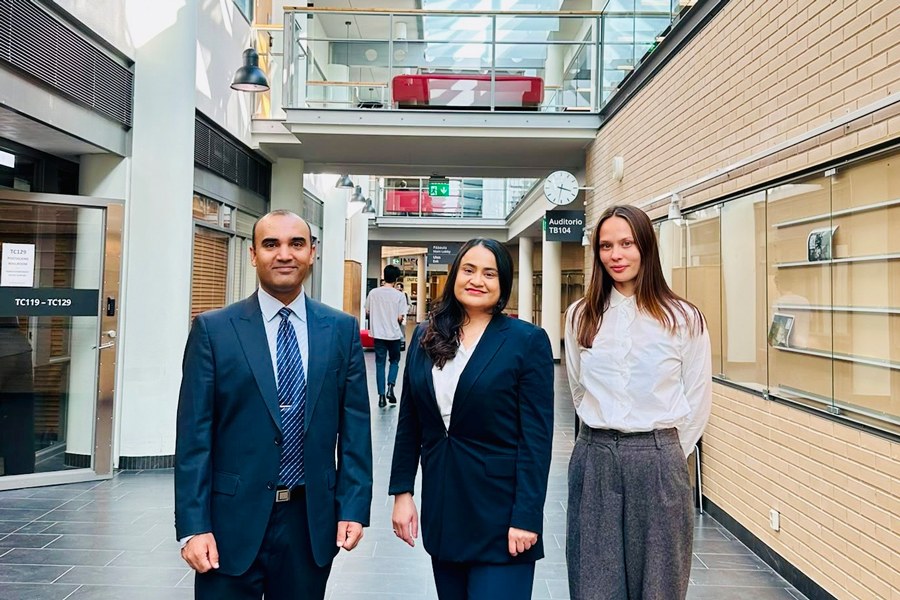
The company is now raising funding to undertake pilot projects. It already has two customers: one in the drone manufacturing sector and the other in the data centre industry. Asghar also sees tremendous potential for the technology in power supply and battery replacement in the maritime sector, in energy production for buildings and power plants, in shopping centres and hospitals, as well as in agriculture.
“Our technology has the potential to be deployed wherever there is demand for hydrogen and green energy solutions,” he concludes.
SMART+IONS
- The company received funding through Business Finland’s Research to Business project in 2023–2025 and Aalto University’s Business Accelerator Programme in 2025.
- The company was founded in 2025 by Imran Asghar, Shandra Pandey and Peter Lund.
- The company employs five people.
- A patent for the technology was granted in November 2025.
- The company aims to generate revenue of more than €100 million by 2030.
- The company is currently headquartered at the Aalto Startup Center in Espoo, Finland.
Contact person
Imran Asghar
Associate Professor, Materials Technology Imran Asghar
Author: Anna Aatinen


