First graduate of doctoral education pilot Lauri Ryyppö works to advance cancer diagnostics

The doctoral education pilot is a national programme to expand doctoral training implemented between 2024 and 2027. Through the initiative, Tampere University recruited 106 doctoral researchers on three-year employment contracts across 13 fields.
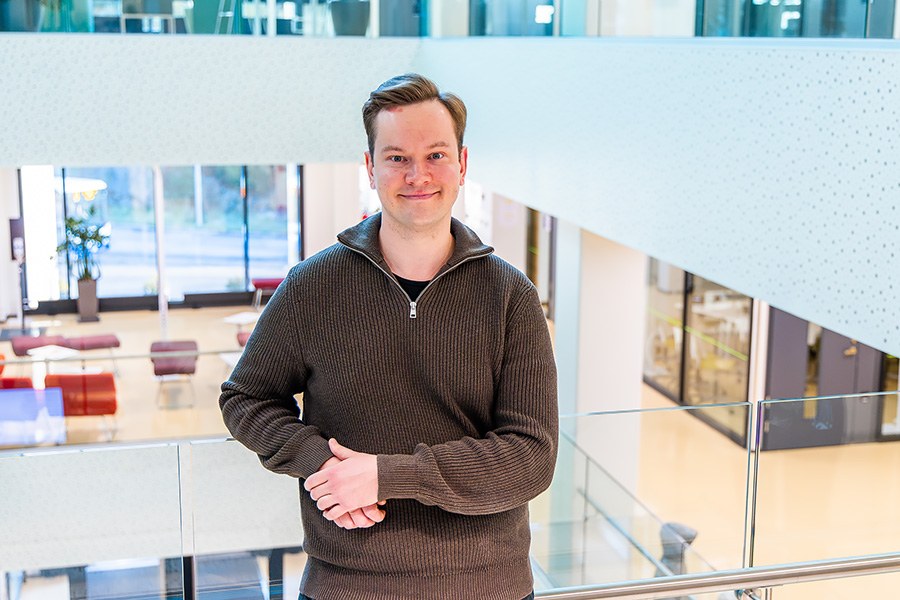
Lauri Ryyppö was one of these researchers and the first participant from the programme to graduate at Tampere University.
Ryyppö conducted his doctoral research in the Precision Cancer Medicine (Flagship iCANDOC) pilot. His work focused on developing new methods for cancer diagnosing and monitoring that would be as accurate as possible whilst putting minimal burden on patients. His research concentrated on ovarian and urothelial cancers, both of which are associated with significant morbidity and mortality. Urothelial cancer originates in the urothelium, the tissue lining the urinary tract, and its most common form is bladder cancer.
“Ovarian cancer is often diagnosed at an advanced stage and has a high risk of recurrence while the follow-up of urothelial cancer requires numerous invasive procedures, such as cystoscopies,” Ryyppö explains.
Because there was a clear need for better methods, Ryyppö investigated whether ovarian cancer could be detected from a blood sample that identifies DNA from the tumour. For urothelial cancer, the research group developed UroScout, a urine test based on a panel of 25 genes.
The study showed that both blood and urine samples are highly effective in detecting cancer. The analysis of tumour DNA predicted the recurrence of ovarian cancer in more than half of the cases, on average six months earlier than the currently used monitoring methods.
The urine test identified urothelial cancer with very high sensitivity: at the time of diagnosis, it detected up to 95 per cent of cases. The test also identified most early-stage tumours, which have been difficult to detect thus far.
Clinical use may be possible within the next few years
The promising results of the doctoral research have also paved the way for the future. Ryyppö is now participating in the international UROSCOUT-1 study, which continues to evaluate the accuracy of the UroScout urine test.
The study aims to recruit 600 participants: 300 with urothelial cancer and 300 healthy controls. What these groups have in common is that the people have experienced symptoms suggestive of urothelial cancer, most commonly blood in urine.
“Participants give us a urine sample before undergoing cystoscopy. The samples are brought to our laboratories and analysed with UroScout. We then compare the test results with cystoscopy findings,” Ryyppö says.
The aim is to complete patient recruitment by the end of 2026. In addition to Finland, the study is being conducted in Japan and Canada.
Another advantage of the urine test is that it can be taken at home. Besides being more convenient for patients, it also has a direct impact on healthcare costs. If cystoscopy is only performed in cases where the urine test yields a positive result, the number of invasive diagnostic procedures can be dramatically reduced.
“Compared with, for example, an elderly patient travelling to hospital by a publicly subsidised taxi for a cystoscopy performed by a specialist, it is far more cost-effective to send a sample collection kit directly to the patient’s home,” Ryyppö points out.
As DNA sequencing technology is advancing rapidly, he believes the test could come into clinical use in just a few years.
Pilot programme brought peace of mind
Ryyppö says that he got a flying start in the doctoral pilot programme. He had completed his master’s degree in the Computational Biology Group led by Matti Nykter and had already written the first article for his doctoral thesis. At around the same time that the article was published, news arrived of the iCANDOC pilot programme. Ryyppö asked his supervisor whether he could pursue his doctorate in the programme.
“Signing the paperwork gave me a sense of peace and allowed me to focus on my doctoral research. Knowing that my funding was secured for three years meant I did not have to worry about finding yet another fixed-term contract. It was definitely relieving,” Ryyppö says.
In addition to providing the opportunity to focus on research, the pilot programme also presented new career development options. Students in the programme were able to participate in career days organised by coordinator Heini Kallio, as well as peer-support discussions. These provided opportunities to share experiences about feasible and effective research approaches.
The doctoral pilot also placed special emphasis on supervision.
“I had three official supervisors: Matti Nykter, Toni Seppälä and Jussi Nikkola. Working with them was easy as we always had a friendly relationship, meaning I never felt intimidated about asking such high-ranking persons as professors for help. I was very fortunate to have such a strong support network,” Ryyppö notes.
Have the courage to prioritise and ask for help
Even though a three-year employment contract provides stability, it also imposes a deadline by which results are expected, which is why Ryyppö emphasises the importance of being able to prioritise.
“When you have several supervisors, you get a great many ideas, but no one can keep up with everything. You just have to learn to say no and stay focused on your primary work,” Ryyppö emphasises.
Because professors are often extremely busy, he also believes it is important for doctoral researchers to actively seek guidance when they need it.
“People are generally not going to just come and hold your hand or offer their help,” Ryyppö says.
He also has a suggestion for further developing the programme. Doctoral researchers should be given a greater role in budgeting. Otherwise, their funding may remain quite abstract: there is money available, but not an unlimited amount. When additional costs arise, the financial constraints may come as a surprise.
“It would be useful for doctoral pilot participants to think in concrete terms about finances: if salaries amount to this much and laboratory chemicals and other expenses to that much, how far can the funding realistically be stretched?” Ryyppö asks.
Overall, he describes his experiences of the doctoral pilot as extremely positive. He extends special thanks to Matti Annala and Jussi Nikkola. Annala is a doctoral researcher in the Computational Biology Research Group, while Nikkola, one of Ryyppö's supervisors, is a clinical researcher and urological surgeon.
“Perhaps the most important factor in the success of my doctoral research was the opportunity to become involved in Matti's projects. Matti has done extensive research on liquid biopsies based on blood plasma, and working closely with him was very helpful to me. Jussi, on the other hand, was someone I could always just talk to without hesitation whenever there were things I did not understand even when they concerned basic concepts,” Ryyppö adds.
Author: Sari Laapotti


