Who looks after the family caregiver? Minna Tiainen’s doctoral research seeks answers in Finland and across Europe

“Many family caregivers have told me that the research interview was the first time someone had actually listened to them,” says Minna Tiainen from Tampere University of Applied Sciences (TAMK).
From the perspective of family caregivers, safety is about much more than preventing falls and accidents or making the home environment physically safe. Psychological safety and caregivers’ ability to cope are also essential aspects.
Tiainen has collected national research data by interviewing family caregivers in Finland. The interviews have highlighted experiences of loneliness and the difficulty of finding advice, someone to listen to, or practical help when it is needed. Many family caregivers carry responsibility for another person almost around the clock.
“They do incredibly valuable work without holidays and without pay. Often, very small things could make a real difference in helping them cope.”
Giving family caregivers a voice
Although Tiainen’s research is generating new knowledge about caregiver safety and support, she sees her work above all as an opportunity to give a voice to people who carry enormous responsibility, but whose experiences too often remain invisible.
Family caregivers have shared very personal and sensitive experiences with me, and I feel I have a responsibility to bring those experiences out.
Minna Tiainen
The topic is concerning a growing number of people in Finland and elsewhere in Europe. Populations are ageing, more care is being provided at home, and at the same time resources for public services are being reduced.
“I always think about the person, the client or the patient”
Tiainen’s choice of research topic is no coincidence. She graduated as a nurse from Pirkanmaa University of Applied Sciences (Piramk) in 2001 and spent 16 years working for the Pirkanmaa Hospital District as an operating room nurse and preparedness trainer.
Tiainen completed her master’s degree in health sciences at Tampere University in 2018. In the same year, she began working at TAMK, where she has combined teaching, project work and research.
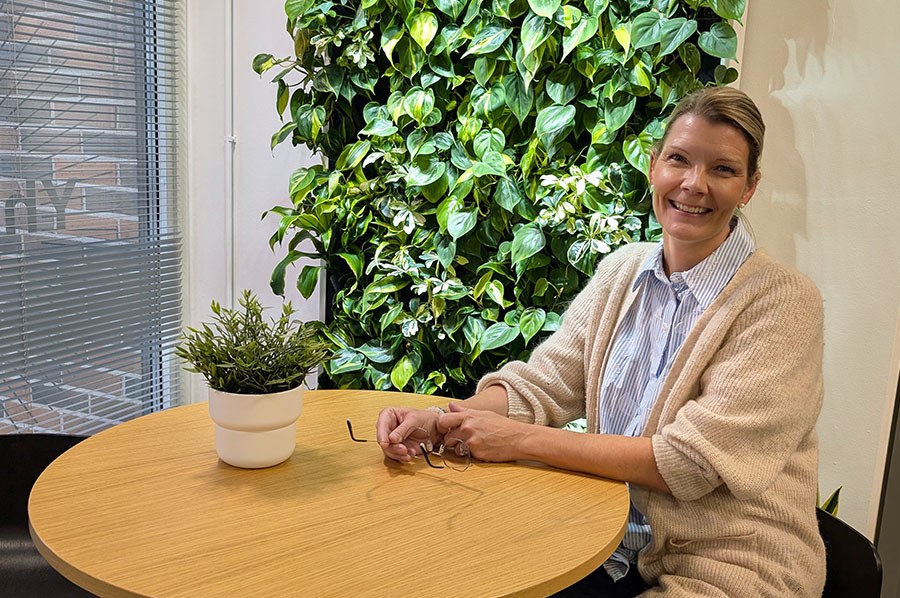
Tiainen became interested in client and patient safety and development while still working in clinical care. In perioperative nursing, she encountered situations in which doctors had to take on considerable responsibility already at the very beginning of their careers. As an experienced nurse, she felt it was her duty to intervene if a situation did not appear to be developing in the patient’s best interests.
“I always think about the person, the client or the patient. In the operating room, I felt that I was the patient’s advocate while they were under anesthesia,” Tiainen says.
Over the years, her interest in patient safety deepened through development work, specialist roles and her master’s studies in health sciences. Her passion for research continued to grow.
“I have always been interested in research. I have a need to find the reason behind things. I want to understand why and how something works and how it can be studied scientifically. My master’s thesis focused on person-centeredness, and my supervisor encouraged me to continue towards a doctorate. I found the topic of my doctoral research through an international collaboration network.”
Finland has fallen behind in supporting family caregivers
Tiainen’s doctoral research focuses on family caregivers’ experiences and safety-promoting practices in Europe. It is a qualitative comparative study with an exceptionally broad international scope.
The research is connected to the EU COST Action BetterCare network, which brings together 47 countries and around 214 researchers. In Finland, Tiainen has interviewed family caregivers about their experiences and everyday lives. At a later stage, she will compare findings from Finland with data from other countries.
International comparison, however, is not an end goal.
The main purpose of comparison is not simply to see how things are done here and elsewhere. Way more important thing is to learn from each other and identify good practices that could be used more widely. Many countries have developed ways of supporting family caregivers that we could also learn from in Finland.
Minna Tiainen
According to Tiainen, Finland’s bureaucratic system of support for family caregivers has fallen behind many other European countries. While other countries offer training, peer support and rapidly accessible assistance, Finnish family caregivers are often left alone in the gap between the home and the service system. Support can be sporadic and is largely dependent on associations and non-governmental organisations.
Family caregivers create their own solutions
One of the more surprising findings emerging from the research is the extent to which family caregivers have to develop solutions themselves. Tiainen has heard numerous examples of older people creating and adapting different safety arrangements in their homes without professional support.
“I have been surprised by how many solutions people must come up with themselves, even though technology that promotes and supports safety already exists. For example, technology could help prevent a spouse with a memory disorder from wandering outside into freezing temperatures at night.”
The research also raises the question of why welfare technologies, digital solutions and other safety-supporting innovations do not reach family caregivers more effectively.
Life can become centered entirely around caregiving
The research interviews have lasted several hours, revealing how meaningful it can be simply to feel heard.
Many family caregivers have described situations in which their own lives have gradually narrowed around their caring responsibilities. Those caring for a spouse or parent describe how their other roles in life have faded into the background.
“Sometimes they tell me with tears in their eyes that they no longer feel they are anything other than a family caregiver. Yet they would still like to be spouses, parents, friends or someone’s children.”
These experiences reinforce Tiainen’s conviction that the research matters, even though, as a researcher, she cannot provide caregivers with specific advice or recommendations during the interviews. The research helps identify practices that support client and patient safety as well as caregivers’ ability to cope, and the results of the doctoral research can be utilised in teaching, project work and decision-making.
Making an impact is what matters most
The international network has also led to new partnerships and the preparation of new projects. Tiainen is involved in a major funded project developing a national train-the-trainer model for client and patient safety.
Tiainen is completing her doctorate under an international cotutelle arrangement. Her research is jointly supervised by Tampere University and Universidad Miguel Hernández in Spain, and upon completion she will receive doctoral degree certificates from both universities. Her first article is currently undergoing peer review, while two others are in progress.
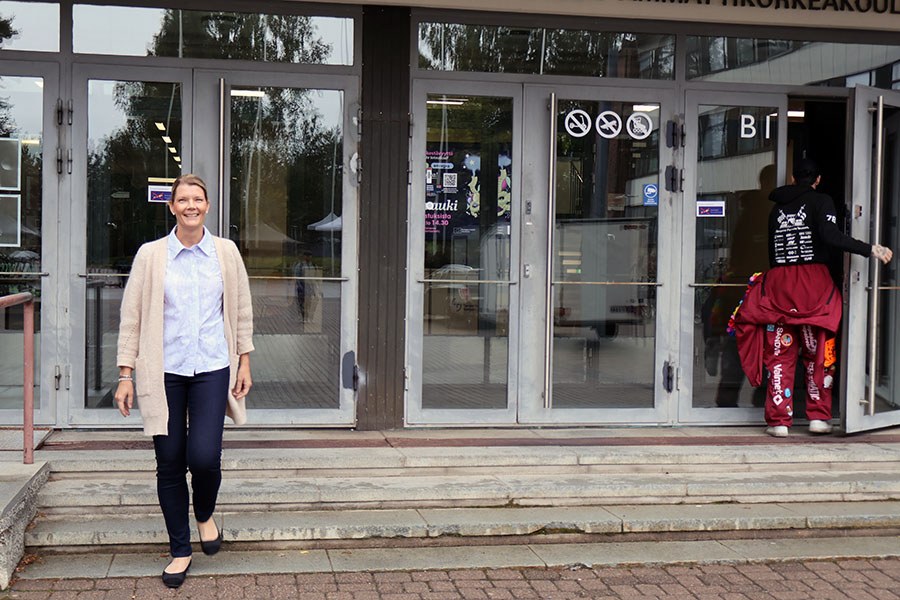
Tiainen was accepted into TAMK’s doctoral pathway programme in the second application round. She admits that not being selected in the first round was disappointing, but the new application round provided an important opportunity to pursue her doctoral research more fully. The programme allocates working time to research and at the same time strengthens its links with TAMK’s teaching, project activities and international networks.
Although the doctoral project is extensive and time-consuming, Tiainen does not describe it as a grueling effort or something that simply must be completed.
“I do this as a hobby,” she says with a laugh.
For Tiainen, it is important that research does not come at the expense of her own wellbeing or that of the people close to her. The doctoral title is not the main goal. What matters is bringing research-based knowledge into decision-making.
“The most important phase, and the real work, begins once I have the results. Then I can take them forward, make an impact and be the voice of family caregivers in networks and in discussions with decision makers. Through that work, I hope that the experiences of more family caregivers will be heard and taken into consideration in future policy and legislation.”
Contact person
Minna Tiainen
Senior Lecturer Minna Tiainen
Author: Hanna Ylli


