
Transportation emissions are one of the major causes for global warming and bad air quality.
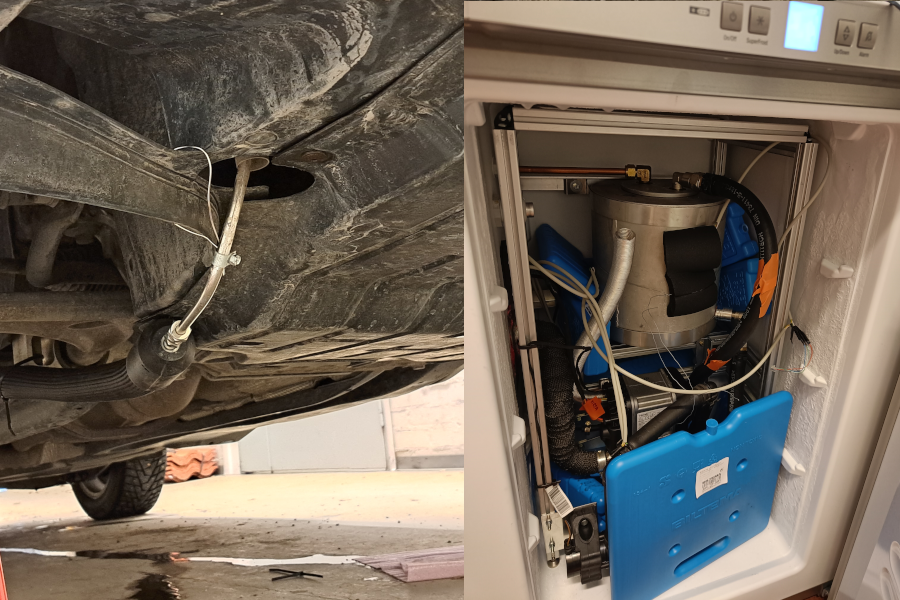
MEAPS develops new measurement techniques to quantify realistic estimates of gaseous and particulate phase emissions from several vehicle categories. Moreover, project focuses on better nanoparticle sampling and detection from road traffic and non-road mobile machinery system renewal, the role of renewable fuels, and the potential effects of these.
Especially, the assessment of the direct and indirect climatic effects as well as air quality impact of aerosols originating from transport requires detailed information of the nature of emission development. Project combines an expertise ranging from construction new instruments, understanding the emission factors from single vehicles, and parameterization of experimental results for further use. This approach can provide new understanding how different vehicle development scenarios will affect our future.
Voluntary Exhaust Emission Measurement Campaign, 21–29 April 2026
We are organising a measurement campaign at P‑Hämppi. You can read more at:
https://www.tampere.fi/ajankohtaista/2026/04/16/vapaaehtoiset-pakokaasumittaukset-p-hampissa-tarkentavat-tietoa (in Finnish)
The data protection notice related to the campaign is available here.
Study on Gaseous and Particulate Emissions from Internal Combustion Engine Vehicles in Road Traffic
We are conducting a study on gaseous and particulate emissions from internal combustion engine vehicles in road traffic in the Pirkanmaa region, tentatively during the period 1 June 2026 to 31 July 2026. Emissions associated with individual vehicles are measured by driving along with normal traffic using a mobile laboratory (van) operated by the Aerosol Physics Laboratory at Tampere University. The dataset will include a diverse selection of passenger cars and heavy-duty vehicles encountered in traffic. An individual measurement lasts approximately 5 minutes.
In reporting the results, vehicles and their emissions are treated based on technical vehicle characteristics. Since individual vehicle owners or holders cannot be identified from the reported results, the study entails neither benefits nor risks for the subjects.
No compensation is provided for participation. You have the right to withdraw from the study at any time without providing a reason and without any negative consequences. Withdrawal does not prevent the continued use of data collected up to that point in the study.
Research data are processed confidentially and securely. Personal data collected during measurements (license plate numbers) are handled only by a small group of researchers. The license plate number is used to retrieve technical vehicle information from Traficom. More detailed information on the processing of license plate data is available in the privacy notice at the end of this document or upon request.
In scientific publications resulting from this study, the collected data will be processed anonymously. Emission data will not be reported in a form that could be linked to a vehicle owner. The research dataset may be published as part of scientific outputs in a form that does not contain information enabling identification of vehicle owners or holders.
For further information, please contact Associate Professor Panu Karjalainen (panu.karjalainen [at] tuni.fi, +358 45 359 2979), Postdoctoral Research Fellow Ville Leinonen (ville.leinonen [at] tuni.fi, +358 50 379 8430), or Researcher Kuisma Vesisenaho (kuisma.vesisenaho [at] tuni.fi).
The data protection notice related to the campaign is available here (in Finnish, ask for enlish translation).
