7-Zip
Compressing and encrypting files
You can compress several files into a single new file and encrypt it at the same time. If you follow these instructions, the encryption is sufficiently secure even for highly sensitive files such as personal data belonging to special categories of personal data (data classification 1R).
The 7-Zip program is pre-installed on TUNI Windows computers. The file format (7z) produced according to these instructions can only be opened with the 7-Zip program, so the recipient must also have the same program. The program is free and anyone may use it.
- Launch 7-Zip File Manager and browse to the folder that contains the folders and files you want to encrypt.
- Choose the folders and files you want to encrypt and click Add (plus sign).
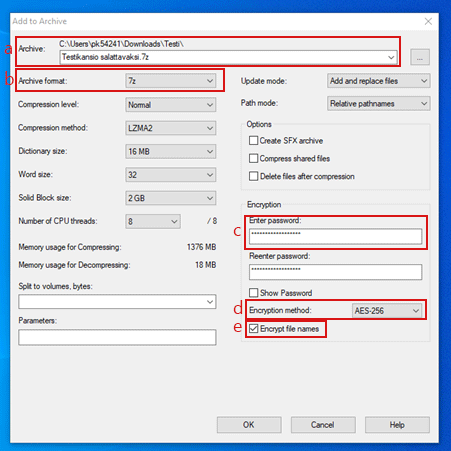
- Configure the required settings (See the picture below.)
- Name the resulting archive in a manner that does not contain anything confidential nor does reveal too much about its contents (section a). You can direct the archive to be created into another folder by selecting it via the three-dot button on the right.
- Choose 7z as the archive format (section b).
- Create and enter the password (section c). The recommended length of the password, or rather the passphrase, is 20 characters and it should include numbers and special characters.
- Write down the password on a piece of paper either in full or in part. See the instructions of the Cyber Security Centre. Keep the paper in a secure place. Record the information in a way that prevents an outsider from determining what the password is for. If you forget the password, the archive cannot be opened and the encrypted files stored in it will be permanently inaccessible.
- Choose AES-256 as the encryption method (section d).
- Select the Encrypt file names checkbox (section e).
- Click OK to create the encrypted archive.
To extract an encrypted 7z archive, right-click the archive in File Explorer -> 7-Zip -> Extract Here. When prompted, enter the password specified when encrypting the archive.
Sending as an attachment
You can use this method to send even highly sensitive data, such as special categories of personal data, by email as attachments.
- Create an encrypted archive according to the instructions above.
- Send the encrypted archive to the recipient as an attachment to a Microsoft 365 encrypted email; see the instructions on the page Email encryption. If the file archive is too large for email, you can also send it using Funet FileSender; see the instructions on the page Sharing large files.
- Send the password to the recipient via another communication channel, preferably by text message to the recipient’s personal mobile phone number.
IT Helpdesk
0294 520 500
it-helpdesk [at] tuni.fi (it-helpdesk[at]tuni[dot]fi)
helpdesk.tuni.fi