
January in Finland ain’t easy. Every time you want to leave your house, you have to prepare for an Expedition. Sometimes the wind bites. Sometimes the ground shifts under your feet. It’s enough to make you wonder: why even leave in the first place? You can have fun at home.
Now, you could play some video games (lame, antisocial). If you’re rich enough, you could grab whoever’s around and play some premium board games (cumbersome, expensive, requires setup). But maybe there’s an option you overlooked. You could always go back to the humble deck of 52 cards (cheap! contains many possible games! fun and social!). This is clearly the superior choice.
Now, I’m sure you have priors here. Who hasn’t been forced to play a boring card game once in their life? Maybe it’s the only way you can bond with your aging relatives. Maybe your only experience with cards was a childhood game of War; a game about as interesting as eating dry oats. This is where I can help.
You see, card games are a special interest of mine, and I’ve played a whole bunch of more obscure traditional card games that you might actually enjoy! Cooperative deck builder games. Competitive gaslighting memory games. Moddable reaction-based games. I can give you games you might actually want to play.
Before we start, a quick word on review criteria. I’m here to review these games, to find a game that suits your needs, but not necessarily teach them to you. I’ll link to Wikipedia (or better sources I find) for that. But I will grade these games on 3 criteria: Fiddliness To Set Up (not just dealing but strict/lenient player counts), Complicatedness (a double edged sword: if your main problem with your current boring card games is how simple they are, the more complicated the better! But you obviously need to teach people it), and How Easy It Is To Have A Conversation While Playing (vital). I think this covers the actual things that matter with card games.
Cambio
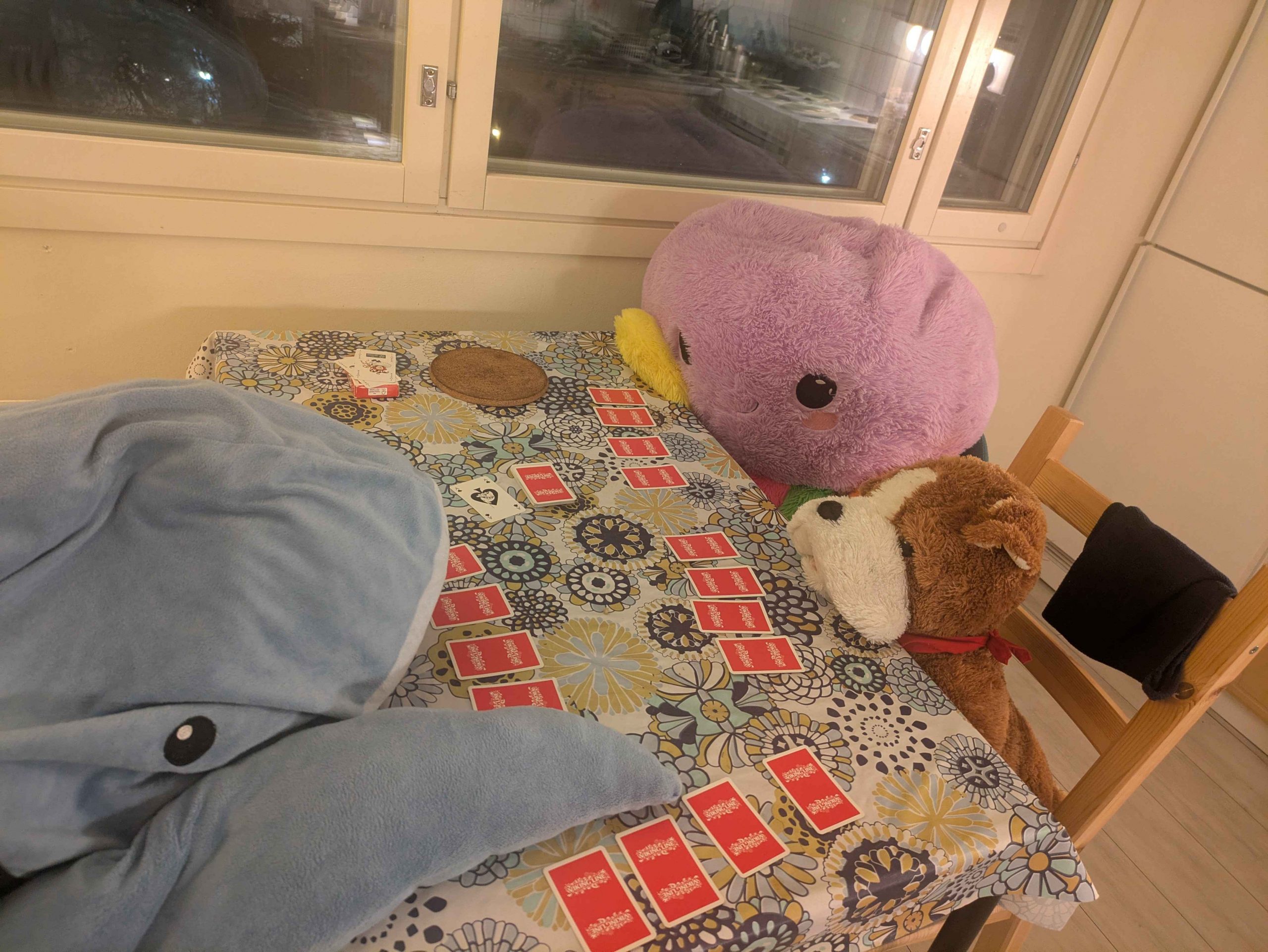
Genre: Strategic-Memory game (with snap-like mechanics)
Rules: https://cambiocardgame.com/
Fiddliness To Set Up: Low (It’s easy to deal, and you just need more than 2 players for a good time)
Complicatedness: Medium (Many cards do different things when discarded! It’s useful to have a cheatsheet)
How Easy Is It To Have A Conversation While Playing: Difficult (A big part of the game is memory based! You’re going to be staring intensely at face-down cards
Cambio is the most intense card game I’ve ever played. You huddle around the table, wordlessly trying to remember the cards in your face-down hand, while desperately trying to follow all the different actions people are taking. Your dad just swapped a card with you! Is that one you knew? Is that one they know? Your mum looked at one of your dad’s cards, and the smirk on her face means something. Your sister just discarded a card that you know you have in your hand. But where in your hand? Guess right, and you’ll be able to get rid of it for good: one step closer to your goal of having The Smallest Hand. Guess wrong, and you’ve probably lost. Every single action feels heightened. There’s so much to keep track of, and terrible consequences for losing focus.
Yes, Cambio is a memory game, and yes, memory games usually suck. But on top of that, it’s a competitive reaction game, AND a betting game. At any point, if the top card matches a card you know someone has, you can play it for them. Any information gleaned (through special cards that let you see their card, or simple observation) is valuable and can be used against you at a moment’s notice. And it is only when someone places a bet that they have the smallest hand that the game draws to a close. Cambio games can even end at the start, with a particularly risky player! These mechanics make the game constantly dynamic – there’s always something to look for, even when it’s not your turn.
But of course, there are issues with a card game being intense. If you want social lubricant, or a game that works well when everyone’s drunk, you probably don’t want to encourage your group to all stare into the middle distance. But if you like intense games: if you wish that card games made you feel the same way that playing Big Boy Games like chess do, then teach people this game! You won’t regret it.
Buraco
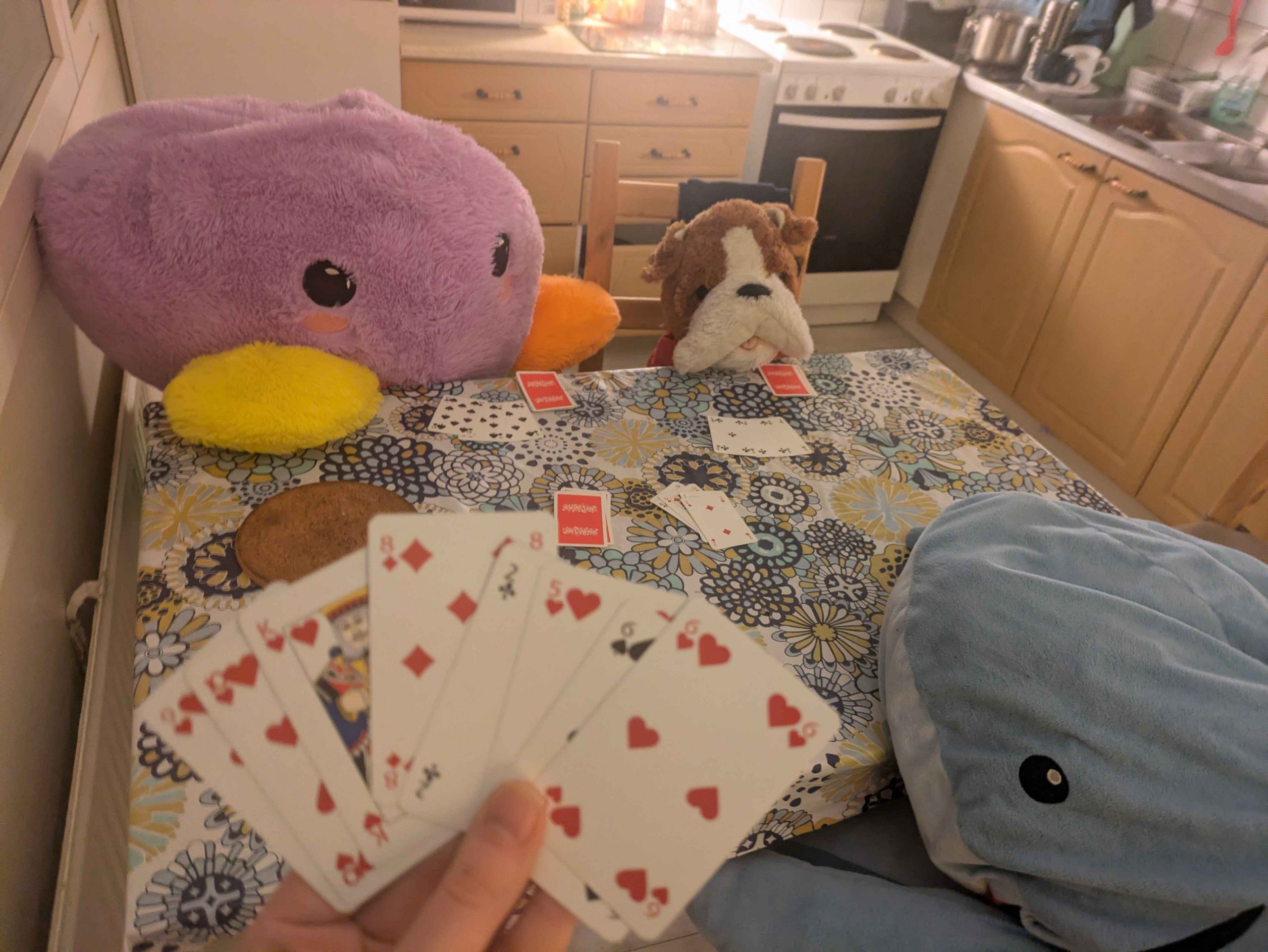
Genre: Team-based deckbuilder (or: Rummy but Good)
Rules: https://en.wikipedia.org/wiki/Buraco
Fiddliness to set up: High (Requires two decks of cards AND only allows 4 players)
Complicatedness: Depends (Medium if the group hasn’t played Rummy before, Low otherwise)
How Easy Is It To Have A Conversation While Playing: Easy (While there are things to pay attention to, the game can fade into the background very easily – there’s not much to do outside of your turn)
I hate Rummy. I hate waiting, wasting another turn as I pray for the card that can Fix my hand. I hate being gated off from doing the stuff I find fun (adding and removing cards from other people’s sets of same cards/consectives!) until I get lucky. I hate how little I get to make decisions. Buraco does not change any of this. But I love it.
See, while you’re doing the same thing as in Rummy (building a nice hand) Buraco reframes everything by putting you on the same team as the person directly opposite you.
Suddenly, everything’s different! The card you decide to discard? That could be picked up by the opposing teammate BUT if they miss it, then maybe your teammate could grab it! You’re now constantly trying to figure out what everyone has, and trying to help your teammate one card at a time.
While it’s a team game, you’re banned from openly strategising with your teammate. And because there’s not a huge number of actions to perform, you can definitely use this game as social lubricant. There’s just interesting meat and strategies you can get into if you wish. It’s a great balance between intensity and a little sociable game.
Egyptian Ratscrew
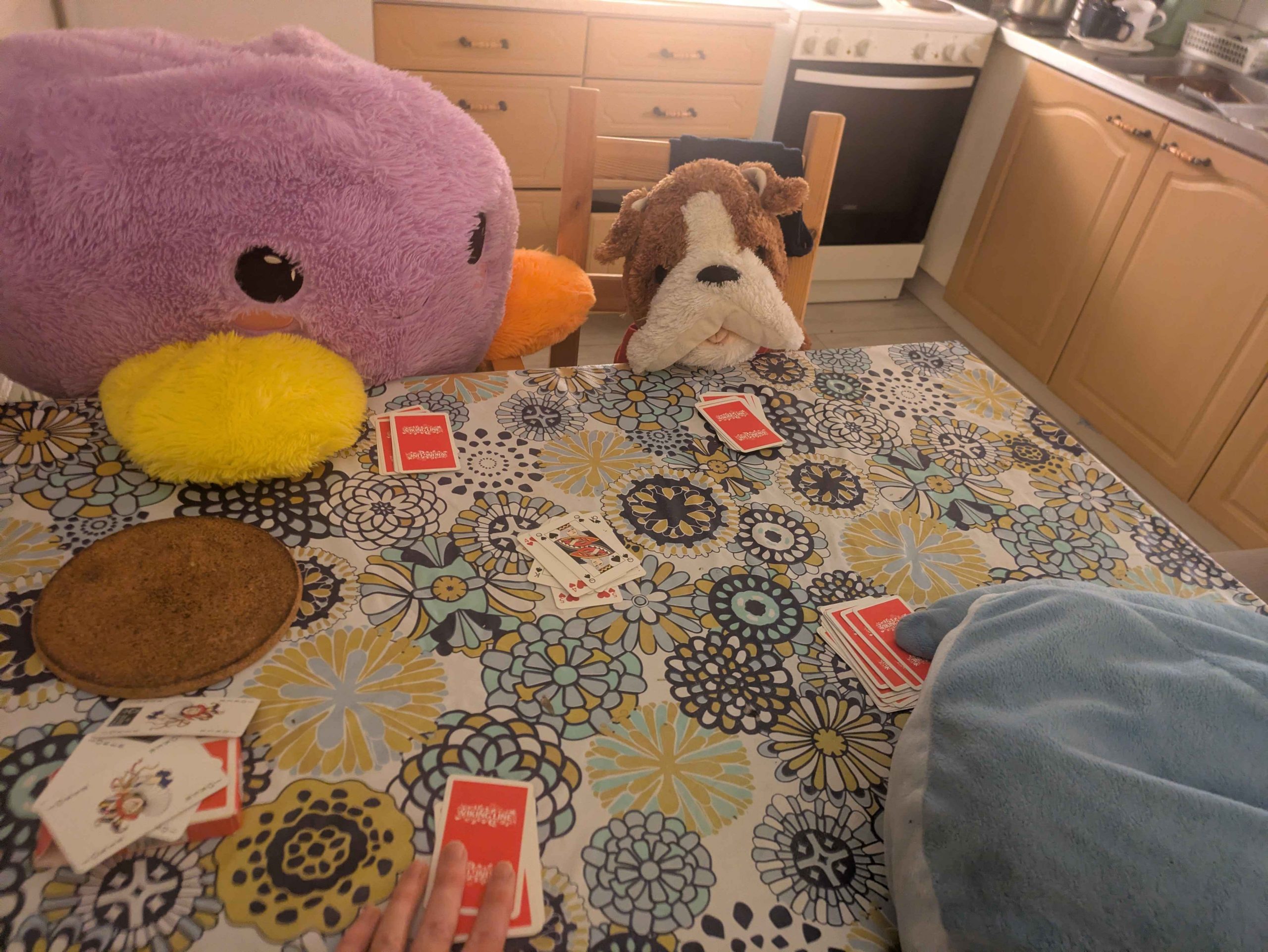
Genre: Moddable reflex game (customizable snap-like)
Rules: https://en.wikipedia.org/wiki/Egyptian_Ratscrew
Fiddliness to set up: Medium (takes any number of players, but requires you to deal out all cards)
Complicatedness: As simple as it gets (c’mon you know snap)
How Easy Is It To Have A Conversation While Playing: Surprisingly hard (reflex games Take Focus)
I won’t take long here. You’ve played snap, and you know how it works. You play cards, and hit the pile when they match. If you’re faster than your opponent, you get the cards. Great job! Egyptian ratscrew stands out by letting you customize exactly when you have to hit the pile, providing more and more things you have to watch for. How about having to hit the pile when two of the same cards are surrounding a different card (a sandwich)? Or 3 cards of the same suit? 4 consecutive cards? Get the balance right, and you’re constantly on edge. Get it wrong and you can always fiddle with the rules again!
The simplicity of the game can get old after a while, and one definite drawback is how long games can last (they only end when one person owns all the cards, and this takes time). But it also makes it incredibly easy to teach. I’ve taught this game to people who don’t speak any English, and we’ve been able to have a good time! If the people you’re wanting to play cards with are already drunk, this is a great option.
Truco
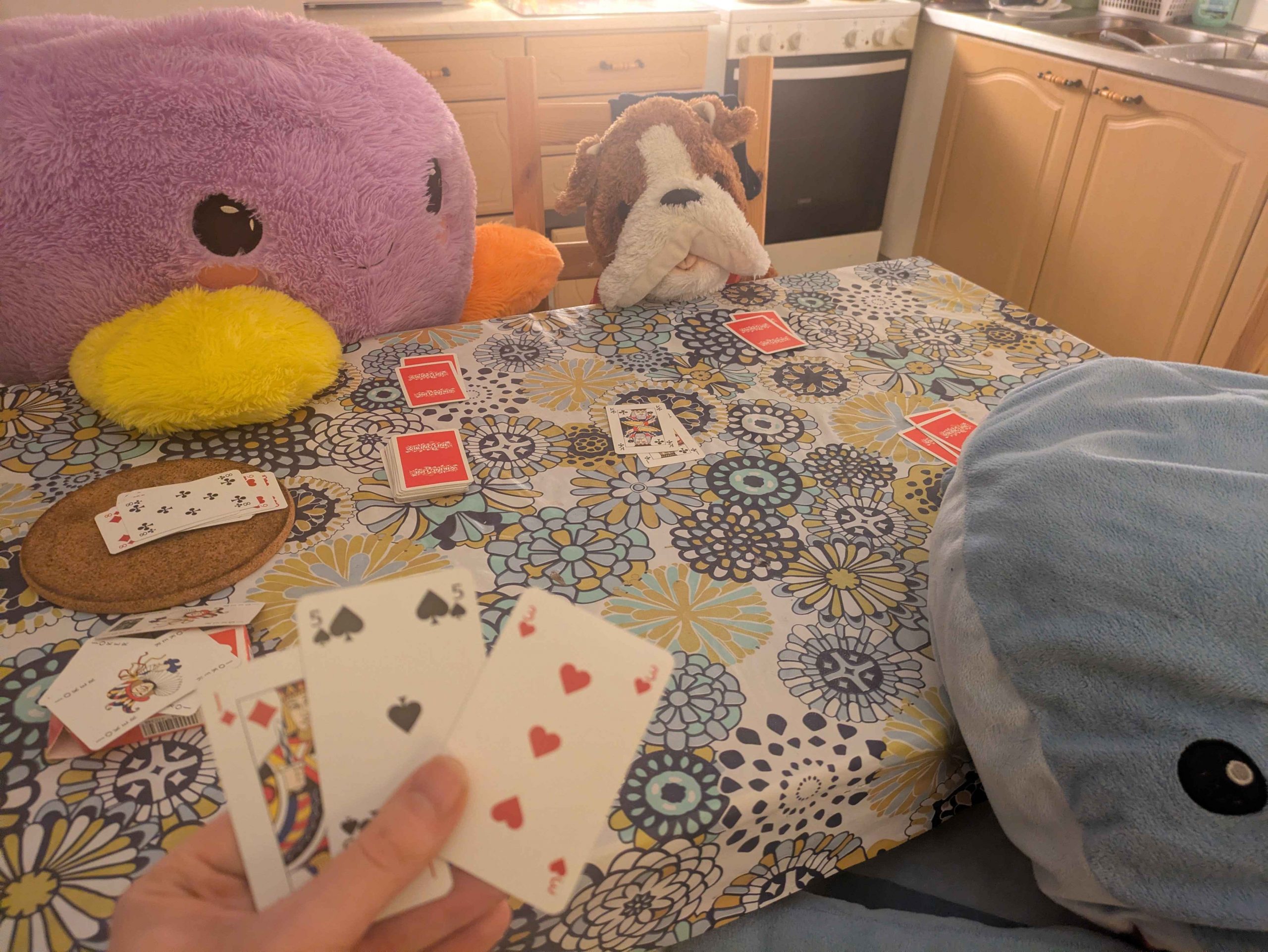
Genre: Team-based bluffing game (The most unique trick taker)
Rules: https://en.wikipedia.org/wiki/Truco
Fiddliness to set up: High (Requires 4 people only, Without a spanish deck of cards, requires removing some cards)
Complicatedness: Very Complicated (It’s not only a trick taker, but one with a whole host of little rituals and rules. You’ll likely need a cheatsheet to understand how strong each card is)
How Easy Is It To Have A Conversation While Playing: Somewhat difficult (You’re talking a lot! But depending on how much bluffing you’re doing you might not be having the deepest conversation)
Truco is maybe a big ask. It’s a complicated game: “trick taking” games (games in which you each play a card in one suit and the highest one wins) often are, being one of the oldest genres of card game. But once you’ve got over the learning curve, this game offers something incredibly unique: a bluffing game with teams.
Truco revolves around raising the stakes. At the start of a round, a team can (and often will) place a bet that they’ll win the round – getting double points if they win. But the other team needs to accept this. If they reject it, they immediately lose the round (but without double points). This can stack: teams can keep raising and re-raising the stakes, with the knowledge that the round will immediately end if either side blinks. So far, so Poker.
But in Poker, you aren’t working with someone else to win. You can’t see the look of Fear in your teammate’s eyes as you place a bet when they clearly, obviously, have a terrible hand. You can’t feel the tangible sense of relief when the other team backs down. You can’t try and strategise with your teammate: unlike many other trick takers, Truco allows you to talk completely openly about the game, with the caveat that of course the other team can hear everything.
It’s anarchic. A table with experienced players can easily fall into loud braggadocious claims of hand strength, manipulative questions to ascertain other hand strengths, and a series of secret signals to communicate only with your teammate. Everything is permitted, and so all kinds of meta tricks can be performed. It’s unlike any trick taker I’ve ever played, and for that it’s well worth a play.
Truco did beat out a few other more conventional games in this genre – if you want something more straightforward, check out Schnapsen (maybe the best two player card game I know) and Russian Schnapsen (for 3 players instead). Both will be easier to pick up. But they won’t give you what this game does.
Publisher: Probably sailors from China (disputed)
Developers: Many
Platforms: Paper, card
Release Date: 9th Century AD (Uncertain)
Genres: Multiplayer
PEGI: 3, 18+ if gambling
Picutres by Author