Building physical research equipment
Building physical research equipment can be used to study the building physical properties of materials and structures in a test laboratory, or the behavior of structures in the open air, either through test building experiments or field measurements.
Building physical material properties
The Laboratory of Building Physics mainly studies the transfer of mass and energy in materials. In practice this means material properties related to heat, airflow and moisture.
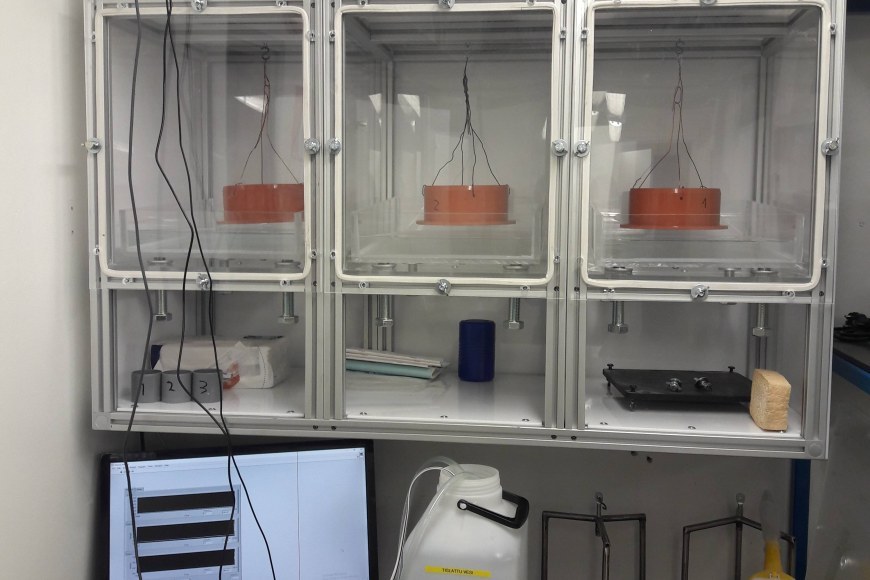
Different types of studies and tests can be carried out on materials to examine their behaviour under different temperature and humidity conditions. For example, the studies can examine durability, mould, deformation, heat and moisture permeability, moisture binding properties or capillarity properties of the material or its surface. The experiments can be in accordance with standards or separate new methods developed for the subject to be examined.
Test buildings
Test buildings and long-term measurements of experimental structures in real outdoor conditions.
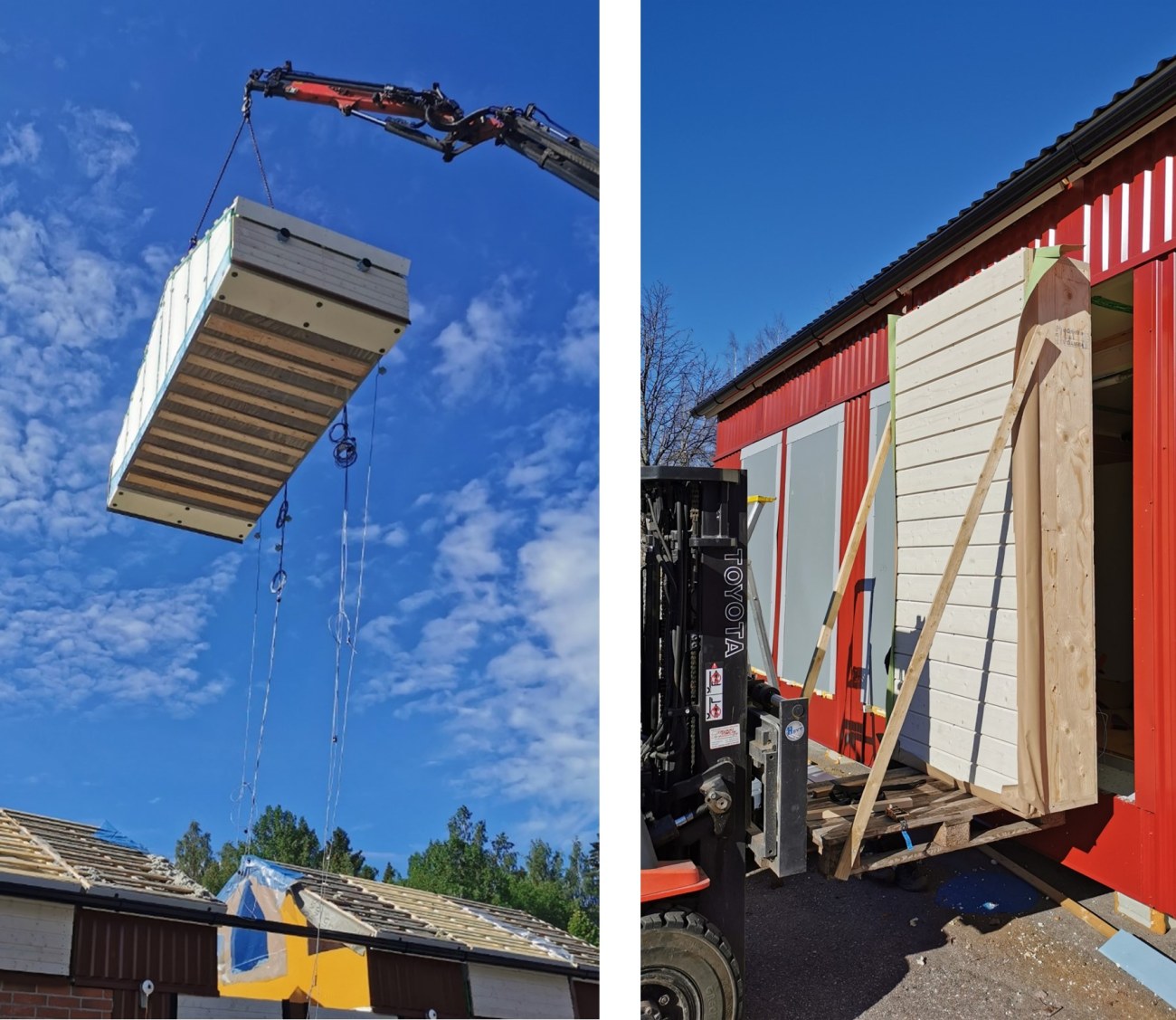
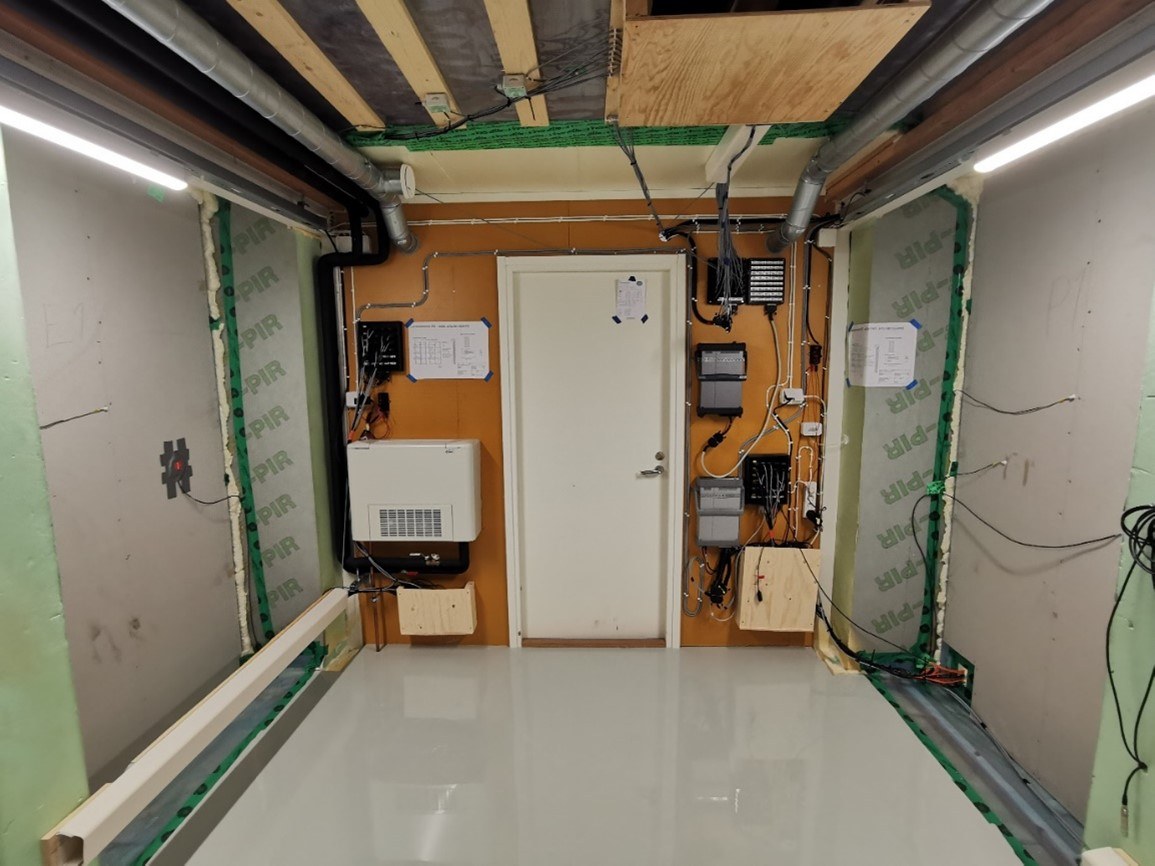
The test buildings are used to monitor the building physical behaviour of different exterior wall and roof structures in real outdoor air conditions. The indoor air temperature and relative humidity of test buildings can be controlled, as well as the pressure difference between indoor and outdoor air. Indoor and outdoor air conditions and the conditions of the interfaces between the different structural layers of the test structures are monitored by continuous measurements using extensive sensors.
The Building Physics research group has two test buildings. The test buildings are mirror images of each other. A total of 12 exterior wall structures and 3 roof structures can be installed in each test building. The test buildings are positioned in the cardinal directions so that the long façades on which the test structures are installed face north and south. Typically, two identical test elements are installed for each type of wall structure to be studied: one on the north façade and one on the south façade.
The test structures will provide comparable measurement data for several years. The data can be used to compare different structures. The data obtained also enables comparisons with simulation models and thus the development of models in a better and more accurate direction.
Field measurements and structural tests
The conditions and indoor air quality of buildings can be assessed during the construction and use of the building with the help of various monitoring measurements.
The most typical building physical measurements are the measurements of temperature, relative humidity, moisture content of materials, air pressure differences and heat flow. The Building Physics research group can measure various indoor air pollutant concentrations (CO2, VOC, radon, microbes), either directly or through partners. Different types of data collection systems are utilised as needed, and the measurement arrangement can consist of small battery-powered data loggers, a unit of several measuring devices and measuring points built around a computer, or a data collection system operating via the Internet where the measurement results are automatically collected on a server.
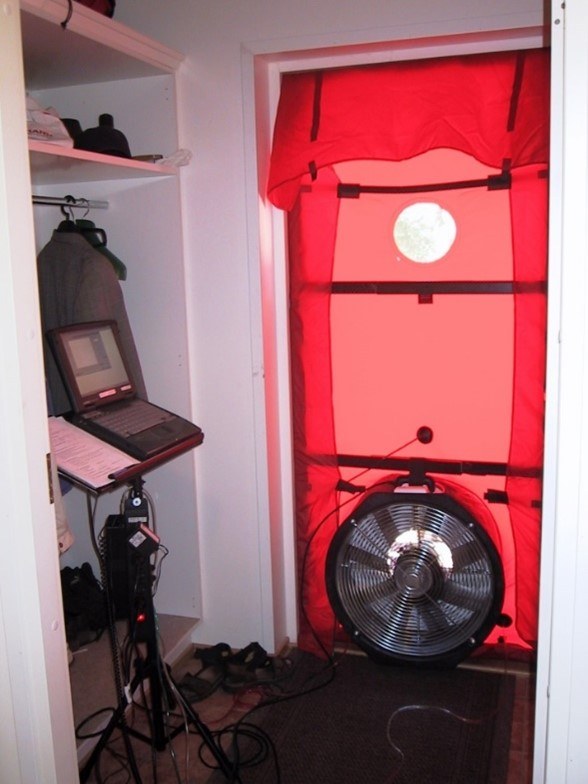
The airtightness of buildings is measured with a pressure test. Airtightness is assessed with the help of the air leakage number q50 obtained as a result of the experiment. In connection with the pressure test, air leaks in the external envelope can also be searched for with the help of thermal imaging.
Building physical tests of wall and roof structures are carried out using research equipment intended for them.
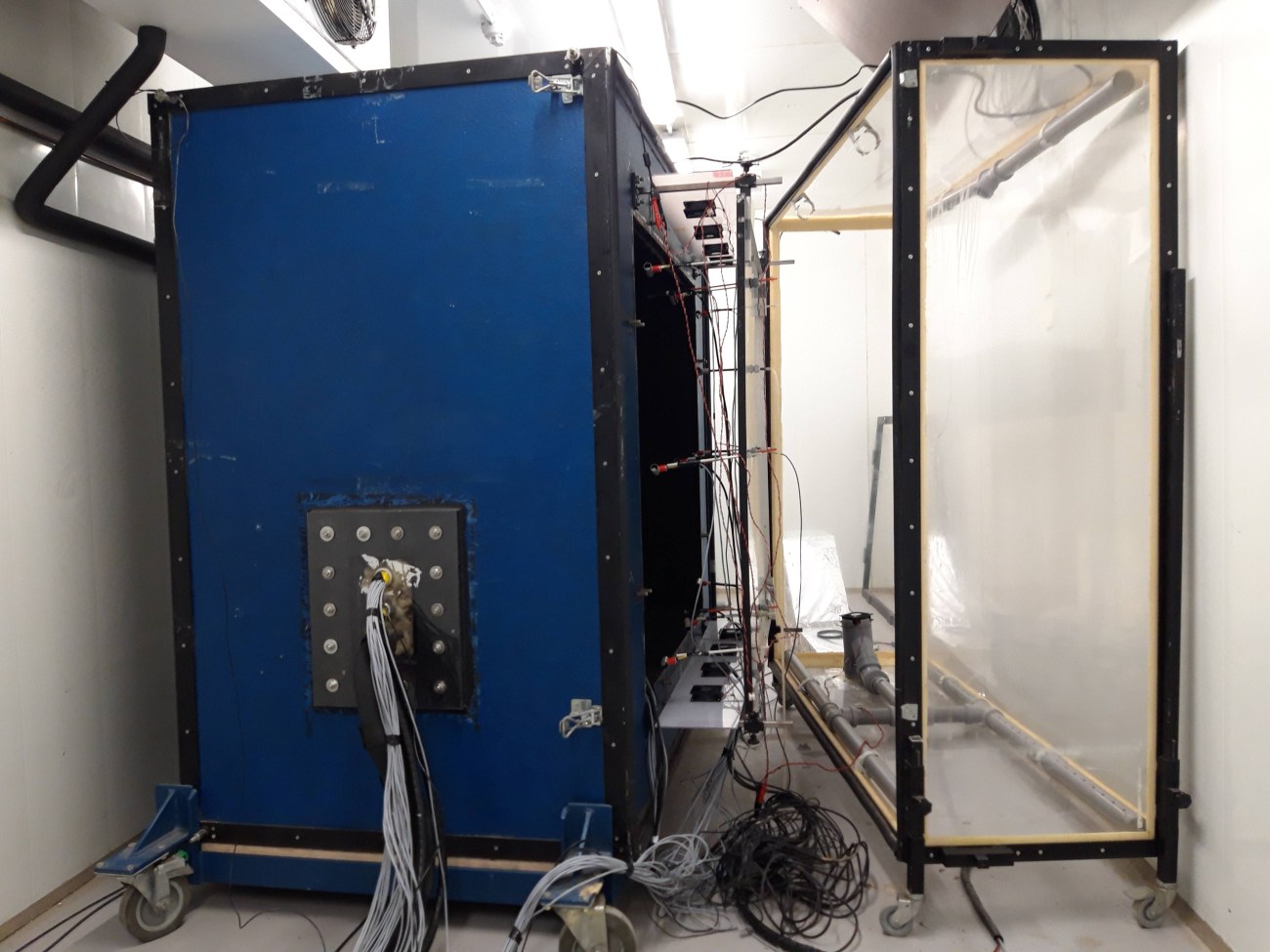
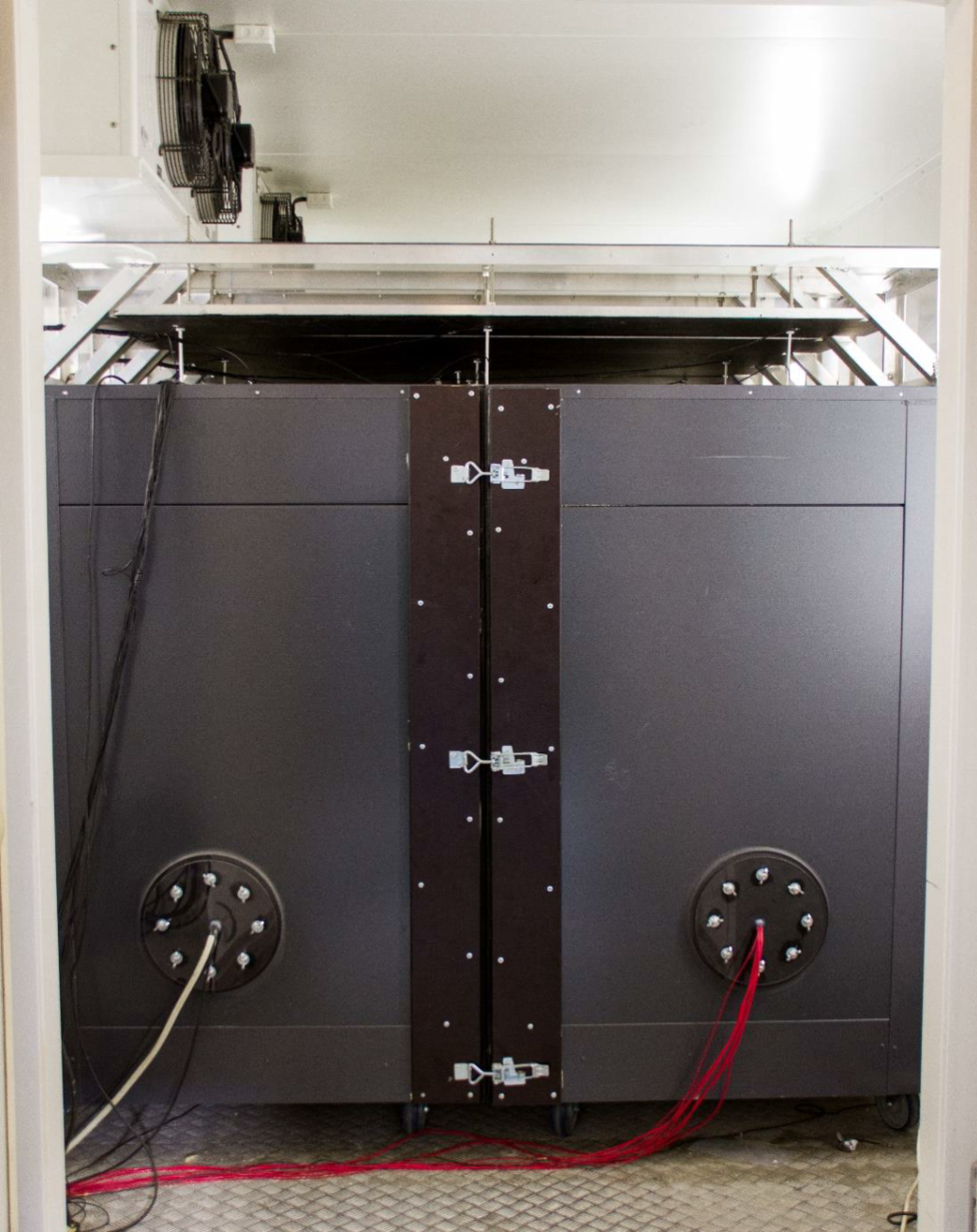
The research equipment for wall and roof structures can continuously monitor the building physical behaviour of different structures during condition tests. The equipment can automatically adjust the indoor and outdoor air conditions on different sides of the test structure. The conditions to be monitored and adjusted are the temperature and relative humidity of the interior and exterior, the pressure difference over the test structure, and the air flow rate near the exterior surface of the structure.
In addition, it is possible to adjust the thermal radiation directed at the exterior surface of the wall structure, which describes the warming effect of the sun.
Condition adjustments and measurements are automatically controlled by a computer.
Device descriptions
Heat flow meter instruments
A sample is placed between two isothermal plates at different temperatures to create a one-dimensional temperature field. Thermal conductivity is calculated using the gradient of the temperature field and the heat flux passing through the object.
The FOX50 and FOX304 heat flow meter instruments are suitable for testing in accordance with the SFS-EN 12667 standard, among other things. The instruments can be used to determine the thermal conductivity λ [W/(m·K)], the thermal resistance R [m2· K/W] and specific heat capacity c [J/(m3· K)].
Free water absorption equipment
The experiment measures the weight change of a test specimen in contact with water over time.
The equipment can be used to determine the water absorption coefficient Aw, water penetration coefficient Bw, capillary saturation moisture content wcap, maximum moisture content wmax and water permeability w for coatings.
Pressure plate extractor
Soil Moisture 15 and 100 bar pressure chambers. The equipment is used to determine the desorption curve of a material in the capillary (95-100% RH) region. In the experiment, the water-saturated pieces are dried using positive pressure. The resulting capillary equilibrium humidity curve can be represented as a function of the mean pore subpressure or air humidity. The tests are conducted in accordance with NT Build 481 and ASTM C1699-09.
Vacuum chamber
The side dimensions of the chamber are 300 mm, and the device can reach an absolute pressure of less than 10 Pa. The equipment can be used to determine the dry and wet density and porosity of the material.
Water vapour permeability test equipment
Vapor permeability and resistance are determined by cup tests, in which a moisture flow is created through the object using different humidity inside and outside the cup. The experiment can be carried out in a low or high relative humidity area using different humidity pairs.
Dynamic vapor sorption analyzer
Dynamic vapor sorption equipment (DVS). Determination of the hygroscopic adsorption and desorption curve in small < 1.5 g specimens. The equipment weighs the test piece in real time, which provides dynamic, i.e. time-dependent data on the material's behavior. An additional advantage of the equipment is that curves can be determined faster than traditional methods due to the small size of the test specimens.
Constant climate rooms and moisture cabinets
Two auto-controlled ambient rooms for humidity from 10 to 30 °C and 30 to 90% RH. In addition to the rooms, there are also humidity cabinets for 11–94% RH conditions.
Air Permeability Measurement Equipment
Two air permeability measuring devices that can be used to measure the material properties of solids, sheet insulation and blown insulation of different sizes:
- airflow resistance AFr [(kPa·s)/m2]
- air permeability Ka [m3/(m·s· Pa)]
- Converted Rayleigh Number Ram (in combination with thermal conductivity tests)
Differential pressure: in the basic case, the maximum differential pressure is 50 Pa, the differential pressure can be increased if necessary. Air flow rate range: <1 mm/s to 0.5 m/s.
Recent publications
Pessi, A-M., Tuominen, E., Häkkilä, S., Westermarck, M. & Vinha, J. 2025. Homehtumisherkkyysmäärityksiä biopohjaisista rakennusmateriaaleista sekä irtomateriaalin testausmenetelmä. The Finnish Building Physics Conference 2025. https://urn.fi/URN:NBN:fi:tuni-202601231798
Hietikko, J. & Vinha, J. 2025. Puru-kutteri materiaalikokeet. The Finnish Building Physics Conference 2025. https://urn.fi/URN:NBN:fi:tuni-202601221778
Sekki P., Huttunen P., Karvinen T. & Vinha J. 2024. Temperature dependence of concrete drying and a method for estimating the effect of temperature on the relative humidity in concrete pores. Journal of Building Engineering. https://doi.org/10.1016/j.jobe.2024.109266
Kari Vänttinen, Olli Tuominen, Eero Tuominen, Ilkka Valovirta, Pauli Karjala, Ilkka Tuurala, Juha Vinha. 2023. Equilibrium Moisture Content of High Strength Concrete Used in Hollow Core Slabs. NSB 2023. https://doi.org/10.1088/1742-6596/2654/1/012032
Pauli Karjala, Ilkka Tuurala, Eero Tuominen, Ilkka Valovirta, Juha Vinha. 2023. Hygrothermal properties of hollow brick masonry used in veneer. NSB 2023. https://doi.org/10.1088/1742-6596/2654/1/012126
Pauli Sekki, Tuomas Raunima, Juha Vinha. 2023. Measurement and modelling of the moisture distribution in early-age concrete in the joint of composite beam and hollow core slab. NSB 2023. https://doi.org/10.1088/1742-6596/2654/1/012045
Eero Tuominen, Juha Vinha. 2023. Ruggedness test made with mortars by free water intake test. NSB 2023. https://doi.org/10.1088/1742-6596/2654/1/012036
Tuominen, E., Haapaniemi, S., Tuurala, I., Hietikko J. & Vinha, J. 2023. Puhalluseristeiden ilmanläpäisevyysmittaukset RIL225 -julkaisuun. The Finnish Building Physics Conference 2023. https://researchportal.tuni.fi/en/publications/puhalluseristeiden-ilmanl%C3%A4p%C3%A4isevyysmittaukset-ril225-julkaisuun/
Haapaniemi, S., Hietikko, J., Tuominen, E. & Vinha, J. 2023. Ilmanläpäisevyyden mittauslaite ja eräiden puhalluseristeiden ilmanläpäisevyyksiä. The Finnish Building Physics Conference 2023. https://researchportal.tuni.fi/en/publications/ilmanl%C3%A4p%C3%A4isevyyden-mittauslaite-ja-er%C3%A4iden-puhalluseristeiden-ilm/
Karjala, P., Tuurala, I., Tuominen, E., Valovirta, I. & Vinha, J. 2023. Reikätiilen ja laastin kosteustekninen yhteistoiminta materiaalikokeissa. The Finnish Building Physics Conference 2023. https://researchportal.tuni.fi/en/publications/reik%C3%A4tiilen-ja-laastin-kosteustekninen-yhteistoiminta-materiaalik/
Westermarck, M., Kilpiäinen, M., Karjala, P., Tuurala, I., Hautala, M., Kiviaho, S., Alanen, M., Liblik, J., Jokinen, T. & Vinha, J. 2023. Korresta kerrostaloksi STALK-hanke. The Finnish Building Physics Conference 2023. https://researchportal.tuni.fi/en/publications/korresta-kerrostaloksi-stalk-hanke/
Valovirta, I., Salkinoja-Salonen, M., Hokkanen, T. & Vinha, J. 2023. Savetuksen vaikutus mikrobitoimintaan rakennusmateriaaleissa. The Finnish Building Physics Conference 2023. https://researchportal.tuni.fi/en/publications/savetuksen-vaikutus-mikrobitoimintaan-rakennusmateriaaleissa/
Pessi, A.-M., Tuominen, E., Häkkilä, S. & Vinha, J. 2023. Rakeisen materiaalin homehtumisherkkyysluokan määrittämisen haasteet: homehdutuskokeet savetetulla ja puhtaalla kutterinlastulla. The Finnish Building Physics Conference 2023. https://researchportal.tuni.fi/en/publications/rakeisen-materiaalin-homehtumisherkkyysluokan-m%C3%A4%C3%A4ritt%C3%A4misen-haast/
Tuurala, I., Tuominen, E. & Vinha, J. 2021. Eräiden kutterinlastutuotteiden rakennusfysikaaliset materiaaliominaisuudet. The Finnish Building Physics Conference 2021. https://researchportal.tuni.fi/en/publications/er%C3%A4iden-kutterinlastutuotteiden-rakennusfysikaaliset-materiaaliom/
Eero Tuominen, Olli Tuominen, Maarit Vainio, Tiina Ruuska, Juha Vinha. 2019. Thermal and moisture properties of calcium silicate insulation boards. CESBP 2019. https://doi.org/10.1051/matecconf/201928202065
Eero Tuominen, Juha Vinha. 2019. Calculation method to determine capillary properties of building materials with automatic free water intake test. CESBP 2019. https://doi.org/10.1051/matecconf/201928202037
Tuominen, E., Vinha, J. & Naskali, J. 2019. Puuelementtien välisen sauman tiivistys kumitiivisteellä. The Finnish Building Physics Conference 2019. https://researchportal.tuni.fi/en/publications/puuelementtien-v%C3%A4lisen-sauman-tiivistys-kumitiivisteell%C3%A4/
Tuominen, E., Tuominen, O., Vänttinen, K., Vainio, M. & Vinha, J. 2019. Betonin kosteustekniset materiaaliominaisuudet ja mittausmenetelmän kehittäminen. The Finnish Building Physics Conference 2019. https://researchportal.tuni.fi/en/publications/betonin-kosteustekniset-materiaaliominaisuudet-ja-mittausmenetelm/
Tuominen, E., Ruusala, A., Laukkarinen, A., Pätsi, S., Pessi, A.-M., & Vinha, J. 2019. Huokoisten puukuitu- ja kipsituulensuojalevyjen homehtumisherkkyys. The Finnish Building Physics Conference 2019. https://researchportal.tuni.fi/en/publications/huokoisten-puukuitu-ja-kipsilevytuulensuojalevyjen-homehtumisherk/
Niemelä, T., Vinha, J., Lindberg, R., Ruuska, T. & Laukkarinen, A. 2017. Carbon dioxide permeability of building materials and their impact on bedroom ventilation need. Journal of Building Engineering. https://doi.org/10.1016/j.jobe.2017.05.009
Ruuska, T., Vinha, J. & Kivioja, H. 2017. Measuring thermal conductivity and specific heat capacity values of inhomogeneous materials with a heat flow meter apparatus. Journal of Building Engineering. https://doi.org/10.1016/j.jobe.2016.11.011
Vänttinen, K., Tuominen, E. & Vinha, J. 2017. Betonin kosteusteknisten materiaaliominaisuuksien määrittäminen. The Finnish Building Physics Conference 2017. https://researchportal.tuni.fi/en/publications/betonin-kosteusteknisten-materiaaliominaisuuksien-m%C3%A4%C3%A4ritt%C3%A4minen/
Tuominen, E., Vainio, M. & Vinha, J. 2017. Suomessa markkinoilla olevien kalsiumsilikaattilevyjen rakennusfysikaaliset materiaaliominaisuudet. The Finnish Building Physics Conference 2017. https://researchportal.tuni.fi/en/publications/suomessa-markkinoilla-olevien-kalsiumsilikaattilevyjen-rakennusfy/
Tuominen, E. & Vinha, J. 2015. Laastien vedenimukertoimen määrittämisen virhelähdekokeet. The Finnish Building Physics Conference 2015. https://researchportal.tuni.fi/en/publications/laastien-vedenimukertoimen-m%C3%A4%C3%A4ritt%C3%A4misen-virhel%C3%A4hdekokeet/
Tuominen, E. & Vinha, J. 2015. Kapillaaristen vedenimuominaisuuksien määrittämiseen sopivan vapaan vedenimukoelaitteiston kehittäminen. The Finnish Building Physics Conference 2015. https://researchportal.tuni.fi/en/publications/kapillaaristen-vedenimuominaisuuksien-m%C3%A4%C3%A4ritt%C3%A4miseen-sopivan-vapa/
Ruuska, T. & Vinha, J. 2015. Laastin ja betonin lämmönjohtavuuden ja ominaislämpökapasiteetin määrittäminen lämpövirtalevylaitteella. The Finnish Building Physics Conference 2015. https://researchportal.tuni.fi/en/publications/laastin-ja-betonin-l%C3%A4mm%C3%B6njohtavuuden-ja-ominaisl%C3%A4mp%C3%B6kapasiteetin-/
Elina Manelius, Juha Vinha. 2011. The effect of leakage through the sealant in the cup test method. NSB 2011. https://cris.tuni.fi/ws/portalfiles/portal/20652025/Manelius_The_effect_of_leakage_through_the_sealant_in_the_cup_test_method.pdf
Kimmo Lähdesmäki, Kati Salminen, Juha Vinha, Hannu Viitanen, Tuomo Ojanen, Ruut Peuhkuri. 2011. Mould growth on building materials in laboratory and field experiments. NSB 2011. https://cris.tuni.fi/ws/portalfiles/portal/20652003/L_hdesm_ki_Mould_growth_on_building_materials_in_laboratory_and_field_experiments.pdf
Salminen, K., Viitanen, H., Paajanen, L., Lähdesmäki, K., Strander, T., Vinha, J., Iitti, H., Ojanen, T. & Peuhkuri, R. 2009. Rakennusmateriaalien homehtuminen laboratorio- ja kenttäkokeissa. The Finnish Building Physics Conference 2009. https://researchportal.tuni.fi/en/publications/rakennusmateriaalien-homehtuminen-laboratorio-ja-kentt%C3%A4kokeissa/
Viitanen, H., Vinha, J., Salminen, K., Ojanen, T., Peuhkuri R., Paajanen, L. & Lähdesmäki, K. 2008. Moisture and biodeterioration risk of building materials and structures. BEST 1. https://researchportal.tuni.fi/en/publications/moisture-and-biodeterioration-risk-of-building-materials-and-stru/
Salminen, K., Lähdesmäki, K., Strander, T., Vinha, J., Paajanen, L., Iitti, H., Ojanen, T. & Viitanen, H. 2007. Homeen kasvu rakennusmateriaaleissa kenttä- ja laboratoriokokeissa. The Finnish Building Physics Conference 2007. https://researchportal.tuni.fi/en/publications/homeen-kasvu-rakennusmateriaaleissa-kentt%C3%A4-ja-laboratoriokokeissa/
Korpi, M., Vinha, J., Valovirta, I., Mikkilä, A. & Käkelä, P. 2007. Rakennusmateriaalien rakennusfysikaaliset ominaisuudet. The Finnish Building Physics Conference 2007. https://researchportal.tuni.fi/en/publications/rakennusmateriaalien-rakennusfysikaaliset-ominaisuudet/
J. Vinha, I. Valovirta, M. Korpi, A. Mikkilä, P. Käkelä. 2005. Rakennusmateriaalien rakennusfysikaaliset ominaisuudet lämpötilan ja suhteellisen kosteuden funktiona. https://researchportal.tuni.fi/en/publications/rakennusmateriaalien-rakennusfysikaaliset-ominaisuudet-l%C3%A4mp%C3%B6tilan/
Ilkka Valovirta, Juha Vinha. 2004. Water vapor permeability and thermal conductivity as a function of temperature and relative humidity. Buildings IX. https://web.ornl.gov/sci/buildings/conf-archive/2004%20B9%20papers/077_Valovirta.pdf
Juha Vinha, Antti Mikkilä, Ilkka Valovirta, Ralf Lindberg. 2002. Water vapour resistance of materials as a function of humidity. NSB 2002. https://researchportal.tuni.fi/en/publications/water-vapour-resistance-of-materials-as-a-function-of-humidity
Ilkka Valovirta, Juha Vinha. 2002. Hemp as insulation material in wooden houses. NSB 2002. https://researchportal.tuni.fi/en/publications/hemp-as-insulation-material-in-wooden-houses
T. Niemelä, J. Vinha, R. Lindberg. 1996. Puukuitueristeisen seinärakenteen hengittävyys. https://urn.fi/URN:ISBN:978-952-15-3155-2
Research equipment for wall and roof structures
Following things can be studied about the structures with the help of wall and roof structure research equipment:
- Thermal transmittance (U-value) and thermal resistance
- Water vapour permeability and water vapour resistance of the structure
- Air permeability coefficient and air permeability resistance of the structure
- Changes in temperature and relative humidity in structures
- Moisture content of wood materials
- Drying rate of a wet structure
- Effects of periodic condition adjustments
- Changes in heat and humidity conditions caused by air leaks
- Changes in heat and humidity conditions caused by internal convection of the structure
- Intensity of moisture condensation at structural interfaces
- Risk of mould in different parts of the structure
Hardware features:
- Dimensions of the structure to be examined with wall structure equipment:
- Area: 1200 mmx1200 mm, i.e. 1.4 m²
- Thickness: ≤ 400 mm
- Dimensions of the structure to be examined with the roof structure equipment:
- Area: 2730 mmx1840 mm, i.e. 5.0 m²
- Thickness: ≤ 800 mm
- Modifiable features:
- Indoor and outdoor temperature
- Relative humidity indoors and outdoors
- Pressure difference across structure
- air flow rate near the outer surface of the structure
- Thermal radiation on the outer surface of the structure (currently only for wall structures)
- Warm chamber temperature: +10 to +30 °C
- Cold chamber temperature: +20 to -30 °C
- U-value measurement uncertainty: ±5%
Test buildings
The following types of structures can be studied at the test buildings:
- Dimensions of the exterior wall structures to be examined:
- Width 1200 mm
- Height 2400 mm
- Maximum thickness 600 mm.
- External dimensions of the roof elements to be examined
- North-south 4000 mm
- East-west 1800 mm
- Height 1900 mm.
Features of the equipment of the test buildings:
- Indoor condition control
- Heating system
- adjustment with an accuracy of ± 1 °C
- Humidifier System
- controlling the relative humidity of indoor air so that the moisture regain of indoor air can be adjusted to comply with RIL 107-2012 humidity classes 1-3.
- Ventilation
- Mechanical supply and exhaust ventilation
- Ventilation can be used to control the pressure difference between indoor and outdoor air.
- Heating system
- Monitoring outdoor conditions at own weather station (Vaisala AWS310-SITE). Monitoring data on the following outdoor air variables:
- Barometric pressure
- Relative humidity
- Temperature and dew point
- Precipitation: rain and wind-driven rain
- Short- and long-wave solar radiation
- wind speed and direction
- Monitoring indoor and outdoor air conditions with a wireless logger system that updates information about the conditions in each examination room from automatic to cloud:
- Temperature
- Relative humidity
- Pressure difference between indoor and outdoor air
- Monitoring of test structures and indoor conditions with its own logger system. A total of about 1,000 sensors have been installed in the test buildings, which measure the following parameters:
- Temperature
- Relative humidity
- Pressure difference between indoor and outdoor air
- Carbon dioxide content of the ventilation space of the roof structures
- Air flow rate in the ventilation space of the roof structures
Recent publications
Sekki, P. 2025. Modeling Early-age Drying and Moisture Transfer in Concrete for Practical Applications in Nordic Climates. (Tampere University Dissertations - Tampereen yliopiston väitöskirjat; Vol. 1378). Tampere University. https://urn.fi/URN:ISBN:978-952-03-4263-0
Huttunen, P. 2025. Hygrothermal Modelling of Sorption-Effects in Vapour Permeable Wood-Based Materials. (Tampere University Dissertations - Tampereen yliopiston väitöskirjat; Vol. 1390). Tampere University. https://urn.fi/URN:ISBN:978-952-03-4290-6
Tuurala, I., Westermarck, M. & Vinha, J. 2025. Olkielementti-ulkoseinärakenteiden rakennekokeet STALK-hankkeessa. The Finnish Building Physics Conference 2025. https://urn.fi/URN:NBN:fi:tuni-202601221790
Kemppi, J., Laukkarinen, A., Lehtimäki, P., Tommola, E. & Vinha, J. 2025. Rakennuksen ulkopuolelle asennettava järjestelmä valesokkelin lämpö- ja kosteusolosuhteiden parantamiseen. The Finnish Building Physics Conference 2025. https://urn.fi/URN:NBN:fi:tuni-202601221789
Jokela, T., Hietikko, J., Tuominen, E. & Vinha, J. 2025. Sisäisen konvektion vaikutus kutterinlastueristeiden lämmöneristävyyteen yläpohjassa. The Finnish Building Physics Conference 2025. https://urn.fi/URN:NBN:fi:tuni-202601221783
Jokela, T., Tuominen, E. & Vinha, J. 2025. Sisäisen konvektion vaikutus puhallettavan lasivillaeristeen lämmöneristävyyteen yläpohjassa. The Finnish Building Physics Conference 2025. https://urn.fi/URN:NBN:fi:tuni-202601221782
Hietikko, J., Tuominen, E. & Vinha, J. 2025. Ilmavuotojen vaikutus ulkoseinärakenteiden kosteustekniseen toimintaan – koerakennuskokeiden alustavat tulokset. The Finnish Building Physics Conference 2025. https://urn.fi/URN:NBN:fi:tuni-202601221779
Valovirta, I. & Vinha, J. 2025. Ilmanvaihtuvuuden, lämmöneristeen hygroskooppisuuden sekä aluskatteen lämmönvastuksen vaikutus yläpohjan rakennusfysikaaliseen toimintaan. The Finnish Building Physics Conference 2025. https://urn.fi/URN:NBN:fi:tuni-202601221775
Valovirta, I., Tuominen, E., Harmaala, T., Salonen, J. & Vinha, J. 2025. DELTABEAM®-rakenteen kuivumisen tehostaminen. The Finnish Building Physics Conference 2025. https://urn.fi/URN:NBN:fi:tuni-202601221774
Hietikko J., Tuominen E., Valovirta I. & Vinha J. 2025. The effects of increased thermal insulation in timbre-framed external walls with a thin gypsum board as a wind barrier. Journal of Building Physics. https://doi.org/10.1177/17442591241309586
Ilgin H.E., Haapaniemi S., Karjalainen M. & Vinha J. 2024. Measurement of air permeance in mass timber elements assembled through the dovetail technique. Journal of Building Engineering. https://doi.org/10.1016/j.jobe.2024.110009
Petteri Huttunen, Juha Vinha. 2024. Hygrothermal Performance of Wood Shavings as Thermal Insulation of Exterior Walls in Cold Climate. IBPC 2024. https://doi.org/10.1007/978-981-97-8313-7_40
Jokela, T., Tuominen, E. & Vinha, J. 2023. Puhallettavien yläpohjaeristeiden sisäisen konvektion vaikutus niiden lämmöneristävyyteen. The Finnish Building Physics Conference 2023. https://researchportal.tuni.fi/en/publications/puhallettavien-yl%C3%A4pohjaeristeiden-sis%C3%A4isen-konvektion-vaikutus-ni/
Huttunen, P. & Vinha, J. 2023. Tuulettuvien yläpohjakoerakenteiden laskennalliset vertailutarkastelut. The Finnish Building Physics Conference 2023. https://researchportal.tuni.fi/en/publications/tuulettuvien-yl%C3%A4pohjakoerakenteiden-laskennalliset-vertailutarkas/
Huttunen P. & Vinha J. 2023. Temperature-dependency of hysteretic sorption in hygrothermal modelling of wood fibreboard sheathing: analysis of exterior wall laboratory experiments. https://doi.org/10.1080/19401493.2023.2293847
Petteri Huttunen, Juha Vinha. 2022. Overview of a research project of novel and rapid in-situ U-value measurements. COBEE 2022. https://doi.org/10.1007/978-981-19-9822-5_75
Hietikko, J., Huttunen, P. & Vinha, J. 2021. Nopeat U-arvomittaukset koerakennusten ulkoseinärakenteissa. The Finnish Building Physics Conference 2021. https://researchportal.tuni.fi/en/publications/nopeat-u-arvomittaukset-koerakennusten-ulkosein%C3%A4rakenteissa/
Huttunen, P., Jokelainen, V. & Vinha, J. 2021. Puurankaisten koeseinärakenteiden laskennallinen analysointi. The Finnish Building Physics Conference 2021. https://researchportal.tuni.fi/en/publications/puurankaisten-koesein%C3%A4rakenteiden-laskennallinen-analysointi/
Tuominen, E., Hietikko, J. & Vinha, J. 2021. Mineraalivillaeristeisten yläpohjarakenteiden koerakennuskokeet Future Spaces - hankkeessa. The Finnish Building Physics Conference 2021. https://researchportal.tuni.fi/en/publications/mineraalivillaeristeisten-yl%C3%A4pohjarakenteiden-koerakennuskokeet-f/
Tuominen, E., Hietikko, J. & Vinha, J. 2021. Mineraalivillaeristeisten ulkoseinärakenteiden koerakennuskokeet Future Spaces - hankkeessa. The Finnish Building Physics Conference 2021. https://researchportal.tuni.fi/en/publications/mineraalivillaeristeisten-ulkosein%C3%A4rakenteiden-koerakennuskokeet-/
Hietikko, J., Tuominen, E. & Vinha, J. 2021. Kutterinlastueristeisten ulkoseinärakenteiden koerakennuskokeet ECOSAFE-hankkeessa. The Finnish Building Physics Conference 2021. https://researchportal.tuni.fi/en/publications/kutterinlastueristeisten-ulkosein%C3%A4rakenteiden-koerakennuskokeet-e/
Sekki, P., Karvinen, T. & Vinha, J. 2020. Moisture behavior of external insulated precast concrete wall panels. Journal of Building Physics. https://doi.org/10.1177/1744259120925850
Edelman, H., Pakkala, T., Tuominen, E., Köliö, A., Jauni, M., Pentti, M., Kiviste, M., Vinha, J. & Lehvävirta, S. 2020. Moisture Safety of Green Facades. Alue ja Ympäristö. https://doi.org/10.30663/ay.83370
Kivioja, H. & Vinha, J. 2020. Hot-box measurements to investigate internal convection of highly insulated loose-fill insulation roof structures. Energy and Buildings. https://doi.org/10.1016/j.enbuild.2020.109934
Sekki, P. & Vinha, J. 2019. Betonin kuivuminen ulkoseinäelementeissä. The Finnish Building Physics Conference 2019. https://researchportal.tuni.fi/en/publications/betonin-kuivuminen-ulkosein%C3%A4elementeiss%C3%A4/
Raunima, T., Vinha, J., Tuominen, E. & Sekki, P. 2019. Kapasitiivisten kosteusantureiden käyttäytyminen betoniseinien ja kipsivalulattioiden kuivumisen seurannassa. The Finnish Building Physics Conference 2019. https://researchportal.tuni.fi/en/publications/kapasitiivisten-kosteusantureiden-k%C3%A4ytt%C3%A4ytyminen-betoniseinien-ja/
Kivioja, H. & Vinha, J. 2019. Sisäinen konvektio puhallusvillaeristeisissä yläpohjissa. The Finnish Building Physics Conference 2019. https://researchportal.tuni.fi/en/publications/sis%C3%A4inen-konvektio-puhallusvillaeristeisiss%C3%A4-yl%C3%A4pohjissa/
Petteri Huttunen, Juha Vinha. 2013. Effect of natural convection on the thermal transmittance of exterior walls with air-permeable insulation. Buildings XII. https://d1wqtxts1xzle7.cloudfront.net/71841429/Effect_of_Natural_Convection_on_the_Ther20211008-7733-1ankcn1.pdf
Ojanen, T., Peuhkuri, R., Viitanen, H., Ojanen, T., Vinha, J. & Lähdesmäki, K. 2009. Homeen kasvun mallintaminen vaihtelevissa lämpötila- ja kosteusolosuhteissa. The Finnish Building Physics Conference 2009. https://researchportal.tuni.fi/en/publications/homeen-kasvun-mallintaminen-vaihtelevissa-l%C3%A4mp%C3%B6tila-ja-kosteusolo/
Lähdesmäki, K. & Vinha, J. 2009. Raketerm-julkisivuelementin rakennusfysikaalinen toiminta. The Finnish Building Physics Conference 2009. https://researchportal.tuni.fi/en/publications/raketerm-julkisivuelementin-rakennusfysikaalinen-toiminta/
Lähdesmäki, K., Salminen, K., Vinha, J., Strander, T., Viitanen, H., Paajanen, L., Iitti, H., Ojanen, T. & Peuhkuri, R. 2009. Homeen kasvu seinärakenteissa laboratorio- ja kenttäkokeissa. The Finnish Building Physics Conference 2009. https://researchportal.tuni.fi/en/publications/homeen-kasvu-sein%C3%A4rakenteissa-laboratorio-ja-kentt%C3%A4kokeissa/
Juha Vinha. 2008. Analysis method to determine sufficient water vapour retarder for timber-framed walls. NSB 2008. https://cris.tuni.fi/ws/portalfiles/portal/20651549/Vinha_Analysis_method_to_determine_sufficient_water_vapour_retarder_to_timber_framed_walls.pdf
Vinha, J. 2008. Analysis method to determine sufficient vapour retarder for wood frame walls. BEST 1. https://researchportal.tuni.fi/en/publications/analysis-method-to-determine-sufficient-vapour-retarder-for-wood-/
Vinha, J. 2007. Hygrothermal Performance of Timber-Framed External Walls in Finnish Climatic Conditions: A Method for Determining the Sufficient Water Vapour Resistance of the Interior Lining of a Wall Assembly. (Tampereen teknillinen yliopisto. Julkaisu; Vol. 658). Tampere University of Technology. http://urn.fi/URN:NBN:fi:tty-200903101040 00000000000000000000000000000
Vinha, J. 2007. Puurunkoisten ulkoseinärakenteiden kosteustekninen toiminta Suomen ilmasto-olosuhteissa. The Finnish Building Physics Conference 2007. https://researchportal.tuni.fi/en/publications/puurunkoisten-ulkosein%C3%A4rakenteiden-kosteustekninen-toiminta-suome/
Heinisuo, M., Ylihärsilä, H., Knuutila, V., Saariaho, A., Vinha, J. & Lähdesmäki, K. 2007. Yhden alumiini-lasiseinän lämpö- ja kosteustekninen toiminta. The Finnish Building Physics Conference 2007. https://researchportal.tuni.fi/en/publications/yhden-alumiini-lasisein%C3%A4n-l%C3%A4mp%C3%B6-ja-kosteustekninen-toiminta/
Juha Vinha, Pasi Käkelä. 2004. Drying rate of timber-framed external wall assemblies in Nordic climate. Buildings IX. https://web.ornl.gov/sci/buildings/conf-archive/2004%20B9%20papers/079_Vinha.pdf
Kalamees, T. & Vinha, J. 2003. Hygrothermal calculations and laboratory tests on timber-framed wall structures. Building and Environment. https://doi.org/10.1016/S0360-1323(02)00207-X
P. Myllylä & T. Lod (eds), R. Lindberg, M. Pentti, J. Lahdensivu, Leivo, V., J. Mattila, J. Suonketo, J. Wahlman, J. Vinha. 2003. Pitkäikäinen puurakenteinen halli. Toimiva kosteustekniikka ja edullinen elinkaari. https://researchportal.tuni.fi/en/publications/pitk%C3%A4ik%C3%A4inen-puurakenteinen-halli-toimiva-kosteustekniikka-ja-edu/
Juha Vinha, Pasi Käkelä, Ralf Lindberg. 2002. Moisture transport in timber-framed external wall structures in Nordic climate – Laboratory tests. NSB 2002. https://researchportal.tuni.fi/en/publications/moisture-transport-in-timber-framed-external-wall-structures-in-n
Juha Vinha, Pasi Käkelä, Ralf Lindberg. 2001. Moisture behavior of timber-framed external wall structures in Nordic climate. IAQ 2001. https://cris.tuni.fi/ws/portalfiles/portal/20651628/Vinha_Moisture_Behavior_of_Timber_Framed_External_Wall_Structures_in_Nordic_Climate.pdf
Juha Vinha, Pasi Käkelä, Ralf Lindberg. 2001. Moisture performance of timber-framed external wall structures. ICBEST 2001. https://researchportal.tuni.fi/en/publications/moisture-performance-of-timber-framed-external-wall-structures/
Juha Vinha, Pasi Käkelä. 2000. Water vapour transmission in wall structures due to diffusion and convection. Healthy Buildings 2000. https://researchportal.tuni.fi/en/publications/water-vapour-transmission-in-wall-structures-due-to-diffusion-and-2/
Juha Vinha. 2000. Drying of timber-framed wall structures. Healthy Buildings 2000. https://cris.tuni.fi/ws/portalfiles/portal/20665643/Vinha_Drying_of_timber_framed_wall_structures.pdf
M. Kilpeläinen, I. Luukkonen, Juha Vinha, Pasi Käkelä. 2000. Heat and moisture distribution at the connection of floor and external wall in multi-storey timber frame houses. WCTE 2000. https://researchportal.tuni.fi/en/publications/heat-and-moisture-distribution-at-the-connection-of-floor-and-ext
J. Vinha, P. Käkelä. 1999. Vesihöyryn siirtyminen seinärakenteissa diffuusion ja konvektion vaikutuksesta. https://researchportal.tuni.fi/en/publications/vesih%C3%B6yryn-siirtyminen-sein%C3%A4rakenteissa-diffuusion-ja-konvektion-/
Vinha, J. 1997. TTKK:n lämmönläpäisevyyslaitteiston toiminnan tarkastelu. http://rmseura.tkk.fi/rmlehti/1997/nro1/RakMek_30_1_1997_6.pdf
Field measurement research equipment
Buildings in field surveys
It is possible to examine several different things about structures and indoor air. The Building Physics research group has experience of the following types of measurements in different contexts:
- Pressure difference across the building envelope
- Indoor and outdoor air temperature
- Indoor and outdoor relative humidity
- Indoor air moisture regain
- Indoor air carbon dioxide concentration
- Indoor air radon concentration
- Indoor air VOC concentration (volatile organic compounds)
- Indoor air concentrations of fine particles (PM1, PM2.5 and PM10)
- Airtightness of the building's envelope (q50 value)
- Thermal imaging of the building
Hardware specifications
- The conditions and indoor air quality of the buildings are measured with varying measurements and measuring devices. The devices may have been acquired for project-specific use through a partner depending on the needs and scope of the research project.
- Specifications of the blower door pressure test equipment:
- The air flow measurement range is 180–7800 m3/h; With a multi-fan system, up to 22500 m3/h.
- Can be installed in doorways with a width of 0.7 to 1.14 m and a height of 1.14 to 2.41 m. With a large frame, the width can be from 1.05 to 1.45 m, and the height from 1.82 to 2.68 m.
- The measurement program automatically calculates the building's air leakage rate when the building's internal volume is known.
- Measurement accuracy ± 5%.
- Specifications of the FLIR T420 thermal imaging camera:
- Measuring range -20...+650 °C
- Sensitivity 0.045 °C (at 30 °C)
- Measurement accuracy ± 2 °C, ± 2 %
- Spectral range 7.5 to 13 μm (longwave range)
- Image resolution 320x240
- Images are saved in jpeg format
- Includes a picture-in-picture function
Research equipment for wall and roof structures
Following things can be studied about the structures with the help of wall and roof structure research equipment:
- Thermal transmittance (U-value) and thermal resistance
- Water vapour permeability and water vapour resistance of the structure
- Air permeability coefficient and air permeability resistance of the structure
- Changes in temperature and relative humidity in structures
- Moisture content of wood materials
- Drying rate of a wet structure
- Effects of periodic condition adjustments
- Changes in heat and humidity conditions caused by air leaks
- Changes in heat and humidity conditions caused by internal convection of the structure
- Intensity of moisture condensation at structural interfaces
- Risk of mould in different parts of the structure
Hardware features:
- Dimensions of the structure to be examined with wall structure equipment:
- Area: 1200 mmx1200 mm, i.e. 1.4 m²
- Thickness: ≤ 400 mm
- Dimensions of the structure to be examined with the roof structure equipment:
- Area: 2730 mmx1840 mm, i.e. 5.0 m²
- Thickness: ≤ 800 mm
- Modifiable features:
- Indoor and outdoor temperature
- Relative humidity indoors and outdoors
- Pressure difference across structure
- air flow rate near the outer surface of the structure
- Thermal radiation on the outer surface of the structure (currently only for wall structures)
- Warm chamber temperature: +10 to +30 °C
- Cold chamber temperature: +20 to -30 °C
- U-value measurement uncertainty: ±5%
Recent publications
Hietikko J., Tuominen E., Valovirta I. & Vinha J. 2024. Timber-framed exterior walls insulated with wood shavings: A field study in a nordic climate. Building and Environment. https://doi.org/10.1016/j.buildenv.2024.111371
Laura Salo, Ville Silvonen, Tuomas Raunima, Michal Vojtisek-Lom, Jakub Ondracek, Jan Topinka, Roel PF Schins, Teemu Lepistö, Henna Lintusaari, Sanna Saarikoski, Luis MF Barreira, Jussi Hoivala, Lassi Markkula, Ilpo Kulmala, Juha Vinha, Panu Karjalainen, Topi Rönkkö. 2024. Particle number concentrations in office spaces around Europe. Indoor Air 2024. https://cris.vtt.fi/en/publications/particle-number-concentrations-in-office-spaces-around-europe
Valovirta I., Hietikko J., Tuominen E., Yletyinen K. & Vinha J. 2024. Hygrothermal performance of ventilated attics: A field study in cold climate. Building and Environment. https://doi.org/10.1016/j.buildenv.2024.112114
Hietikko, J., Yletyinen, K., Valovirta, I., Tuominen, E. & Vinha, J. 2023. Tuulettuvien yläpohjien kosteustekninen toiminta kenttäkokeissa. The Finnish Building Physics Conference 2023. https://researchportal.tuni.fi/en/publications/tuulettuvien-yl%C3%A4pohjien-kosteustekninen-toiminta-kentt%C3%A4kokeissa/
Kuurola P., Raunima T., Ketko J., Toyinbo O., Vinha J. & Haverinen-Shaughnessy U. 2023. Reduced night ventilation did not impair indoor air quality for occupants in a sample of Finnish school and daycare buildings. Energy and Buildings. https://doi.org/10.1016/j.enbuild.2023.113470
Kuurola, P., Raunima, T., Ketko, J., Toyinbo, O., Vinha, J. & Haverinen-Shaughnessy, U. 2023. Ilmanvaihdon käyttöajan ulkopuolisen pysäyttämisen vaikutukset koettuun sisäilmastoon käyttöaikana kouluissa ja päiväkodeissa. The Finnish Building Physics Conference 2023. https://researchportal.tuni.fi/en/publications/ilmanvaihdon-k%C3%A4ytt%C3%B6ajan-ulkopuolisen-pys%C3%A4ytt%C3%A4misen-vaikutukset-ko/
Raunima T., Laukkarinen A., Kauppinen A., Kiviste M., Tuominen E., Ketko J. & Vinha J. 2023. Indoor air temperature and relative humidity measurements in Finnish schools and day-care centres. Building and Environment. https://doi.org/10.1016/j.buildenv.2023.110969
Raunima, T., Ketko, J., Laukkarinen, A. & Vinha, J. 2023. Päiväkotien ja koulujen koneellisen ilmanvaihdon yöaikaisen pysäyttämisen vaikutus sisäilman olosuhteisiin ja laatuun. The Finnish Building Physics Conference 2023. https://researchportal.tuni.fi/en/publications/p%C3%A4iv%C3%A4kotien-ja-koulujen-koneellisen-ilmanvaihdon-y%C3%B6aikaisen-pys%C3%A4y/
Raunima, T., Laukkarinen, A., Kauppinen, A., Kiviste, M., Tuominen, E., Ketko, J. & Vinha, J. 2023. Sisäilman lämpötila- ja kosteusolosuhteet päiväkodeissa ja kouluissa. The Finnish Building Physics Conference 2023. https://researchportal.tuni.fi/en/publications/sis%C3%A4ilman-l%C3%A4mp%C3%B6tila-ja-kosteusolosuhteet-p%C3%A4iv%C3%A4kodeissa-ja-kouluis/
Silvonen V., Salo L., Raunima T., Vojtisek-Lom M., Ondracek J., Topinka J., Schins R. P.F., Lepistö T., Lintusaari H., Saarikoski S., Barreira L. M.F., Hoivala J., Markkula L., Kulmala I., Vinha J., Karjalainen P. & Rönkkö T. 2023. Lung-depositing surface area (LDSA) of particles in office spaces around Europe: Size distributions, I/O-ratios and infiltration. Building and Environment. https://doi.org/10.1016/j.buildenv.2023.110999
Ilpo Kulmala, Ville Silvonen, Laura Salo, Topi Rönkkö, Tuomas Raunima, Juha Vinha. 2022. Modelling of particle size resolved I/O ratio in an office building. Indoor Air 2022. https://research.tuni.fi/app/uploads/2023/06/4ec52a52-ia22_1208.pdf
Kauppinen A., Kiviste M., Pirhonen J., Tuominen E., Laukkarinen A., Huttunen P. & Vinha J. 2022. Air Pressure Differences over External Walls in New and Retrofitted Schools and Daycare Centers. Buildings. https://doi.org/10.3390/buildings12101629
Ville Silvonen, Laura Salo, Tuomas Raunima, Panu Karjalainen, Juha Vinha, Topi Rönkkö. 2022. ISO EPM1 60 % grade type filter (F7) behavior in a building with air recirculation. FILTECH 2022. https://researchportal.tuni.fi/en/publications/iso-epm1-60-grade-type-filter-f7-behavior-in-a-building-with-air-
Jokelainen, V., Huttunen, P. & Vinha, J. 2021. Sisälämpötilan vaihtelun vaikutus ulkoseinärakenteen U-arvon nopeaan kentällä tehtävään mittaukseen. The Finnish Building Physics Conference 2021. https://researchportal.tuni.fi/en/publications/sis%C3%A4l%C3%A4mp%C3%B6tilan-vaihtelun-vaikutus-ulkosein%C3%A4rakenteen-u-arvon-nope/
Raunima, T., Laukkarinen A. & Vinha, J. 2021. Sisäilman kosteuslisä palvelu- ja toimistorakennuksissa. The Finnish Building Physics Conference 2021. https://urn.fi/URN:NBN:fi:tuni-202201111255
Juha Vinha, Jarkko Piironen, Mihkel Kiviste. 2019. Impacts of energy efficient constant output heating on the moisture conditions of unoccupied summer cottages in Finland. Cold Climate HVAC 2018. https://doi.org/10.1007/978-3-030-00662-4_7
Laukkarinen, A., Kauppinen, A., Tuominen, E., Raunima, T. & Vinha, J. 2019. Koulujen ja päiväkotien sisäilman lämpötilan, suhteellisen kosteuden ja hiilidioksidipitoisuuden mittaukset COMBI-hankkeessa. The Finnish Building Physics Conference 2019. https://researchportal.tuni.fi/en/publications/koulujen-ja-p%C3%A4iv%C3%A4kotien-sis%C3%A4ilman-l%C3%A4mp%C3%B6tilan-suhteellisen-kosteud/
Tuomas Raunima, Eero Tuominen, Juha Vinha. 2019. Behavior of capacitive humidity sensors in monitoring the drying of concrete walls. CESBP 2019. https://doi.org/10.1051/matecconf/201928202053
Tuominen, E., Laukkarinen, A., Kauppinen, A., Raunima, T. & Vinha, J. 2019. COMBI-hankkeen paine-eromittausten yhteenveto. The Finnish Building Physics Conference 2019. https://researchportal.tuni.fi/en/publications/combi-hankkeen-paine-eromittausten-yhteenveto/
Keskikuru, T., Salo, J., Huttunen, P., Kokotti, H., Hyttinen, M., Halonen, R. & Vinha, J. 2018. Radon, fungal Spores and MVOCs reduction in crawl space house: A case study and crawl space development by hygrothermal modelling. Building and Environment. https://doi.org/10.1016/j.buildenv.2018.04.026
Vinha, J., Salminen, M., Salminen, K., Kalamees, T., Kurnitski, J. & Kiviste, M. 2018. Internal moisture excess of residential buildings in Finland. Journal of Building Physics. https://doi.org/10.1177/1744259117750369
Anssi Laukkarinen, Juha Vinha. 2017. Temperature and relative humidity measurements and data analysis of five crawl spaces. NSB 2017. https://doi.org/10.1016/j.egypro.2017.10.011
Huttunen, P., Rantala, J. & Vinha, J. 2017. Suuren lämmöneristämättömän maanvastaisen alapohjan vaikutus rakennuksen energiankulutukseen. The Finnish Building Physics Conference 2017. https://researchportal.tuni.fi/en/publications/suuren-l%C3%A4mm%C3%B6nerist%C3%A4m%C3%A4tt%C3%B6m%C3%A4n-maanvastaisen-alapohjan-vaikutus-rake/
Kauppinen, A., Kiviste, M., Pirhonen, J. & Vinha, J. 2017. Paine-erot Pirkanmaan ja Helsingin julkisissa palvelurakennuksissa. The Finnish Building Physics Conference 2017. https://researchportal.tuni.fi/en/publications/paine-erot-pirkanmaan-ja-helsingin-julkisissa-palvelurakennuksiss/
Laukkarinen, A., Musakka, S., Penttilä, O., Teriö, O. & Vinha, J. 2017. Puukerrostalon työmaavaiheen lämpö- ja kosteusolosuhteiden mittaukset. The Finnish Building Physics Conference 2017. https://researchportal.tuni.fi/en/publications/puukerrostalon-ty%C3%B6maavaiheen-l%C3%A4mp%C3%B6-ja-kosteusolosuhteiden-mittauk/
Mihkel Kiviste, Juha Vinha. 2017. Air pressure difference measurements in Finnish municipal service buildings. NSB 2017. https://doi.org/10.1016/j.egypro.2017.09.690
Teriö, O., Penttilä, O., Laukkarinen, A., Musakka, S. & Vinha, J. 2017. Puukerrostalorakentamisen kosteudenhallinta. The Finnish Building Physics Conference 2017. https://researchportal.tuni.fi/en/publications/puukerrostalorakentamisen-kosteudenhallinta/
Hilliaho, K., Köliö, A., Pakkala, T., Lahdensivu, J. & Vinha, J. 2016. Effects of added glazing on balcony indoor temperatures: Field measurements. Energy and Buildings. https://doi.org/10.1016/j.enbuild.2016.07.025
Vinha, J., Manelius, E., Korpi, M., Salminen, K., Kurnitski, J., Kiviste, M. & Laukkarinen, A. 2015. Airtightness of residential buildings in Finland. Building and Environment. https://doi.org/10.1016/j.buildenv.2015.06.011
Arvela, H., Holmgren, O., Reispacka, H. & Vinha, J. 2014. Review of low-energy construction, air tightness, ventilation strategies and indoor radon: results from Finnish houses and apartments. Radiation Protection Dosimetry. https://doi.org/10.1093/rpd/nct278
Aaltonen, A., Saatsi, P. & Vinha, J. 2013. Perinteisten ikkunoiden tiivistysvaihtoehtojen tutkiminen ilmanpitävyysmittauksin. The Finnish Building Physics Conference 2013. https://researchportal.tuni.fi/en/publications/perinteisten-ikkunoiden-tiivistysvaihtoehtojen-tutkiminen-ilmanpi/
Anu Aaltonen, Kimmo Lähdesmäki, Juha Vinha. 2011. Airtightness of structural elements and internal air leakages in a multi-apartment building. NSB 2011. https://researchportal.tuni.fi/en/publications/airtightness-of-structural-elements-and-internal-air-leakages-in-
Juha Vinha, Minna Korpi, Kari Salminen, Jarek Kurnitski. 2010. Air tightness of residential buildings in Finland. ICBEST 2010. https://researchportal.tuni.fi/en/publications/airtightness-of-residential-buildings-in-finland-2/
Kalamees, T., Kurnitski, J., Jokisalo, J., Eskola, L., Jokiranta, K. & Vinha, J. 2010. Measured and simulated air pressure conditions in Finnish residential buildings. Building Service Engineering Research & Technology. https://doi.org/10.1177/0143624410363655
Aaltonen, A. & Vinha, J. 2009. Kerrostalon ilmanpitävyyden määritys koko portaan mittauksena. The Finnish Building Physics Conference 2009. https://researchportal.tuni.fi/en/publications/kerrostalon-ilmanpit%C3%A4vyyden-m%C3%A4%C3%A4ritys-koko-portaan-mittauksena/
Kalamees, T., Korpi, M., Vinha, J. & Kurnitski, J. 2009. The effects of ventilation system and building fabric on the stability of indoor temperature and humidity in Finnish detached houses. Building and Environment. https://doi.org/10.1016/j.buildenv.2008.10.010
Lähdesmäki, K. & Vinha, J. 2009. Hyvin eristetyn ikkunan kondensoitumisherkkyys kenttätutkimuksessa. The Finnish Building Physics Conference 2009. https://researchportal.tuni.fi/en/publications/hyvin-eristetyn-ikkunan-kondensoitumisherkkyys-kentt%C3%A4tutkimuksess/
Piironen J. & Vinha, J. 2009. Energiatehokas ja kosteusteknisesti turvallinen kuivanapitolämmitys kesämökeissä. The Finnish Building Physics Conference 2009. https://researchportal.tuni.fi/en/publications/energiatehokas-ja-kosteusteknisesti-turvallinen-kuivanapitol%C3%A4mmit/
Jokisalo, J., Kalamees, T., Kurnitski, J., Eskola, L., Jokiranta, K. & Vinha, J. 2008. A comparison of measured and simulated air pressure conditions of a detached house in a cold climate. Journal of Building Physics. https://doi.org/10.1177/1744259108091901
Jokisalo, J., Kalamees, T., Kurnitski, J., Eskola, L., Jokiranta, K., & Vinha, J. 2008. A comparison of measured and simulated air pressure conditions in a detached house in a cold climate. BEST 1. https://researchportal.tuni.fi/en/publications/a-comparison-of-measured-and-simulated-air-pressure-conditions-of/
Lari Eskola, Jarek Kurnitski, Juha Vinha. 2008. Air change rate in Finnish houses and apartments. Indoor Air 2008. https://researchportal.tuni.fi/en/publications/air-change-rate-in-finnish-houses-and-apartments
Minna Korpi, Juha Vinha, Jarek Kurnitski. 2008. Airtightness of single-family houses and apartments. NSB 2008. https://doi.org/10.4122/1.1000000843
Minna Korpi, Targo Kalamees, Juha Vinha, Jarek Kurnitski. 2008. The influence of exterior walls on the level and stability of indoor humidity and temperature in detached houses. NSB 2008. https://cris.tuni.fi/ws/portalfiles/portal/20651853/Korpi_The_influence_of_exterior_walls_on_the_level_and_stability_of_indoor_humidity_and_temperature_in_detached_houses.pdf
Targo Kalamees, Jarek Kurnitski, Matias Keto, Lari Eskola, Juha Jokisalo, Minna Korpi, Juha Vinha. 2008. Indoor temperature and humidity conditions in Finnish dwellings. Indoor Air 2008. https://researchportal.tuni.fi/en/publications/indoor-temperature-and-humidity-conditions-in-finnish-dwellings
Juha Jokisalo, Jarek Kurnitski, Juha Vinha. 2007. Building leakage, infiltration and energy performance analyses for Finnish detached houses. REHVA World Congress Clima 2007. https://researchportal.tuni.fi/en/publications/building-leakage-infiltration-and-energy-performance-analyses-for
Juha Jokisalo, Targo Kalamees, Jarek Kurnitski, Lari Eskola, Kai Jokiranta, Juha Vinha. 2007. Infiltration simulation in a detached house – Empirical model validation. REHVA World Congress Clima 2007. https://researchportal.tuni.fi/en/publications/infiltration-simulation-in-a-detached-house-empirical-model-valid
Kalamees, T., Korpi, M., Eskola, L., Kurnitski, J. & Vinha, J. 2007. Kylmäsiltojen ja ilmavuotokohtien jakauma suomalaisissa pientaloissa ja kerrostaloasunnoissa. The Finnish Building Physics Conference 2007. https://researchportal.tuni.fi/en/publications/kylm%C3%A4siltojen-ja-ilmavuotokohtien-jakauma-suomalaisissa-pientaloi/
Korpi, M., Vinha, J. & Kurnitski, J. 2007. Pientalojen ja kerrostaloasuntojen ilmanpitävyys. The Finnish Building Physics Conference 2007. https://researchportal.tuni.fi/en/publications/pientalojen-ja-kerrostaloasuntojen-ilmanpit%C3%A4vyys/
Lari Eskola, Jarek Kurnitski, Juha Jokisalo, Kai Jokiranta, Jari Palonen, Juha Vinha. 2007. Room airflow rates in Finnish houses. REHVA World Congress Clima 2007. https://researchportal.tuni.fi/en/publications/room-airflow-rates-in-finnish-houses
Targo Kalamees, Jarek Kurnitski, Juha Jokisalo, Lari Eskola, Kai Jokiranta, Juha Vinha. 2007. Air pressure conditions in Finnish residences. REHVA World Congress Clima 2007. https://www.researchgate.net/profile/Jarek-Kurnitski/publication/228860304_Air_pressure_conditions_in_Finnish_residences/links/02e7e5232139d49ac9000000/Air-pressure-conditions-in-Finnish-residences.pdf
Targo Kalamees, Jarek Kurnitski, Minna Korpi, Juha Vinha. 2007. Indoor climate conditions in lightweight detached houses in cold climate. IAQVEC 2007. https://cris.tuni.fi/ws/portalfiles/portal/20651325/Kalamees_Indoor_climate_conditions_in_lightweight_detached_houses_in_cold_climate.pdf
Vinha, J. & Käkelä, P. 2007. Puurunkoisten ulkoseinien kosteustekninen toiminta Suomen ilmasto-olosuhteissa. https://oulurepo.oulu.fi/bitstream/handle/10024/35926/isbn978-951-42-8335-2.pdf?sequence=1&isAllowed=y
Kalamees, T., Vinha, J. & Kurnitski, J. 2006. Indoor humidity loads and moisture production in lightweight timber-frame detached houses. Journal of Building Physics. https://doi.org/10.1177/1744259106060439
Targo Kalamees, Jarek Kurnitski, Juha Vinha. 2005. Indoor humidity loads in Finnish detached houses. NSB 2005. https://www.researchgate.net/publication/267558958_Indoor_humidity_loads_in_Finnish_detached_houses
Minna Korpi, Juha Vinha, Jarek Kurnitski. 2004. Airtightness of timber-framed houses with different structural solutions. Buildings IX. https://cris.tuni.fi/ws/portalfiles/portal/20651833/Korpi_Airtightness_of_Timber_Framed_Houses_with_Different_Structural_Solutions.pdf
Targo Kalamees, Jarek Kurnitski, Juha Vinha. 2004. Indoor temperature, humidity, and moisture production in lightweight timber-framed detached houses. Buildings IX. https://web.ornl.gov/sci/buildings/conf-archive/2004%20B9%20papers/155_Kalamees.pdf
J. Vinha, P. Käkelä, T. Kalamees. 2003. Puurunkoisten seinärakenteiden kosteusteknisen toiminnan vertailu omakotitalossa
Pasi Käkelä, Juha Vinha, Ralf Lindberg. 2001. Moisture performance of timber-framed external wall element structure under Finnish outdoor climate, Field Test. ICBEST 2001. https://researchportal.tuni.fi/en/publications/moisture-performance-of-timber-framed-external-wall-element-struc/
T. Koski, R. Lindberg, J. Vinha. 1997. Lisäeristettyjen hirsiseinien kosteustekninen kunto