Can Virtual Reality Help Us Think About Climate Change in New Ways?

The CLIMETA: Meta-engagement in Metaverse project has received funding from the Research Council of Finland as an Academy Project for 2026–2030. The project explores whether engagement with immersive virtual environments can help people reflect on their own thinking, make more considered decisions, and develop a stronger sense of agency.
The research focuses on metacognition: the ability to recognise, reflect on, and regulate one's own thought processes. These skills can play an important role in understanding complex challenges such as climate change.
Climate change is also a challenge for human thinking
Climate change is not only a scientific and political issue; it is also a challenge involving human cognition, emotions, and decision-making. Access to reliable information alone does not guarantee that people can grasp the complexity of the issue or translate their knowledge into changes in behaviour.
Climate anxiety, short-term thinking, echo chambers, and the tendency to favour one's own social group can all make it harder to process information, understand different perspectives, and find meaningful solutions.
The CLIMETA project investigates how metacognitive skills can be developed through experiential approaches that go beyond simply providing information or nudging people towards particular behaviours. A central concept is meta-engagement: the ability to examine and regulate one's own thinking processes, emotional responses, and inclinations towards action.
The aim is not merely to increase knowledge about climate change, but to help people understand how they form their views on it and how their thinking influences their decisions and actions. The ability to critically examine one's own thinking is also important for democracy, particularly in a polarised media environment.
The project aims to make its research findings and methods openly available to educators, policymakers, and the public.
Virtual reality opens up new possibilities
Virtual reality (VR) enables people to experience and participate in situations in ways that reading or listening to information alone cannot offer. CLIMETA investigates how these immersive experiences can support the development of metacognitive skills.
The project's theoretical foundation is the 4E cognition framework, which understands cognition as embodied, embedded, enacted, and extended. From this perspective, thinking emerges through interactions between the body, the environment, action, and various tools and technologies.
The project focuses particularly on strengthening three capabilities: recognising one's own cognitive biases, understanding one's emotional responses, and developing a stronger sense of agency and self-efficacy — the belief in one's own ability to make a difference.
The research will also examine how people engage with complex and conflicting information and how social interaction shapes their thinking. The broader goal is to generate new knowledge and practical methods for harnessing immersive technologies to address global challenges.
Multidisciplinary research at Tampere University
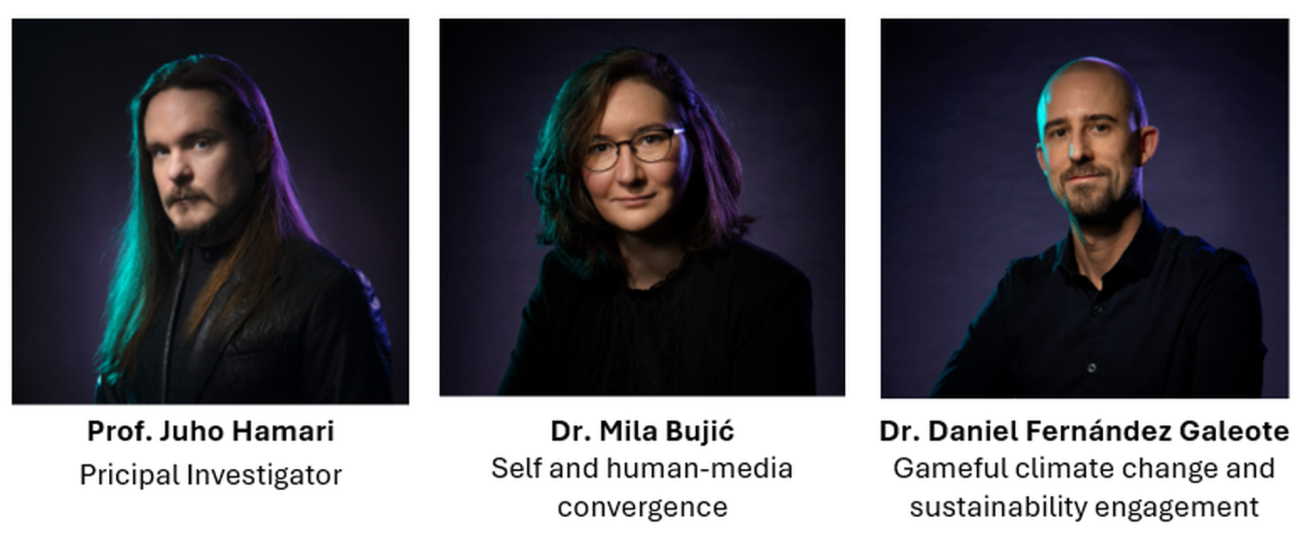
CLIMETA is based at Tampere University's Gameful Realities research centre and its Gamification Group. The research centre explores the potential of gamification, interactive technologies, and immersive environments to influence individuals and society.
The project brings together perspectives from virtual reality, cognition, and human behaviour. In the long term, it aims to advance the development of technologies and methods that help people understand complex issues, reflect on their own thinking, and take action towards a more sustainable future.
Further information:


