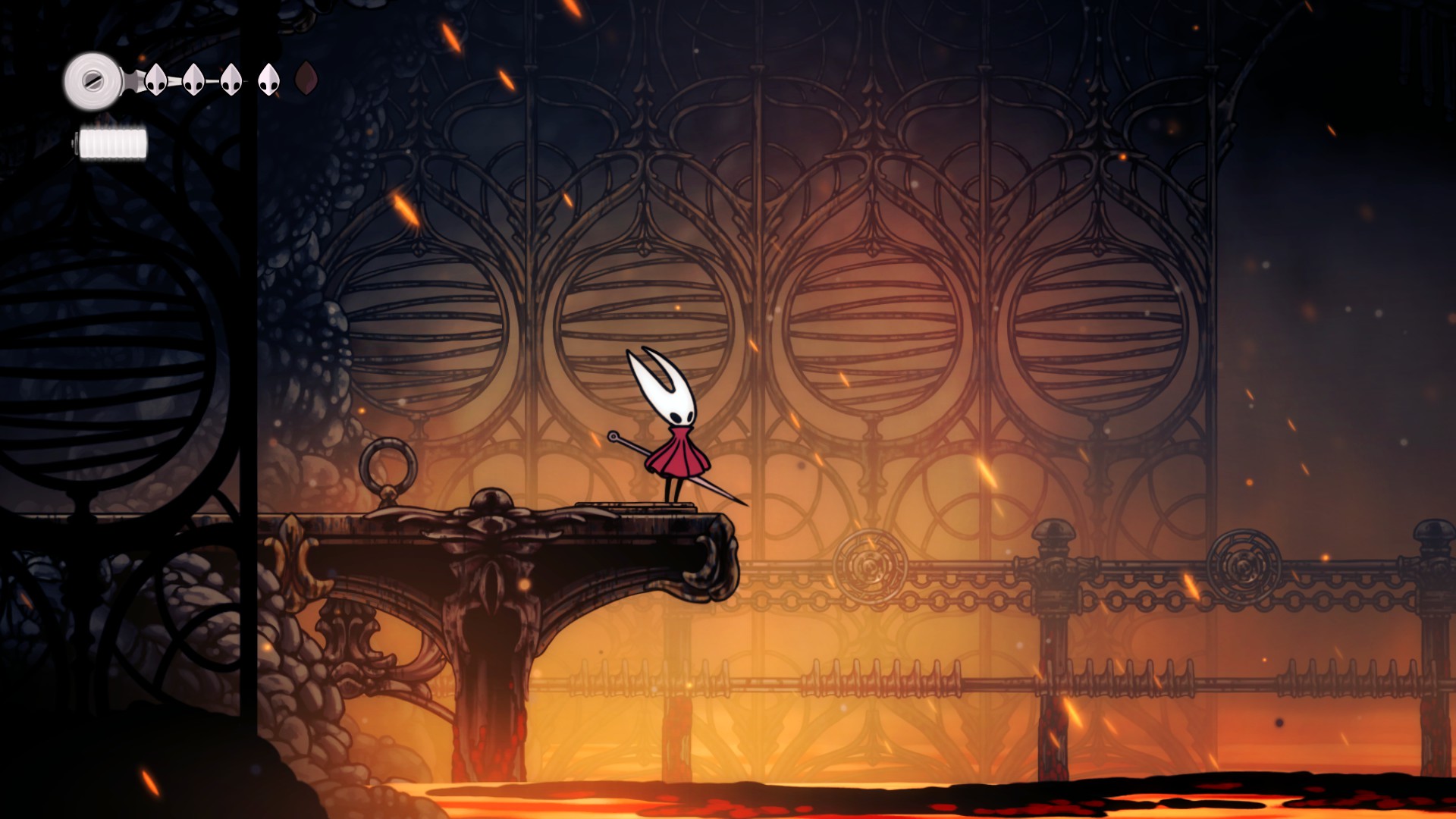
In the six years following the 2019 announcement of Hollow Knight: Silksong, Team Cherry’s follow-up to the highly acclaimed 2017 insect-themed, soulslike-metroidvania Hollow Knight, the game (or continual absence thereof) has become something of a phenomenon. Between the years-long radio silence and the eventual reveal that Team Cherry took so long because they simply enjoyed making the game too much, it’s fair to say that no one else is doing it like them. The result is an experience defined in part by the grandiosity of the team’s ever-growing vision: a game that is larger, more polished, more detailed, and certainly more difficult than Hollow Knight. Compared to the launch of its predecessor, the number of eyes on Team Cherry’s work has likewise ballooned. But even if Silksong is now on everybody’s radar, does that mean that everybody should play it?
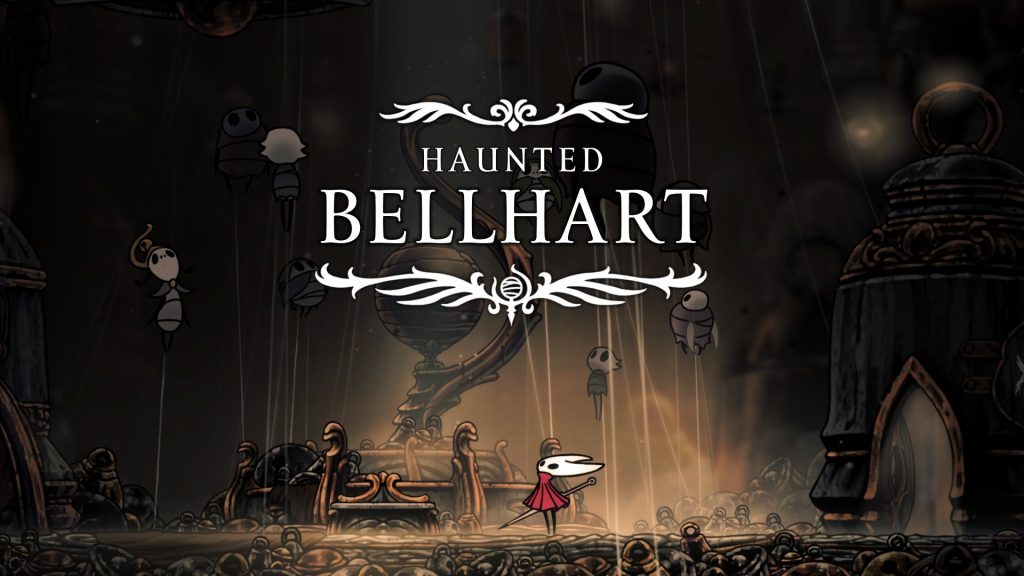
Silksong follows Hornet, a prominent side character in Hollow Knight, as she is kidnapped by unknown bugs and taken to the crumbling, haunted kingdom of Pharloom. Her quest to discover her own place in the mystery leads her, alongside Pharloom’s desperate pilgrims, on a winding journey towards the object of everyone’s hopes and dreams: the Citadel of Song, regarded as a beacon of hope in a desolate and dangerous land. (Of course, this shining city is not as it seems.) Though much more upfront and straightforward than Hollow Knight’s cryptic plot, Silksong’s story is no less intriguing—or moving. The narrative is supported not only by the wonderful character voice of Hornet, a fun addition to a franchise that previously starred a voiceless protagonist, but also the beautiful and detailed world.
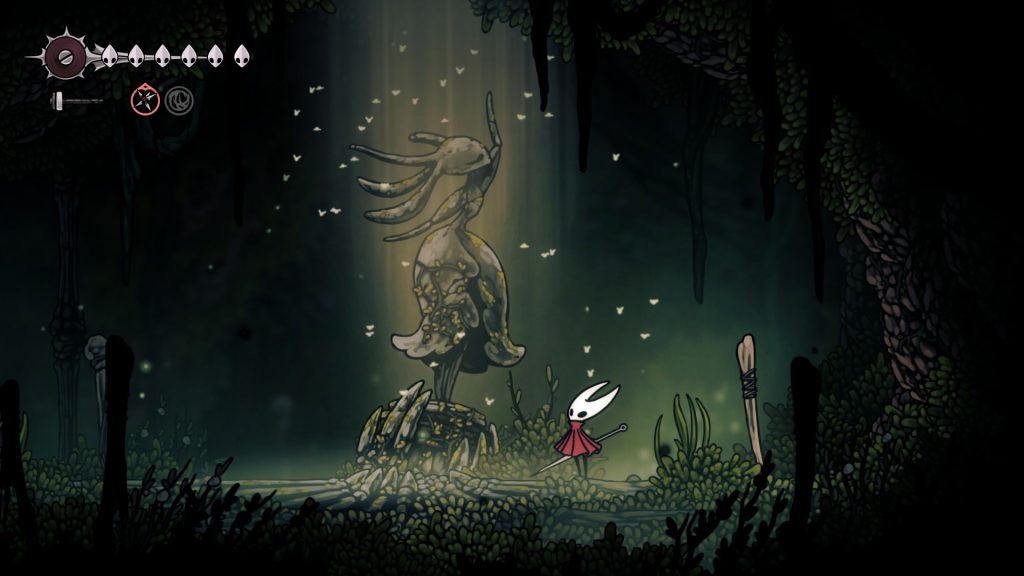
This strong sense of atmosphere is one of the many standout features that Silksong carries over from Hollow Knight. Though its early areas do not grip you with the same deep sense of place and history felt from the beginning of Hollow Knight, it more than makes up for this in the midgame with the highs and lows of the central Citadel: a towering, multifaceted structure whose cultural and social complexities form a significant part of the plot.
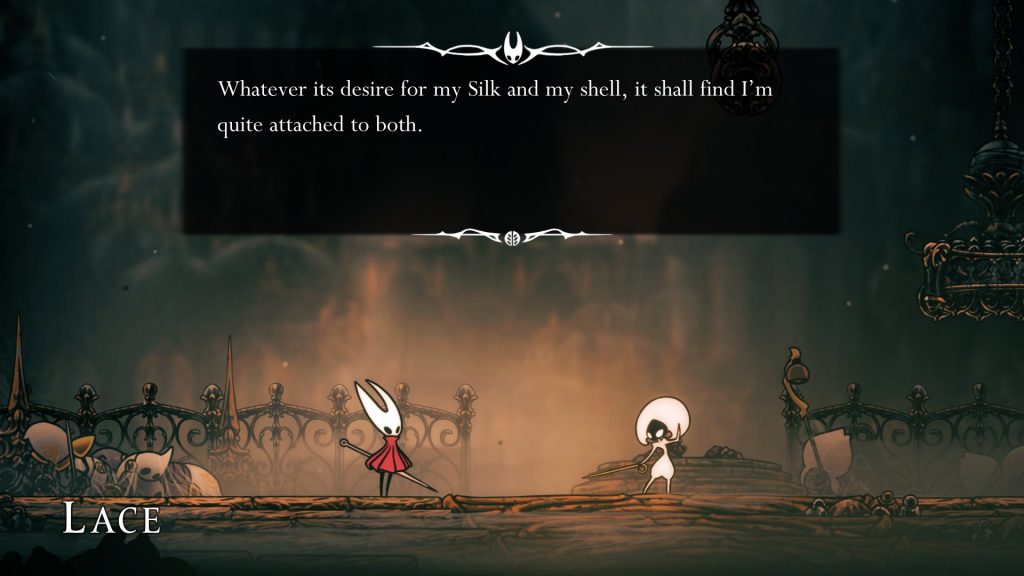
This is not to say that Silksong’s opening chapter is uneventful. As it slowly eases you into its story, the world becomes ever more aesthetically diverse, moving from gloomy moors to caverns of luscious greenery to lava-flooded mines. Systems unique to Silksong also spice up the early game: new healing mechanics open up exciting new gameplay rhythms, while adapting to the scarce in-game currency and frightening amounts of double damage requires patience and caution.
By far the best improvement from Hollow Knight is the way that Hornet moves. Even in the early game it is satisfying to see her pull herself up onto ledges; by the time you’ve got five movement abilities under your belt (including some fun new ones not seen in Hollow Knight), everything from boss fights to simply wandering around the map becomes an opportunity for constant parkour. Hornet controls so tightly and fluidly that you won’t want to stand still. It is no surprise that the game’s strongest segments are its platforming challenges, and the game’s best bosses are those that force you to perfect your airborne control.
As in other soulslikes, boss fights in Silksong continually demand perfect play. Silksong limits the player’s ability to “cheese” bosses relative to the first game, creating experiences that require not brute force but a careful dance. A comparable leap in quality is the difference between the spread of bosses in Dark Souls and Dark Souls III—DS3’s required bosses are on the whole more refined, but also harder, making them more rewarding but also making it easier to burn out if that’s all you’re doing. Fortunately, Silksong almost always offers an alternate path if you’re not feeling the main progression: especially in the midgame, the possibilities for exploration feel endless.
This high level of polish is not the only part of Silksong reflective of its protracted development. In some ways, you can kind of tell it was made by a handful of people who shut themselves in a room and didn’t look at any other game released since 2017. Long, tedious runs from savepoints back to boss arenas—long a despised mainstay of the Souls series—make a return from Hollow Knight as easily the worst aspect of Silksong. FromSoftware themselves seem to have learned their lesson in Elden Ring, in which a new mechanic mitigates the worst parts of runbacks, but Team Cherry have made no such quality-of-life changes in their latest release. Do they want you to push past and overcome this frustration? Do they hate you and want you to suffer? Does Team Cherry’s William Pellen just not realize that soulslikes as a genre have advanced since that one time he played a “fair bit” of Dark Souls?
Team Cherry’s somewhat-charming, somewhat-frustrating refusal to examine how other recent games have pushed the soulslike and metroidvania genres in new, interesting directions might mean that Silksong rarely feels like it’s treading new ground, but it also keeps the game from falling into the same pitfalls as, for example, Moon Studios’ 2020 sequel Ori and the Will of the Wisps, an Ori game that does not feel like it wants to be an Ori game. In its quest to become “the perfect metroidvania”, Will of the Wisps studied and assimilated concepts from many recent entries in the genre (including, arguably, Hollow Knight itself), diluting its own unique identity. Silksong does no such thing. Silksong, for better or for worse, is a Hollow Knight game to its core.
You can’t attribute every annoying decision made in Silksong to a disinterest in innovation or player-friendly design, however. Like all the best soulslikes, there are moments when the game unfurls, with what I can only call gleeful malice, just how far it is willing to go to hurt its players. It is in these moments—not the moments when the savepoint is just a bit too far away from a key boss, but those where you feel ensnared by the workings of a master troll—that my frustration turns to a begrudging respect. Would a flow- and player-retention-obsessed AAA exec approve that one boss who makes you fight a whole enemy gauntlet before the main guy appears? Like FromSoftware’s catalog, Silksong calls for a special level of perseverance, though it affords the player more limited opportunities to completely change their playstyle than a typical Souls game. Silksong is for players who want to slowly work to gain mastery over a game system that challenges them not only with pure artistry, but also with sheer obstinacy.
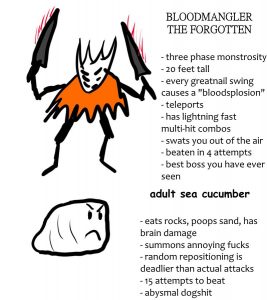
But when you do finally gain that mastery, Silksong feels magical. Everything clicks. You are rewarded for exploring every nook and cranny, for testing every new item and tool, even if its use isn’t immediately obvious. What at first seem like insurmountable challenges can be studied or reframed—and when in doubt, you can, as is often the optimal Souls strategy, ask your friends what approaches they recommend. (Once you get to Act 2, please do ask someone where to find the second damage upgrade. It will change your life.)
Of course, as with any soulslike, this type of challenge isn’t for everyone. Though I now often name Hollow Knight as my favorite game, when I first picked it up, the punishing difficulty and the vagueness of the objectives made me rage-quit a few hours in. Despite this, it’s a game with many diverse points of appeal and one I would recommend to a wide swath of players. Silksong is a slightly trickier sell. Its plot stands on its own without any required knowledge from the first game, but, as the difficulty curve rewards familiarity with Hollow Knight’s mechanics, I would recommend picking up Silksong only after beating its predecessor.
Overall, Silksong remixes, perfects, and refines the Hollow Knight formula, not into something entirely different and unexpected but something that still feels fresh and interesting. But as I work my way through the challenges necessary to complete Silksong’s true ending, I think about playing Hollow Knight for the first time in 2018: knowing nearly nothing about it and being drawn into greater depths than I’d ever imagined. For all its technical mastery, Silksong could never surpass that. I suspected this would be the case as soon as it was announced. I am a person who has been thoroughly shaped by Hollow Knight; of course such a faithful, soulful sequel could not recreate that experience of something entirely new. But I am happy to say that the wait has nevertheless delivered something exciting, engrossing, and beautiful.
Hollow Knight: Silksong
Publisher/Developer: Team Cherry
Platforms: Windows, Mac, Linux, Switch/Switch 2, Xbox One/X/S, PlayStation 4/5
Release Date: September 4 2025
Genres: Metroidvania, soulslike
PEGI: 7
All screenshots taken by author.