The peer-reviewed article “Top Shelf Drinks, Bottom Line Play: Examining Representations of Class in Bartending and Mixology Games” by Scott Dejong and Courtney Blamey published in the fifth issue of Games and Culture (vol. 18), examines representations of class in games with drink making themes and mechanics by discussing how labor is presented and embedded in digital games. With the aspect of class labor as a dominant theme of game characters and the role the player takes, the authors argue that the ties to creative work, poverty and uncertainty change (DeJon & Blamey 2023). With a focus on creativity in the role of the mixologist, the reality of labor related to the job of preparing drinks and the economic hardships get obstructed. This relates to the comparison of the two labor tropes the authors present – the bartender on the one hand and the mixologist on the other. While both are situated in the service industry, the romanticization of the mixologists’ creative labor does not represent the reality of economic uncertainty.
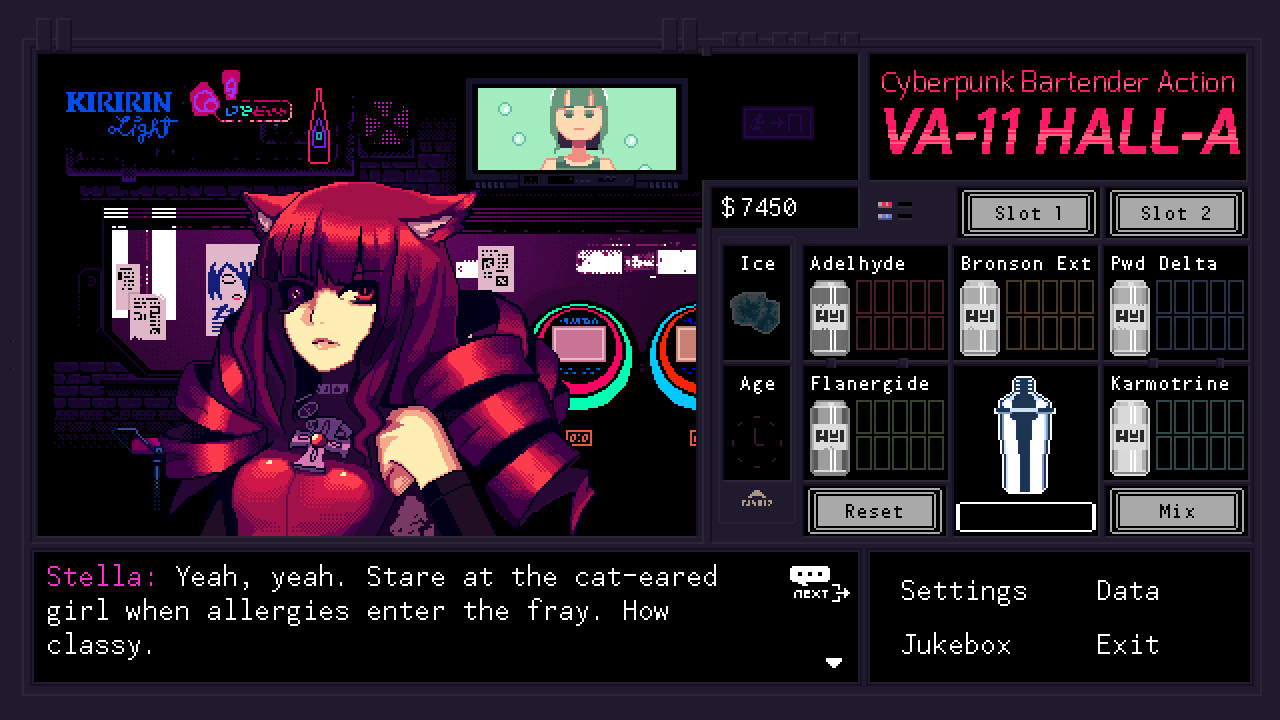
Based on examined examples, the authors illustrate how game narratives include shifts from inside and outside of the bar as a working space. While some games explore topics such as employment safety, paying bills, and stress, others do not directly deal with them but can be read through game mechanics and the distinction of menial tasks and creative work. The chosen titles for their analysis are: Tapper (1983), Bartender The Right Mix (2005), VA-11 Hall-A (2016, c.f. article banner picture), and Red Strings Club (2018).
The study itself is focusing on the labor elements of digital drink making and serving games and how their displays “influence a game’s understanding of social class.” (DeJon & Blamey 2023). Different games either showcase the distinctions of labor and their ties to economic uncertainty or they conceal them. Through their intriguing argumentation and visualization, the authors direct their results towards further research “on representations of working-class labor.” (Dejon & Blamey 2023).
Finally, the research builds on established concepts of precarity, class-labor, and videogames. The applied methods of the article follow a mixed methods approach of game analysis and content analysis. Their initial sample size narrowed down from 37 games based on game descriptions to four selected previously mentioned titles that work well in a comparative approach which prevents an isolated view on the selected games.
Basic information:
Games and Culture: A Journal of Interactive Media is an international journal that publishes innovative theoretical and empirical research about games and culture within interactive media. The journal serves as a premiere outlet for ground-breaking work in the field of game studies.
Reference:
DeJong, S., Blamey, C. (2023). Top Shelf Drinks, Bottom Line Play: Examining Representations of Class in Bartending and Mixology Games. Games and Culture, 18(5), 622-642. https://doi-org.libproxy.tuni.fi/10.1177/15554120221119962.
Picture credit:
Banner: VA-11 Hall-A: Cyberpunk Bartender Action (Promotional material: Steam store page)