How many problems can games solve? With serious games and gamification, the discussion of games has at times turned from ”games are ruining the youth” into ”games might heal the world”. Mental health is one of the areas looking for gamified solutions.
Game academia has often explored this interesting concept. In a semi-recent study, the researchers developed a game to investigate gameplay elements that help mental health literacy – a skill that is helpful whether one is personally suffering, or meeting and supporting people that do.
In Finland, the power of games in increasing mental health literacy has not gone unnoticed either. Koala Ryhmä is a mental health activism group for young adults that runs in Helsinki. It approaches the topic in diverse ways, from events to social media activism to…. Game activism.
I interviewed Koala’s Operational Manager and Coordinator, Venla, and Supervisor, Sinna, (both have more detailed introduction in Finnish in here), who have been tightly tied to the process of both creating and then playing and seeing being played the games that aid mental health literacy.
With both the theory and the practice, it is time to dive in and find out if gamified solutions are a wish fulfillment fever dream or if they really can increase mental health literacy, how they do it, and how they work in practice in Finland.
Games for mental health literacy
As part of their 2024 study, Anvari, Hammer and Wehbe created a game to research whether mental health literacy can be improved with a serious game. Short answer: Yes, it can.
They developed a game called ”Pet Project”that combined mixed reality with mechanics inspired by other mental health related serious games. The game was played combining big display and users’ mobile phones, and it included minigames that raised the participants’ awareness on mental health. Completion of minigames awarded snowballs, and week culminated in a snowball fight on a big display.
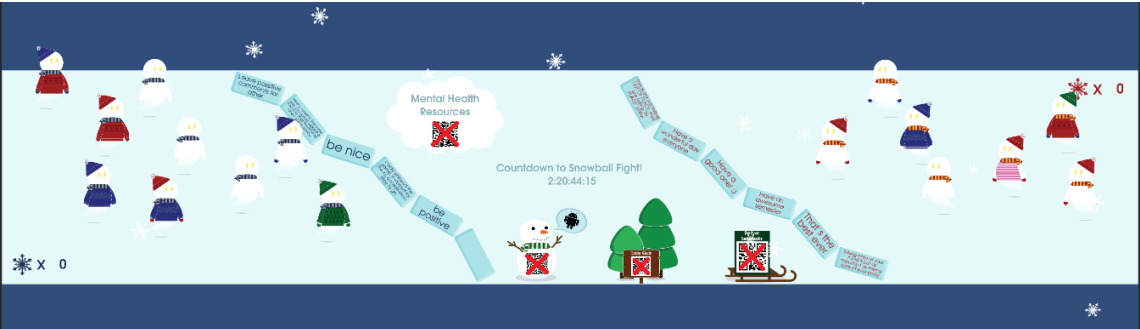
The results were promising – the participants both enjoyed the game and felt more informed about mental health subjects. Some elements that were helpful were creating opportunities for attachment – by having a customizable player character, for example – being captivating, which meant different techniques for boosting engagement, and finding ways to design for collaboration, not competition.
Various methods were employed, from tracking digital engagement with the game, to observing the players, to in-app Survey and qualitative interviews.
Game activism in Finland: Koalan Korttipeli
This was then seen in a study. But what about practice – what about these kind of games in Finland?
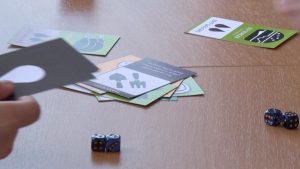
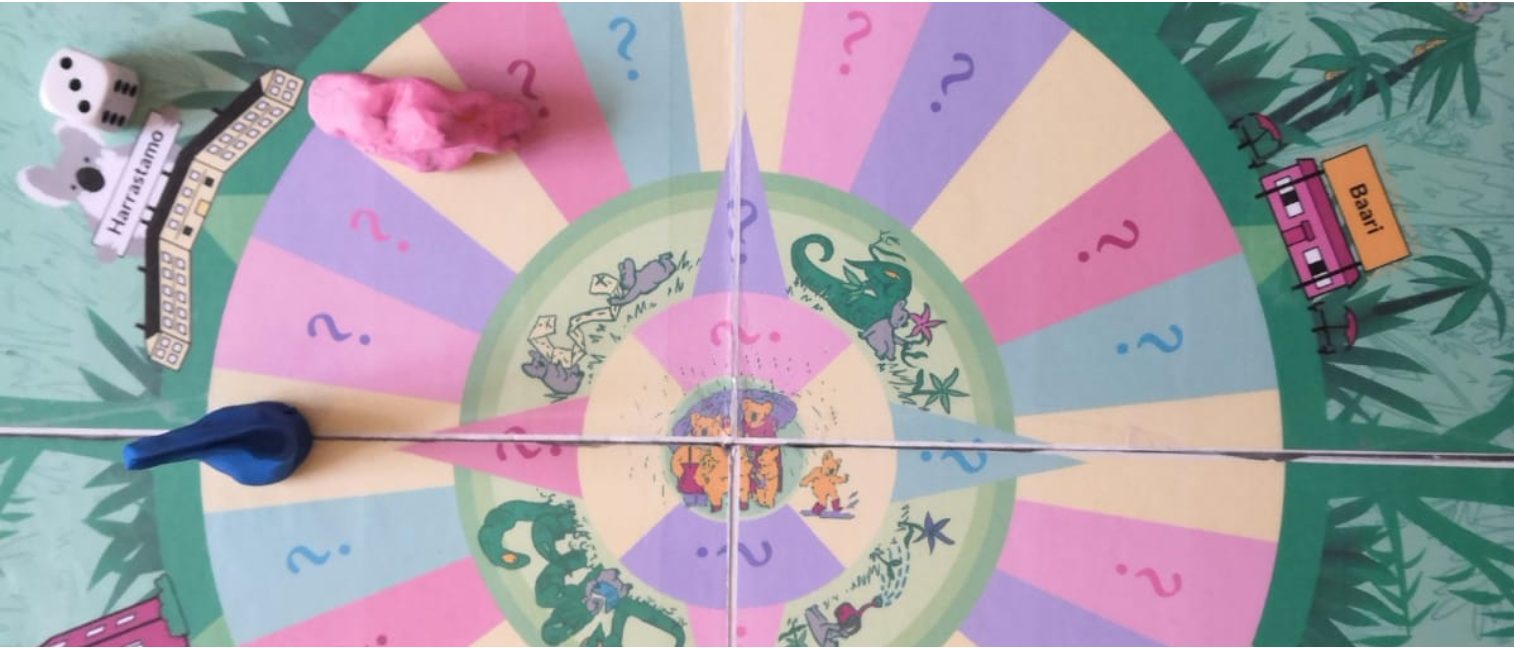
Koala-ryhmä has a card game, simply titled ”Koalan korttipeli”. In this card game, players get to collaborate to solve problems for their characters, create stories, and discuss struggles and solutions tied to mental health. It’s as much for other people to understand someone struggling with mental health as for people who do.
”The game activism idea in Koala Ryhmä started with wanting to raise awareness and discussion about mental health related things in many different ways”, Sinna tells me. ”Idea was that even someone without personally experiencing mental health struggles could, through the card game, understand the experiences of someone in mental health rehabilitation.”
”Adding empathy and understanding”, adds Venla.
In the card game, people create their characters in a character sheet, resembling DnD and tying back to the study where the importance of character customisation was ntoed. This brought humour and added distance: ”You create yourself a character so it’s not you who is experiencing the situations from situation cards, but it could be a three-headed wizard who is experiencing them instead”, Sinna says.
The game is played by picking cards from different piles and compiling them into a story. It is played together: On their turn, a player will pick up a card, read it to everyone, and then solution to the situation will be brainstormed together.
The game has three different card types: Situation cards, experience cards, and solution cards. There are six different types of situation cards, with categories such as leaving home, running errands, social situations, studies and career life, outdoor activities and hobbies. To play the game, one would pick one situation card, and two experience and solution cards. Then they choose one of each. Based on this, a story will be built, it could be an individual story for each round or continuous one.
In one particular game, the situation was ”Your hobby group has kept you active, and supported your mental health. Summer break is here, and somehow you have to survive the summer without group meetings.”
”The options for ’experience’ were ’my social battery is full’ and ’it feels as if someone is following me’, and I picked ’my social battery is full”, Venla says. ”The solutions were ’AI’ or ’panic’. I chose AI, and the chain of thought was that ’alright, actually I am quite tired and my social battery is full so I can talk to AI when I’m in the need of company [in-game].”
”Yes, those fit together quite well”, Sinna says. ”Sometimes they don’t… Sometimes you have to use quite a lot of imagination, and it’s quite ok, you don’t always have to be exactly realistic in the game.”
Often, to warm the group up, the facilitator will go first. When played, The card game tends to spark a lot of conversations, some silly, some going deep. ”In one game we discovered that when solution was always avoidance, that lead to loneliness”, Venla says about a game that inspired particularly deep conversation
In Koala, designing and creating the game is just as important as the end result and end users. The card game has had multiple iterations. ”The hardest thing is always to decide that okay, now the game is ready, now we no longer take any new comments.”
Similar to Pet Project, collaboration is an important part of the game. ”We play the game together and can help each other out, and there is not really one winner”, says Venla.
Games for change
So… can games heal the world?
Probably not completely. But it seems that they can help people come together and talk about things, and understand each other better. Which is a win in my books.
Research paper:
Anvari, S. S., Hammer, J., & Wehbe, R. R. (2024). “More than just a game, it’s an app that builds awareness around Mental Health”: Mental Health Stigma Reduction Using Games for Change. Proceedings of the ACM on Human-Computer Interaction, 8(CHI PLAY), Article 325. https://doi.org/10.1145/3677090
Koala ryhmä’s webpage:
https://www.koalaryhma.fi/