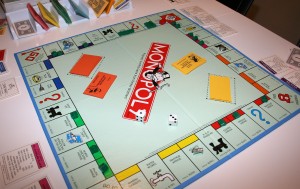
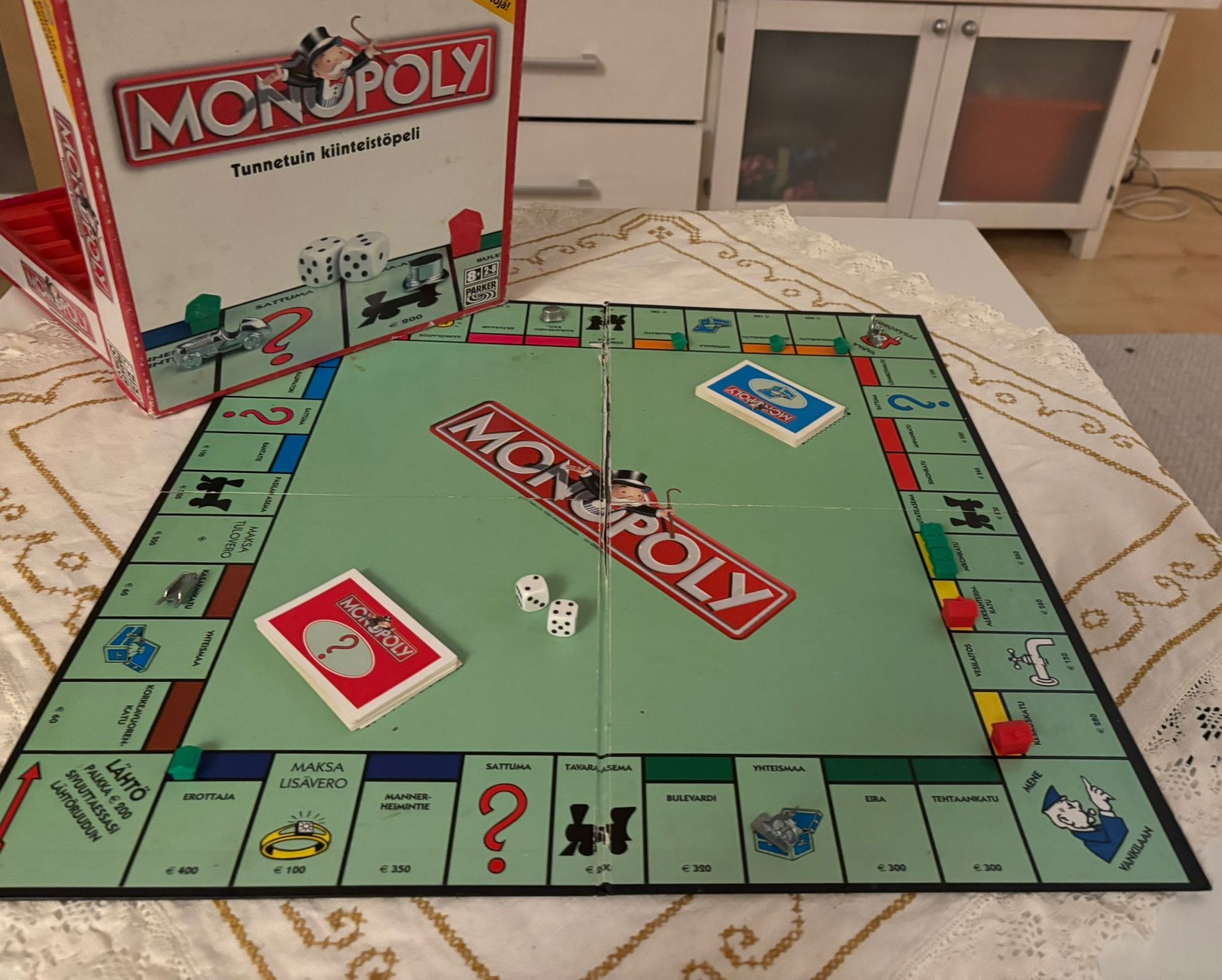
Monopoly (1935), the best known economics-themed game, was originally called ”The Landlord’s Game”, and created to be an educational tool that warns about the dangers of privately owned land. Ironically, it became a hit within our capitalist society. Many different variants have been produced and sold, and today Monopoly is the best-selling board game. Perhaps nomen est omen, because the game itself was not designed for entertaining gameplay, and it usually is fun only for the one winner. But, as the capitalist princess Taylor Swift once said: So it goes.
In Monopoly, players throw dice to go around the game board and buy, sell and trade properties.
When a player arrives on a property, they can buy it or put it to auction. When a player owns a property, other players have to pay them when in the property. Once a player has the whole set of certain type of property, they can start building houses and hotels, which further raise the cost of visiting the property. There are also train roads and utilities (cannot be built on, but the more a player owns, the more other players have to pay them when they visit), and random events where a player wins or loses money, as well as jail that prohibits the play for certain number of turns. The game ends when everyone but one player is bankrupt.
The player experience of Monopoly simulates how capitalism feels for both sides. The winning player often feels compulsion to expand and make more money, as well as the pride and pleasure that comes with it. The rest of the players often feel dread and frustration as their already low resources keep depleting. For the winning person, the game only gets easier, and for people losing, the game only gets harder – after certain point in-game, there are no good ways for the tides to turn. This is not too far off from real world, where it takes money to make money.
Monopoly, while arguably an accurate simulation, is rarely considered to be a well-designed game. When I was studying game design there were always some first years who tried to take on Monopoly and improve it. All of this to say: No one wanted to play Monopoly anymore, so I got Furnace for Christmas some years ago.
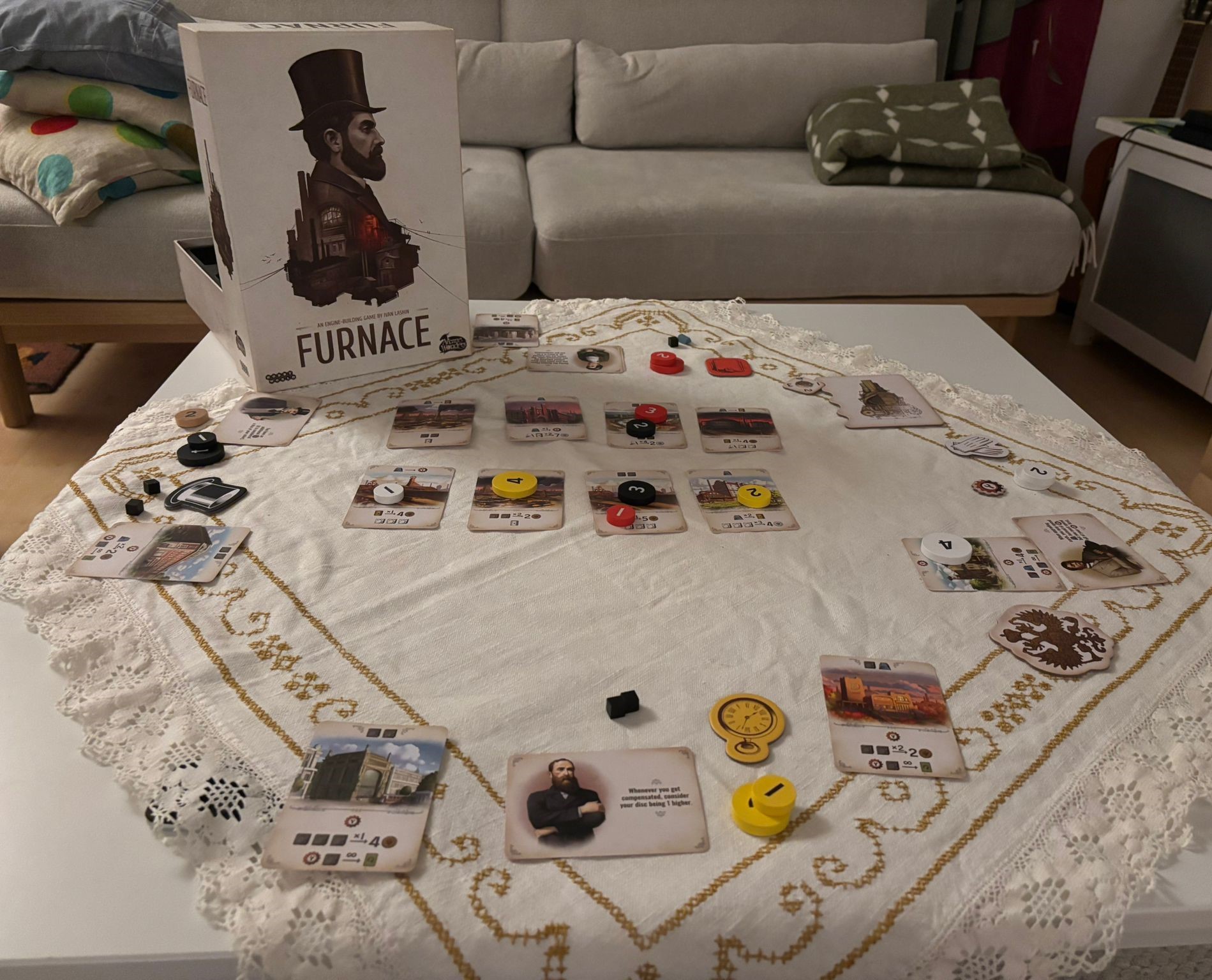
Furnace (2020) is another capitalism themed game. In it, players take on roles of 19th century capitalists: They build their industrial corporations and aspire to make as much money as possible by purchasing companies, extracting resources and processing them in the most optimal combinations. There are two phases in the game: Auction and production. In auction phase, players bid on available factories. Losing the bid is sometimes strategically sound, as this results in ”compensation” – which means that the player who lost the bid gets resources right away. In production phase, the actions in the factories activate. Some give you resources, some help you process them into different ones, some help you upgrade your factories, and others turn resources into money. These two phases in this order are considered one game round. After four rounds, the game ends and the player with the most money wins.
Furnace differs from Monopoly in how it presents capitalism and the philosophies underpinning it. As a result, it is more enjoyable as a game. In Monopoly, winning is about taking from others. In Furnace, it is about building the most effective production cycle. The rules are relatively fair: Unlike in Monopoly, winning or losing is down to skill rather than luck.
In this way, Furnace is more about the ideal of capitalism than its reality. One thing about it is realistic though: The game distances you from the implications (you’re processing oil and coal in industrial, polluting factories) and makes you think of numbers and profit only. Nonetheless it makes capitalism look like something you achieve with your own logic and strategy. It doesn’t imply taking from others to maximize your winnings.
This of course makes Furnace more enjoyable in its gameplay experience for every player and engaging throughout entirety of play. Makes sense: It was designed for gameplay, not realistic simulation of capitalism. Also, who is to say that this wasn’t what capitalism felt like to capitalists at the time?
While capitalism is embedded in all our culture and games, board games that are specifically capitalism-themed help to understand, simulate and articulate it. These games can also easily be modded by players to experiment with different, potentially fairer systems.
Genuine question: If games like these can accurately simulate capitalistic systems and emotions they inspire, could a game accurately simulate other ways to organize a society? What would it look like?
Monopoly
Designer: Based on The Landlord’s Game by Lizzie Magie; Artwork by Charles Darrow
Published: 1935
Genre: Board game
Age: 8+
Players: 2-8
Playing time: 60-240 min
Furnace
Designer: Ivan Lashin; Artwork by Egor Zharkov, Ilya Konovalov, Marta Ivanova, Oleg Yurkov, Sergey Dulin, Vadim Poluboyarov
Published: 2020, 2021
Genre: Board game
Age: 12+
Players: 2-4
Playing time: 30-60 min
Pictures of the games are taken by the author.