
Iron Lung (2022), with its single-room setting, minimalist controls, and hour-long play-time, is a game that would feel right at home among the free, experimental horror experiences headlining the front page of itch.io. The film Iron Lung (2026) just made $22 million (against a $3M budget) in its opening weekend. Though this isn’t the first time a viral indie game hit has become a box office success, otherwise comparable adaptations—like Five Nights at Freddy’s, which also began as a tiny, simplistic horror game—had years and years to build up a multimedia franchise and a large, passionate fanbase. So what’s different about Iron Lung?
Why this film?
YouTuber Markiplier (aka Mark Fischbach), an enormously popular letsplayer with a reputation for playing and reacting to indie horror games (such as, indeed, Five Nights at Freddy’s), first played Iron Lung when it released in 2022. A year later, he announced that he was adapting it into a film. Though surprising to some, this wasn’t Markiplier’s first foray into acting; for example, he starred in the 2024 horror miniseries The Edge of Sleep. But Iron Lung—which features Markiplier as director, writer, editor, and lead actor, among other things—is his first feature film. Markiplier’s other projects and commitments meant that he couldn’t work on it full-time; in all, the film took three years to make. David Szymanski, the game’s developer, was part of the production team, and game composer Andrew Hulshult (who did the soundtrack for Szymanski’s game Dusk) scored the film.
Iron Lung had nearly no marketing budget. Instead, it was Markiplier’s close relationship with his fans that brought in viewers. The original plan had the film showing in only a handful of theaters, but fan hype grew the numbers: one source reported 50-100 theaters, then a thousand across the US, and then over four thousand worldwide, including eight in Finland. Much of this momentum came from fans calling their local indie theaters and requesting the movie, with some even making scripts to help each other call. Despite this overwhelming and unprecedented popularity, Markiplier has kept the film independent and not signed any deals with distribution studios. If Iron Lung has a physical release, he says he wants to burn all the Blu-rays himself.
Why this game?
In an interview with Deadline, Markiplier explained that the film was part of his quest to be “taken seriously” as a creator: a “bridge” between his regular job as a game streamer and his ultimate goal of working in film. Iron Lung was a small, contained, and manageable idea that would teach him more about filmmaking. It’s also part of a larger effort to topple the “stigma” against YouTubers moving into other creative fields.
In the game Iron Lung, you play as an investigator trapped inside a collapsing submarine (the titular Iron Lung) navigating the floor of an alien ocean made of blood. The objective: photographing certain points of interest with the grainy sub camera. The main source of tension—and with it, much of the horror—comes from the way this vessel moves. With no windows, no visual sense of your location, and only a blurry map, you must propel the submarine across the ocean floor by cross-referencing your coordinates and sending yourself blindly in a direction, praying that your beeping proximity indicator will warn you of any walls before you crash into them. It is the sort of deeply physical experience that only a video game can offer. Add to this the excellent minimalist sound design, a handful of well-placed jumpscares, and some truly freaky camera images, and you can get a picture of why Iron Lung was a hit upon release. It commits entirely to its simple premise and delivers a legitimately scary, stressful experience.
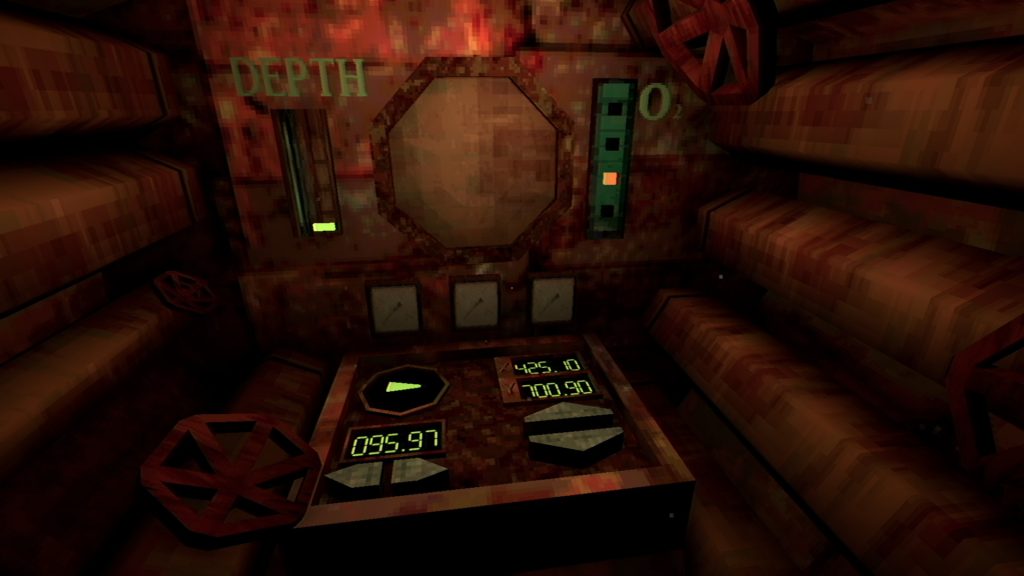
Iron Lung the movie is considerably less scary. Instead, unable thanks to its new medium to capitalize on the stress of potential failure, it leans into a more psychological atmosphere. The oppressive, claustrophobic submarine becomes the site of a character drama more suited to the cinematic: though not able to maintain and maneuver the vessel ourselves, we feel the weight of these things on Markiplier’s protagonist. Some exciting breaks from reality and a touch of (perhaps heavy-handed) cosmic horror complete the experience, expanding on the minimalism of the game in a way that feels natural. The film succeeds in its project of adaptation because it understands and respects what it is like to play Iron Lung. We wait, we watch, we question the grainy photos on the wall, we second-guess everything we see. The slow pace of the film won’t be for everyone, but a faithful adaptation of the game could never have done anything else.
Markiplier gravitated towards Iron Lung as a game to adapt not because of the gameplay but because of the story. “There’s really a universe in here,” he explained: “There’s something to dig into.” Interestingly, I thought the clunky script and slightly-too-foregrounded attempts to introduce backstory and lore were some of the weakest parts of the film. But the universe—at least, the tiny universe of the submarine—feels real and tangible under Markiplier’s direction. Memorable sequences see him desperately use the camera’s flash as a light, pressing the button over and over, or fit himself into an awful little crawlspace not seen in the game. And of course, there is a reason why Iron Lung broke the record for amount of fake blood used in a film—80,000 gallons/300,000 L, to be exact.
Iron Lung (2026) was playing at Tampere’s Finnkino theater in Finlayson.
Screenshot taken by author from Iron Lung (2022). Header image is from ironlung.com.