
Mahjong is a popular Asian game that is still enjoyed a lot today, there are several variants of mahjong and this text will be covering the Japanese version known as riichi mahjong. Many people, myself included, were introduced to mahjong through games like the Yakuza series, where there are notoriously annoying-to-get completion metrics tied to it that have resulted in players needing to spend several hours playing mahjong for the games’ Completion Lists to achieve 100% completion. It was this 10+ hour completion experience in Yakuza 0 specifically that made me learn and eventually really enjoy mahjong, enough to buy a set for myself and kidnap a couple of friends to play so I can write about it.
When I first brought up the idea of forcing people to play mahjong my friends reacted with varying amounts of dread, but quickly came around on the whole thing after a brief two hours of cramming rules into their heads. Exaggeration aside they felt the game was fairly approachable and simple to learn the basics of, if a little obtuse due to all the terminology and me being a less-than-stellar teacher. For any direct quotes from the people I played with other than myself I will simply refer to them as Player 1 and Player 2
Basic rules
Mahjong is a game played with tiles consisting of three suits and so-called honour tiles which include winds and dragon tiles. The suits are pretty easy to read with the exception of one of them, man, being the Japanese kanji characters for numbers 1-9 and the mahjong set I bought not having numbers on them so everyone was forced to memorise those characters. Learning to read the man suit and wind tiles was generally the hardest part of learning the basics of the game.
The goal of the game is to be the first to complete a hand made up of 14 tiles, generally consisting of four three-tile sets and a pair. A pair is obviously two of the same tile, and the three-tile sets can consist of three identical tiles or any sequence of three numbers within the same suit, for example 123, 456, 789.
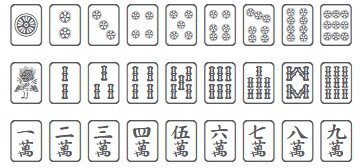
Top to bottom: Pin, Sou, Man
Left to right: Numbers from 1-9
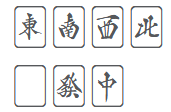
Top row depicting wind tiles from left to right: east, south, west, north
Bottom row depicting dragon tiles left to right: white, green, red
Setup and Game flow
Mahjong is ideally played with four players on a square table, still works fine with three but is a tad depressing with any less than that. The tiles are shuffled and every player makes a wall in front of themselves that is 17 tiles long and two tiles tall.
Players then draw tiles from the east side wall four tiles at a time starting with the player sitting on the east side, also called the dealer. Tiles are drawn until the dealer has 14 and everyone else has 13. A player’s turn starts by drawing one tile from the wall and ends when discarding a tile, players make discards depending on what tile they deem the least desirable for the hand that they’re trying to build, and most of the deeper learning process is knowing the myriad win conditions, as simply having a hand of three sets and a pair isn’t enough to win by itself.
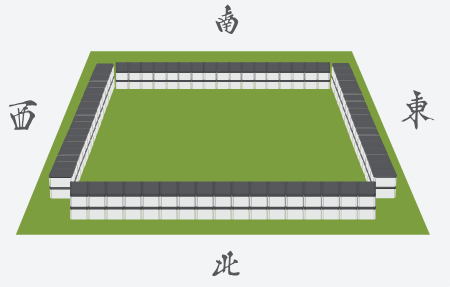
Picture: Wall setup before tiles have been distributed to players.
How to win
Now this is where it gets a little dubious and where most of the complexity lies, as there are tons of different hand formations and a lot of knowledge is required to know what is optimal to go for with the tiles you have. The win conditions for hands are called yaku in the Japanese version of the game, you can think of these a bit like hands in poker.
There are yaku of differing values and difficulties to achieve; the simple ones being examples like having a triplet of any dragon tile, your hand containing no terminal tiles (1 and 9 in any suit), or having a full straight of 1-9 in the same suit. Hands can contain multiple yaku, stacking the value of each yaku present to make the hand even stronger. Player 2 remarked that learning some basic yaku at the start is fairly simple, but it is easy to overcomplicate the game for yourself by trying to remember too much.
“The game opens up quite naturally when you begin learning the yaku, and is well designed in that the player with the most knowledge of the game usually wins. It does, however, require a lot of memorisation to know what to go for during a round.” Player 1
This brings us to yet another set of rules: the two different ways to win and stealing discarded tiles from other players. In mahjong you can win either by drawing the last tile you need from the wall (Tsumo), or by taking the tile you need from another player (Ron). Once a player wins, the value of the winning hand will be taken from the points of other players and given to the winner. The points are taken equally from all losing players in the case of Tsumo, and in the case of Ron the points will be deducted only from the player whose tile was taken to complete the winning hand.
During the game each player will be placing the tiles they discard in front of themselves face up for everyone to see, and immediately after a discard it is possible for another player to take that tile for themselves if it completes a set in their hand or is their winning tile. For triplets it is possible to take a tile from any player, while for sequences you can only take tiles from the player on your left.
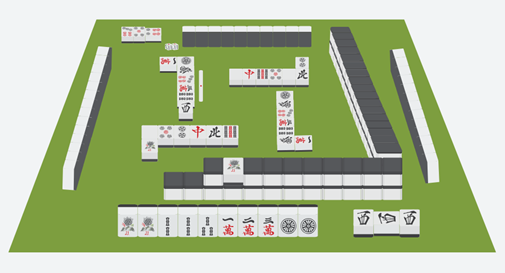
Picture: Example of how the table looks during play
A drawback of this is that taking a tile from another player will need you to reveal that part of your hand, locking in the three tile set the taken tile belongs to, and potentially decreasing its value for no longer being a fully concealed hand as well as disabling some yaku that require the hand to be concealed.
And that just about covers the basic concepts and game flow that goes into Japanese mahjong, it’s certainly more than the average card game and isn’t something you’d just whip out at any meeting as it is a fair bit of effort to set up and get the hang of, but doesn’t really require learning everything at once and makes for a satisfying experience when you start improving at the game.
“The game has a lot of the same feeling that makes card games addicting and fun, but also is complex enough that it did not get boring as quickly as card games would.” Player 2
Image source:
http://mahjong-europe.org/portal/images/docs/Riichi-rules-2016-EN.pdf