Clair Obscur: Expedition 33 is one of the most hyped game releases in a while, receiving high praise from just about everyone and winning most categories at The Game Awards in 2025. I am also a big fan of this game; I played it when it was released with no prior expectations and had a great time. But one thing bothered me: I had to actively keep myself from becoming too powerful and risking skipping major boss fights entirely due to them not keeping up with the potential power of the player. This is due to the game’s main build crafting mechanic: the Pictos and Lumina system.
How it works
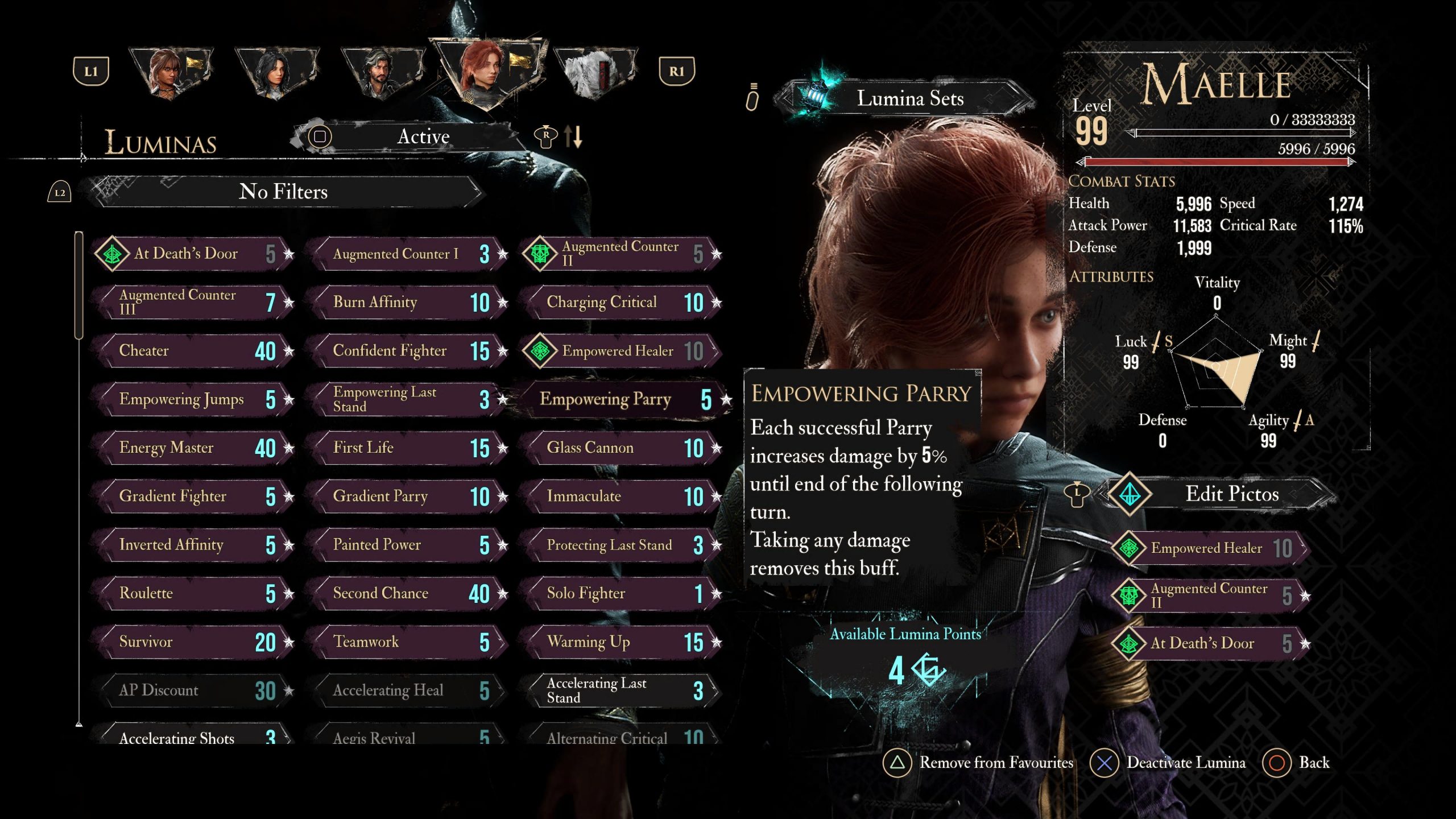
Pictos are items that can be equipped onto a character –up to a maximum of three per character– to gain all sorts of effects ranging from simple stat boosts and status effect resistances to more interesting ones like not being able to be healed but dealing 25% more damage. Once a Pictos has been equipped onto a character and used during enough combat encounters, it will be mastered and unlocked as a Lumina.

Luminas grant the same effect as the Pictos it came from, but rather than being limited to three per character, more of them can be equipped according to a point cost tied to each one and the character’s maximum available Lumina points. These effects can be stacked infinitely as long as you can afford them, and very little planning or strategy goes into picking 20 things that say “increased damage dealt” on them and equipping them to one shot the final boss of the game. A lot of effects do come with downsides for some attempt at balancing, but these hardly matter when enemies barely get a chance to attack in the first place.
Why I think this is a problem
Difficulty balance is one of the most important things to get right in a game in my opinion. If important fights during the story are too easy, they risk being forgettable or disappointing, and the gameplay quickly becomes stale if there is no need to adapt to new enemies and strategize accordingly. Rather than relying on having high enough numbers to survive like most other turn-based RPGs, Expedition 33’s combat is much more active and focused on parrying or dodging enemy attacks more akin to an action game. This is most of my reasoning for why being too powerful in this game kind of ruins it since enemies in a more skill-based combat system like this can provide very fun and unique challenges with their attacks and mechanics. Not to mention missing out on the game’s music and visual spectacle if everything is over before it starts.
It is a shame because the Pictos and Lumina systems can be a lot of fun to engage with to plan setups that synergize well, but it becomes a bit redundant when nothing in the game can provide a challenge after a point. Not even the hardest optional superbosses are immune to being simply defeated in one hit instead of requiring the player to interact with the unique challenges they present. This can result in the very beginning of the game being one of the hardest parts of it due to the limited options the player has to power themselves up. Granted, it does take a bit of effort to get some of the stronger Pictos to really start snapping the game in half, but if you’re the kind of player to explore games thoroughly and optimize your characters to be as strong as they can be, it is fairly easy to accomplish before the halfway point of the game.
The Balancing especially falls apart in the last third where a lot of new areas open up, most of which are higher level than the final story area and completely optional, making it very easy to become vastly more powerful than what the finale is balanced for if the player does just about any optional content. Updates have added options like challenge modifiers that allow players to toggle on HP multipliers for enemies or limit their own damage output as well as New Game+ existing to crank up the numbers even higher, but what matters most are the baseline stats that everything has on a first playthrough and those could stand to be higher for some things, maybe even adding level scaling for the finale to avoid it being a disappointment.
An update released shortly after The Game Awards did add several new endgame bosses which eclipse everything else in the game in difficulty and what they demand from the player, both in terms of character builds and skill. These encounters are finally somewhat balanced for how powerful the player can make themselves and really let the game’s combat and build crafting shine if one chooses to seriously attempt them.
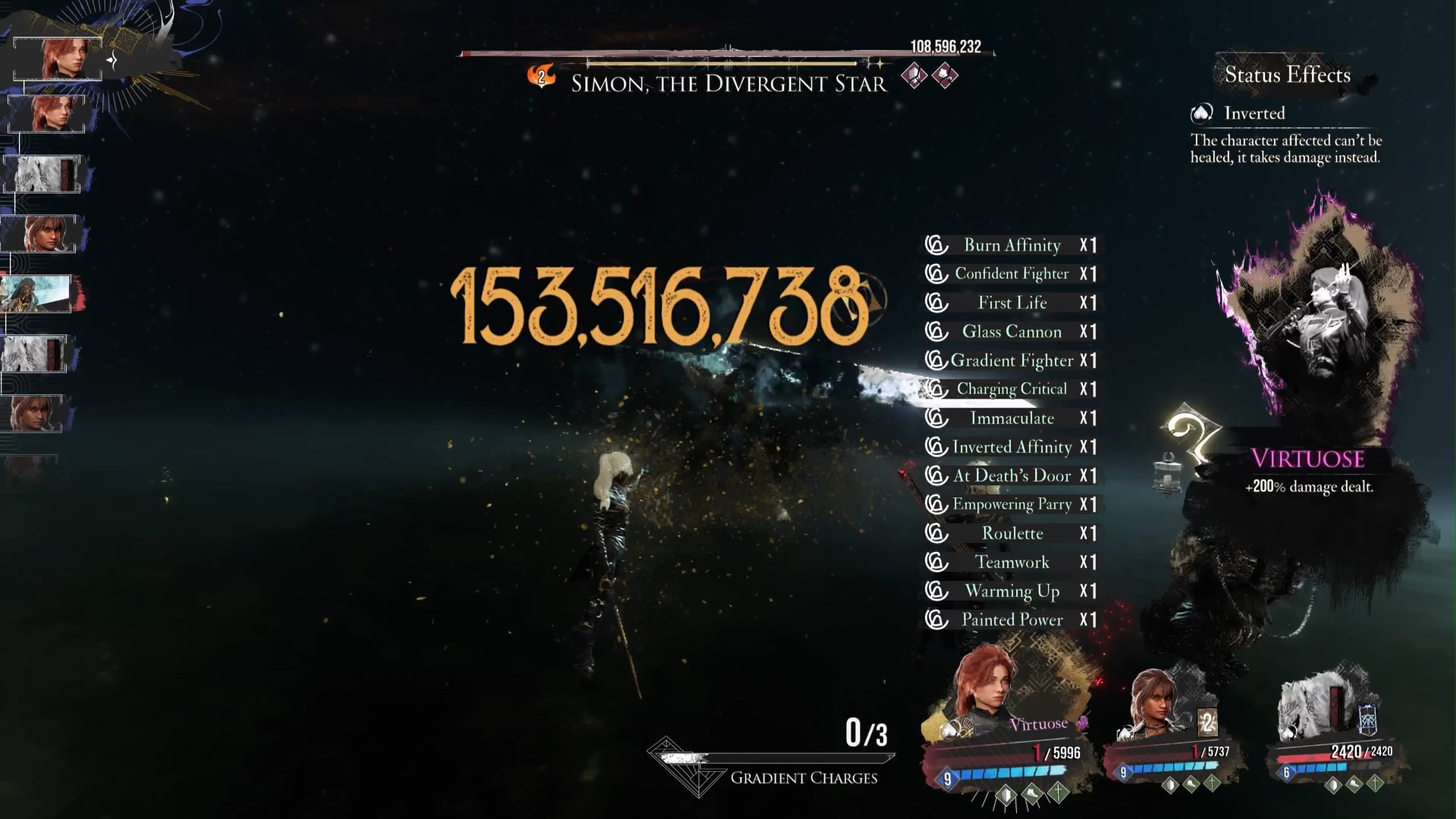
To put the numbers into perspective; the final boss of the game has between 400k-700k HP depending on the difficulty setting and the bosses added in the update have upwards of 200 million HP and can still be killed in a single hit if everything lines up properly, while the strongest opponent in the game prior to the update by far was a secret boss with 45 million HP, less than a quarter of what can reasonably be achieved.
In conclusion, I put a lot of importance on having a well-balanced experience in games and am not one to really enjoy breaking things. There’s nothing wrong with enjoying being overpowered but personally I prefer having the game’s enemies actually just kill me, rather than the challenge be trying to balance the game for myself so I can fully experience what it has to offer.
Screenshots by the author