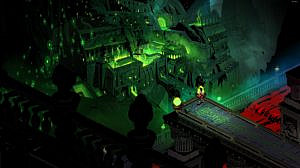
3 words begin both Hades 1 and 2: 3 words that set the tone for the rest of the game. In Hades, it’s “Good-bye father”. Main character Zagreus’ troubled relationship with his dad (God Of The Underworld Hades) is placed centre stage. As you keep losing and dying – landing, inescapably, back at his parents’ house – you start to get an idea exactly why he wants to escape this place. Gruff conversations with his father fill out what Zagreus is and isn’t allowed to talk about, and his frustrations feel palpable. As you improve at the game, you watch Zagreus mature, learning ways in which his father is himself hurt and damaged. You watch them work towards reconciliation, through fight after fight. Credits roll. I shed a little tear.
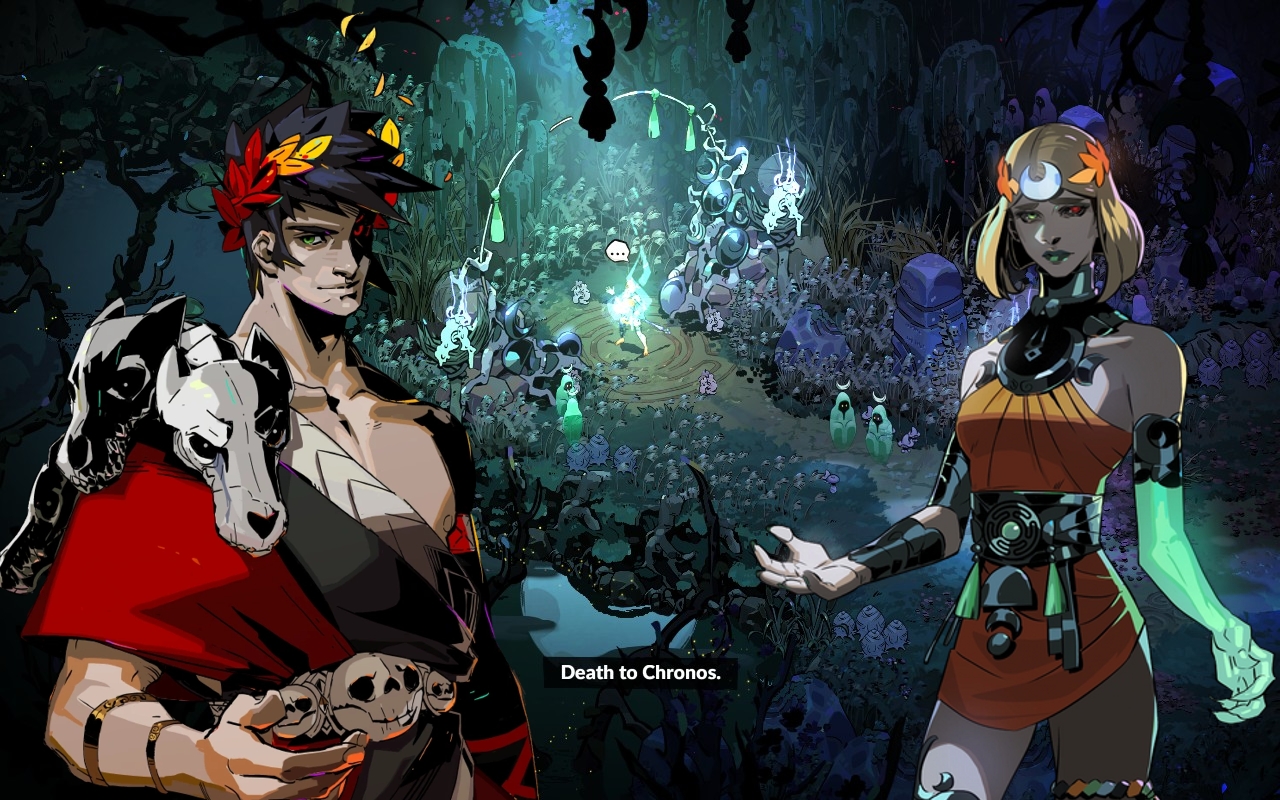
In Hades 2, it’s “Death to Chronos”. Uttered by the new protagonist Melinoë in a staunch hiss, it is a striking change in two ways. One is in its vagueness: who is “Chronos” to this character? Who is he to us? Zagreus’ words also raise questions (“Why am I leaving?”) but they’re tied clearly to his family. You can imagine a dad, even before you see him. A “Chronos” is a much more abstract concept.
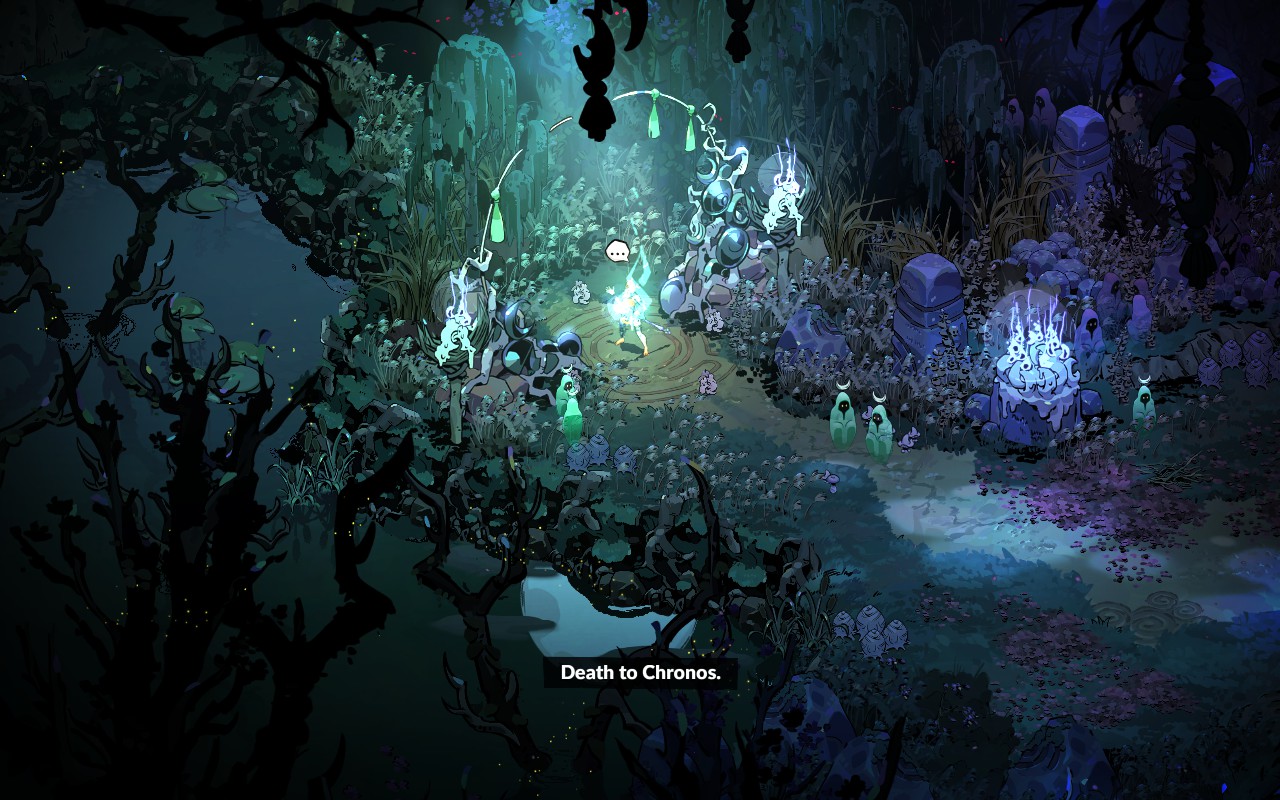
She said the line! She did it!!
The other change is in how violent it is. For someone who would slaughter thousands of undead spirits in a single run, Zagreus didn’t have this drive, this clarity of mind to wish for someone’s permanent death. He just wanted to leave home. Like how Zagreus’ words signalled a game about his relationship to his dad, we can see these words as a statement of intent. Hades 2 isn’t satisfied with merely being a tight family drama. It wants to be about something bigger. To that end, it has a protagonist dead set on killing someone we’ve never met.
And someone she’s never met. As with Hades, you gain answers to your initial questions. You learn that Melinoë was militantly raised from birth to perform this assassination in the war camp she calls home, by her foster mother Hecate. You learn that her family – including almost everyone you met in the first game – has been imprisoned by her estranged grandfather Chronos. He’s laying siege to Olympus and sits on Hades’ old throne. And you learn that Melinoë’s never interacted with anything outside this camp. She is sheltered to a tee.
Much of Melinoë’s interactions have her playing naive hall monitor to the rest of the cast: lecturing anyone who’ll listen about the importance of following Hecate’s rules, while expressing indignation at any hint that her higher ups (Hecate, the House of Hades, the Gods themselves) might have flaws. This feels rich: we’re talking about the Greek Gods here. Cursory knowledge of Zeus’ messy sex life aside, we spent most of Hades learning, precisely, what wasn’t working within the House of Hades!. The naivety is often played for laughs: Melinoë talks with such reverence over Hypnos (the incredibly irritating doorkeeper from the first game, here stuck in permanent slumber), and listens in awe as returning punching-bag Skelly spins a yarn of his great deeds as “General Schmelneus”. Playing as Melinoë means playing as a groomed holy warrior, one who exhibits some of the most irksome traits of a long-standing Kela bureaucrat. I just wanted to reach into the screen and shake her.
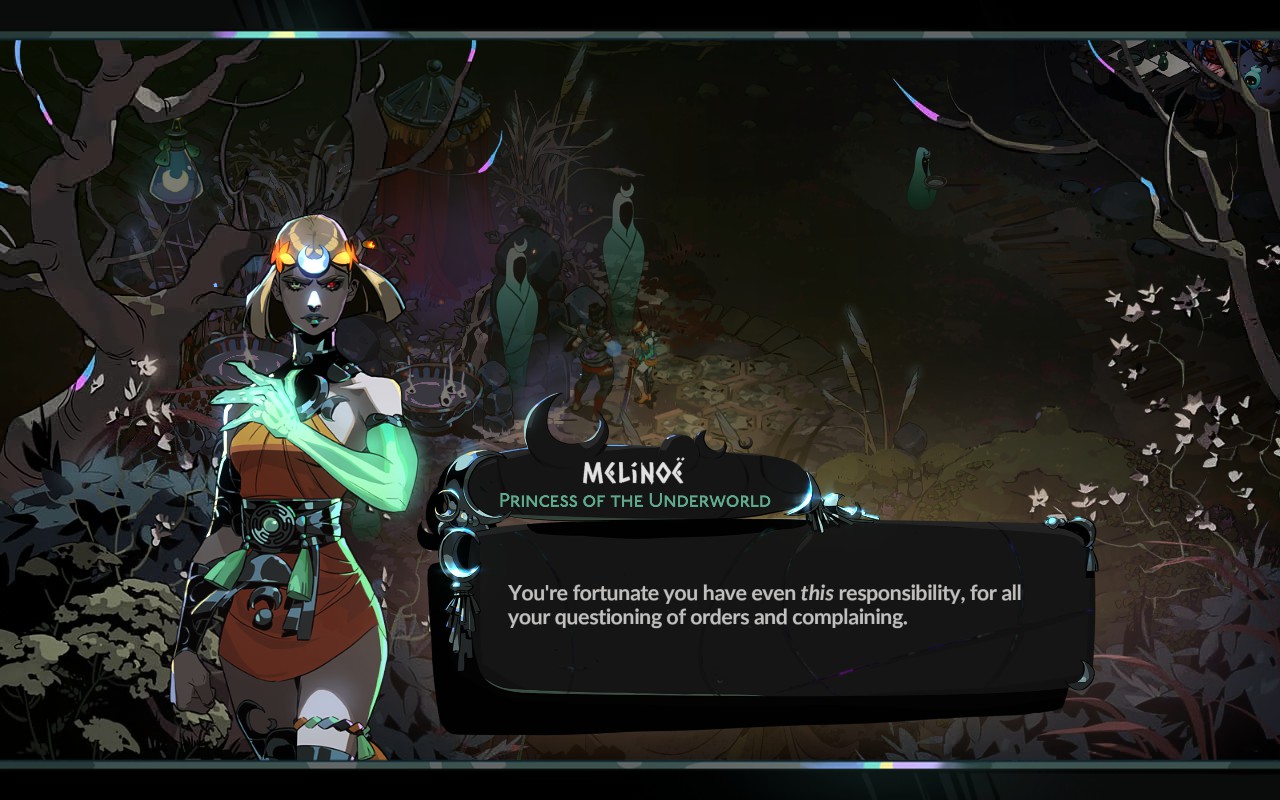
She does this a lot.
It is a strange sensation, embodying a character who fundamentally bothers you. Unlike simply observing a flawed character in a book or a film, I feel some agency over Melinoë’s actions: choosing how she achieves the goal I don’t want her to do. But Hades 2 is a linear game, thus I don’t have too many ways to express a formal complaint. I choose for Melinoë to romance her chaotic foil Eris, in the vain hope that it makes her loosen up. I could stop playing: although as my esteemed colleague Berk discovered in his review, this game is very hard to put down. Otherwise, I’m stuck waiting for the other shoe to drop, for Melinoë to realise how she’s been played. Surely the writers of the game about coming to terms with your parents aren’t just going to have their protagonist commit senicide?
The rest of this review will contain spoilers for the ending (s) of Hades 2. Stop here if you don’t want that!
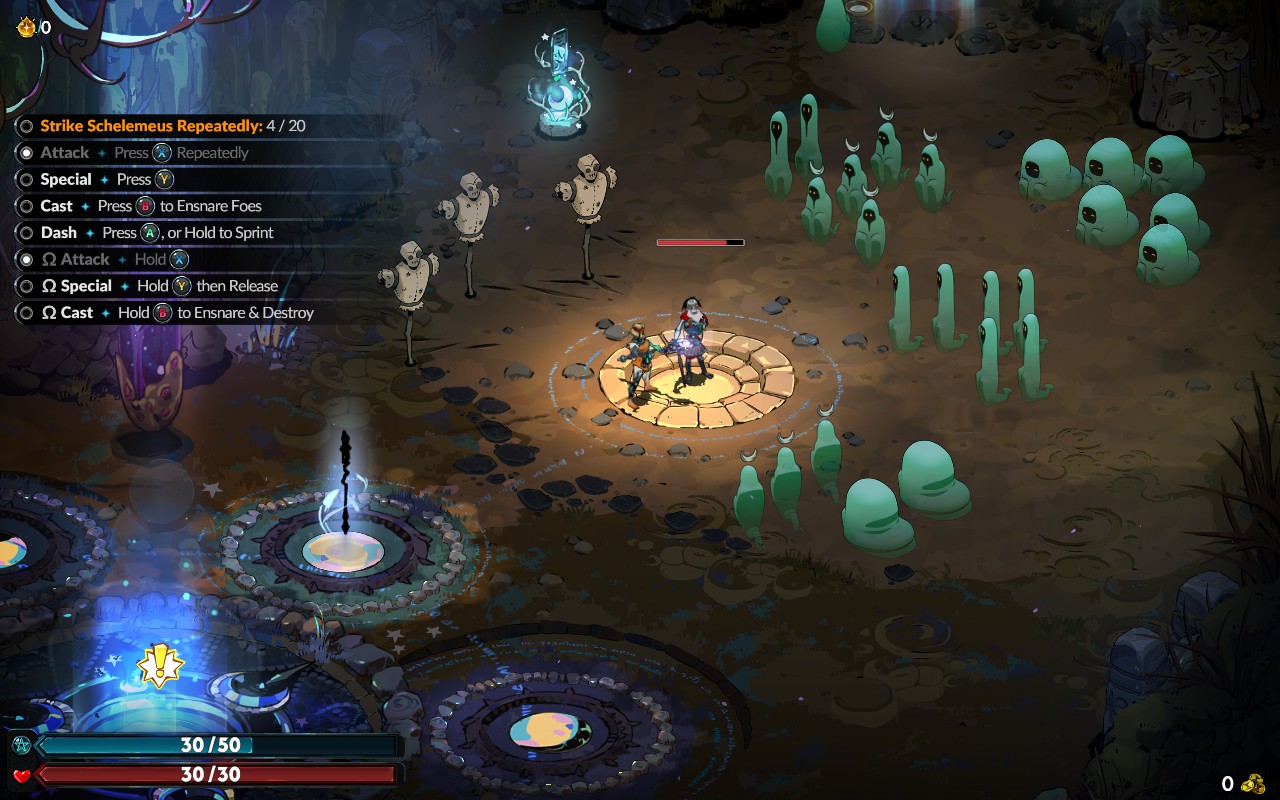
This Schmelneus lives to protect you, the reader from further spoilers. Remember to thank him.
She doesn’t. Of course she doesn’t., In the version of the game I played, each successful fight against Chronos ends with Melinoë performing time travel magic to communicate, briefly, with a Zagreus from before she was born. These were my favourite parts of the game, in part due to how much I realised I’d missed Zagreus, missed his wry cynicism and casual charm. These conversations provide the real pushback against Melinoë’s worldview, as she tries to convince Zagreus to assassinate Chronos in his time, while he expresses his reservations about killing a family member he’s never met before. The fourth time you beat Chronos, it comes to a head: Zagreus refuses to comply with this plan, and takes (understandable) offence to Melinoë’s attempts to lecture him about his own father. As I watched a dejected Melinoë respawn back at the camp, I’d never been more motivated to play another run. This was it. The catharsis I craved.
The next time you beat Chronos, Melinoë has changed her mind. She proposes that Zagreus instead try to befriend Chronos in his time, with killing as a backup plan. All the juicy angst, the moment of realisation I’d craved, effectively happened off screen. I felt immeasurably cheated. She keeps Hecate in the dark over this ploy, and so by the time the final ending does roll, she gets to be one of the chorus of voices confronting Hecate (who’s so close to finally killing Chronos herself). Melinoë has her cake and eats it too, undoing years of conditioning in a clean hour-long gameplay session. This was deeply unsatisfying.
Now, I said “in the version of the game I played”. For Hades 2’s ending was patched, due to mass outcry. I’d only played the new version. In the original ending, it is Zagreus who acts alone, befriending Chronos without letting Melinoë know. The ending confrontation has both Melinoë and Hecate confronting Zagreus and his father over what to do about a newly sympathetic Chronos. They argue that he’s performed horrible deeds. Zagreus and Hades tell them to stop maintaining a cycle of familial violence. Conversation over. An interminable amount of time passes while Melinoë helps the family (and good!Chronos) fix the house, and then when we next see her she’s entirely forgiven them.
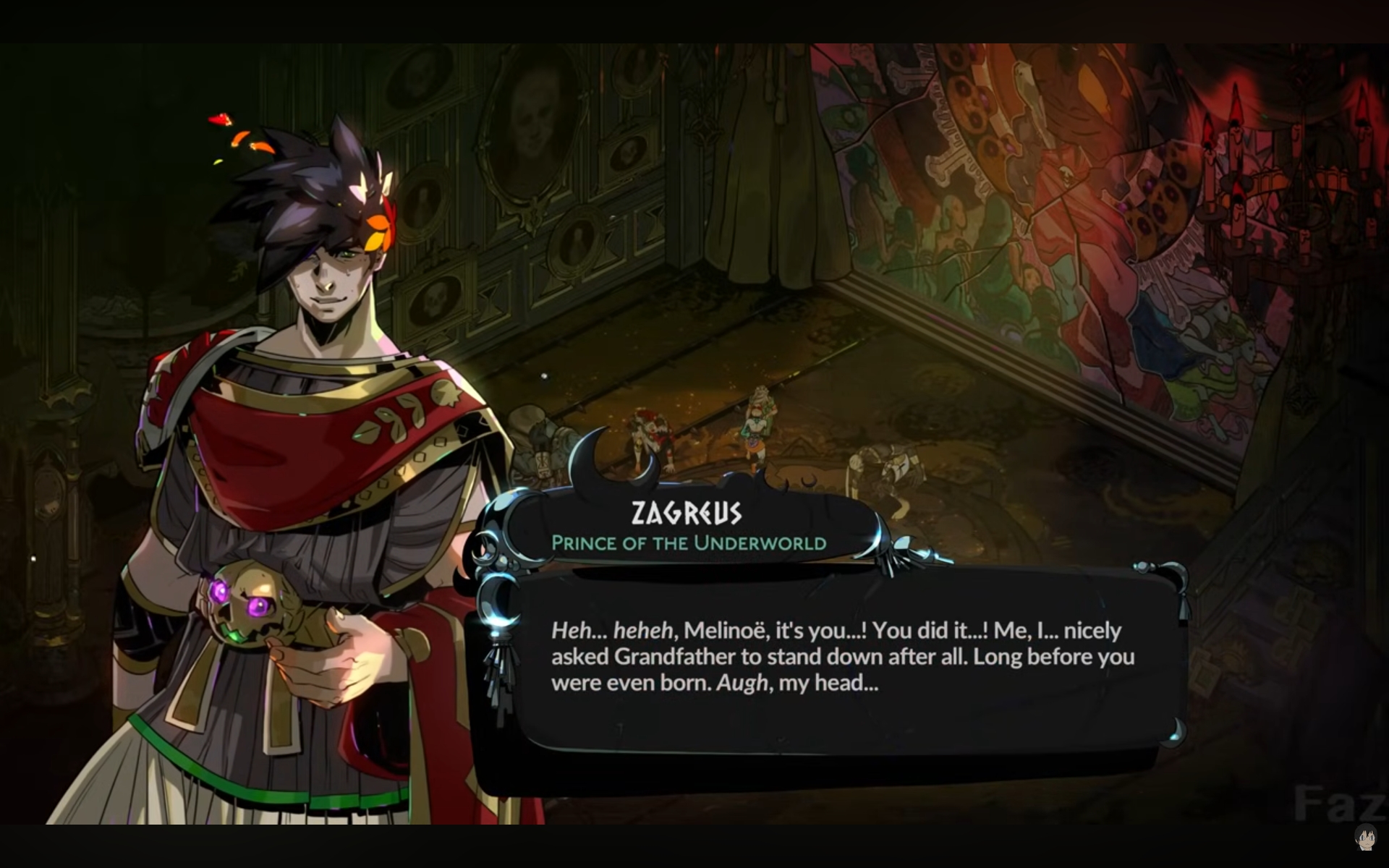
Here, in the original ending, Zagreus admits to his deception
I would love to write a fun take here, to argue that this earlier ending was better. Gamers simply didn’t get the artistic vision. You know the drill. But it’s a little more complicated than that. On paper, this original ending is more clearly About Something: Hades 2 is then a game about this brainwashed character failing at her task. One part of the outcry comes from people who liked Melinoë and wanted her to succeed. The character they play should be correct. They should win. In listening to this, in making Melinoë change her task last minute and still be Right, Supergiant diluted this aspect of their game. If this was the only complaint about the ending, it’d be a simple story about a company bowing to conservative pressure: to people with an insanely limiting view of what a protagonist should be.
But! To make this argument is to ignore what it’s actually like to experience the original ending. This pivotal confrontation – between the Wrong Melinoë and the Correct Zagreus – barely lasts more than a few lines. The catharsis I craved doesn’t hit: she’s simply overwhelmed and then changes her mind off screen. The shift is just moved to a timeskip. And indeed, having two sage men invalidate the main goal that your female protagonist has been trying to achieve in a few throwaway lines stinks, especially without a chance to make her argument well. The resolution feels abrupt in a way it doesn’t in the newer ending: there you’re at least given context, through Zagreus’ conversations and even some additional new Chronos lines. It’s a more competent ending, just one attached to a significantly messier game.
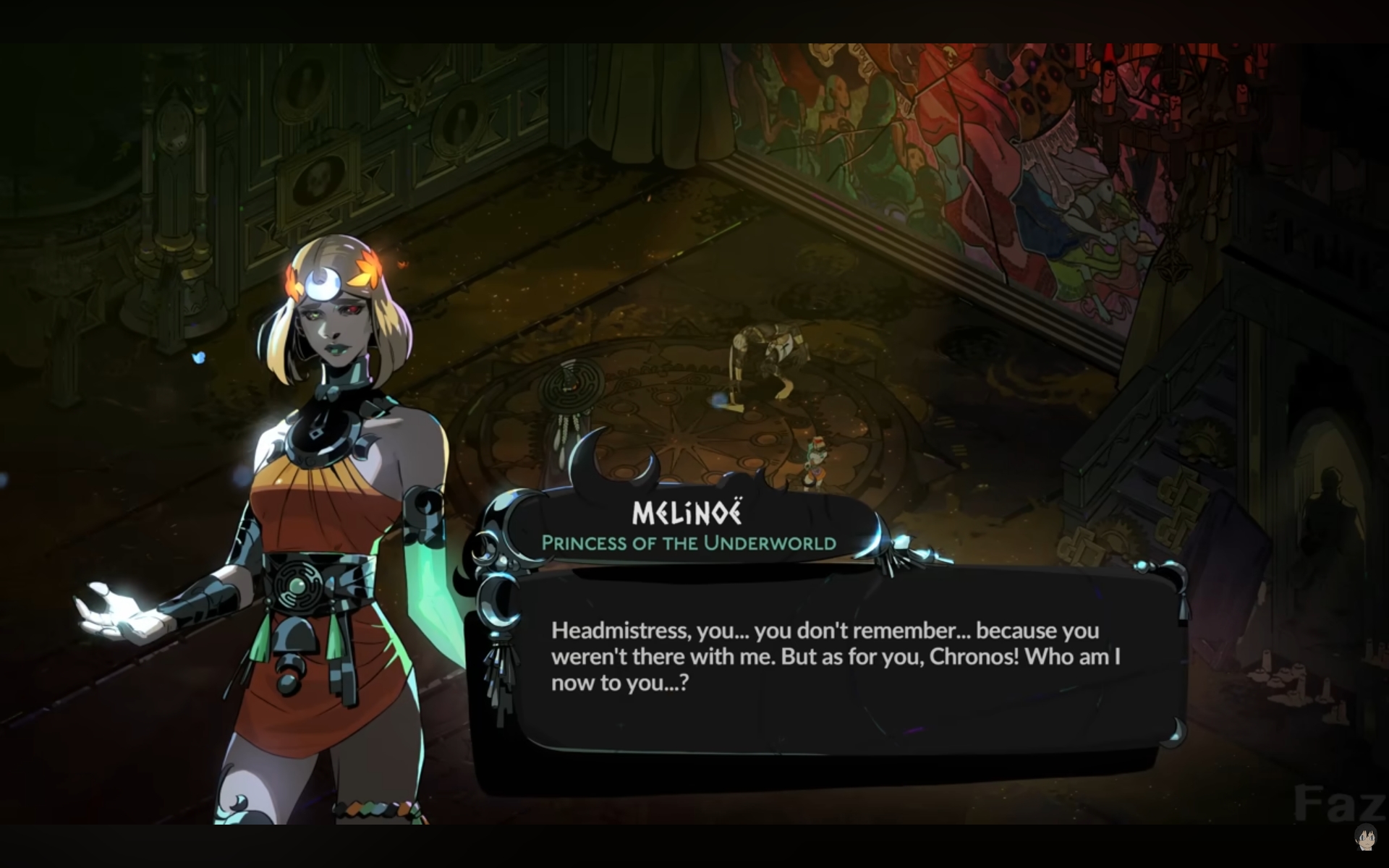
Here, in the new ending, Melinoë starts to explain her actions to an angry Hecate
You might notice that I’ve barely mentioned Chronos in this review. You know, the pivotal grandfather that Melinoë is trying to kill. This is not for a lack of screentime: he shows up in a variety of situations outside of the big boss fights: mainly to taunt Melinoë, or express his outrage at the progress she’s making. Little else. Contrasted with Hades’ treatment of Hades – where his facade is allowed to crack, where his and Zagreus’ relationship changes in complex ways throughout the game – he barely feels like a character. Similarly, Melinoë’s relationship with Hecate stays pretty much the same throughout. There’s a pattern here: this game is uninterested in its main character’s relationship to her family. All of the issues both endings face – a sense of abruptness, characters making bizarre-feeling decisions – are downstream from this.
Regardless of the ending, Hades 2 suffers from being the sequel to Hades: a game which was focused on one familial relationship to a fault. Zagreus was allowed to have a complex relationship to Hades, one outside of being entirely beholden to him or entirely opposing him. It is disappointing that Melinoë isn’t given the same courtesy.
All photos taken by the article’s author ASIDE FROM photos taken from the two endings. These are taken from two youtube videos by youtube user “Faz Faz”
Publisher: Supergiant Games
Developers: Supergiant Games
Platforms: Mac OS, Windows, Nintendo Switch, Nintendo Switch 2
Release Date: September 25, 2025
Genres: Roguelike, Action RPG
PEGI: 12