Kuukausittain järjestettävä tapahtuma, joka on avoin tutkijoille, opiskelijoille ja muille kiinnostuneille osallistujille. Seminaarin tavoitteena on edistää monitieteistä tutkimusta sekä esitellä ihmiskeskeisen tutkimuksen ajankohtaisia menetelmiä. Jokainen seminaari koostuu lyhyistä esityksistä, joissa esitellään eri NEXUS-laboratorioissa käytettäviä tutkimusmenetelmiä. Osallistuminen on mahdollista paikan päällä tai etänä.
Tulevat seminaarit:
Seminaari #3: Käytännön kokemukset laboratoriotutkimusten toteuttamisesta
Aika: Tiistai 24.11.2026 klo 14:00-16:00
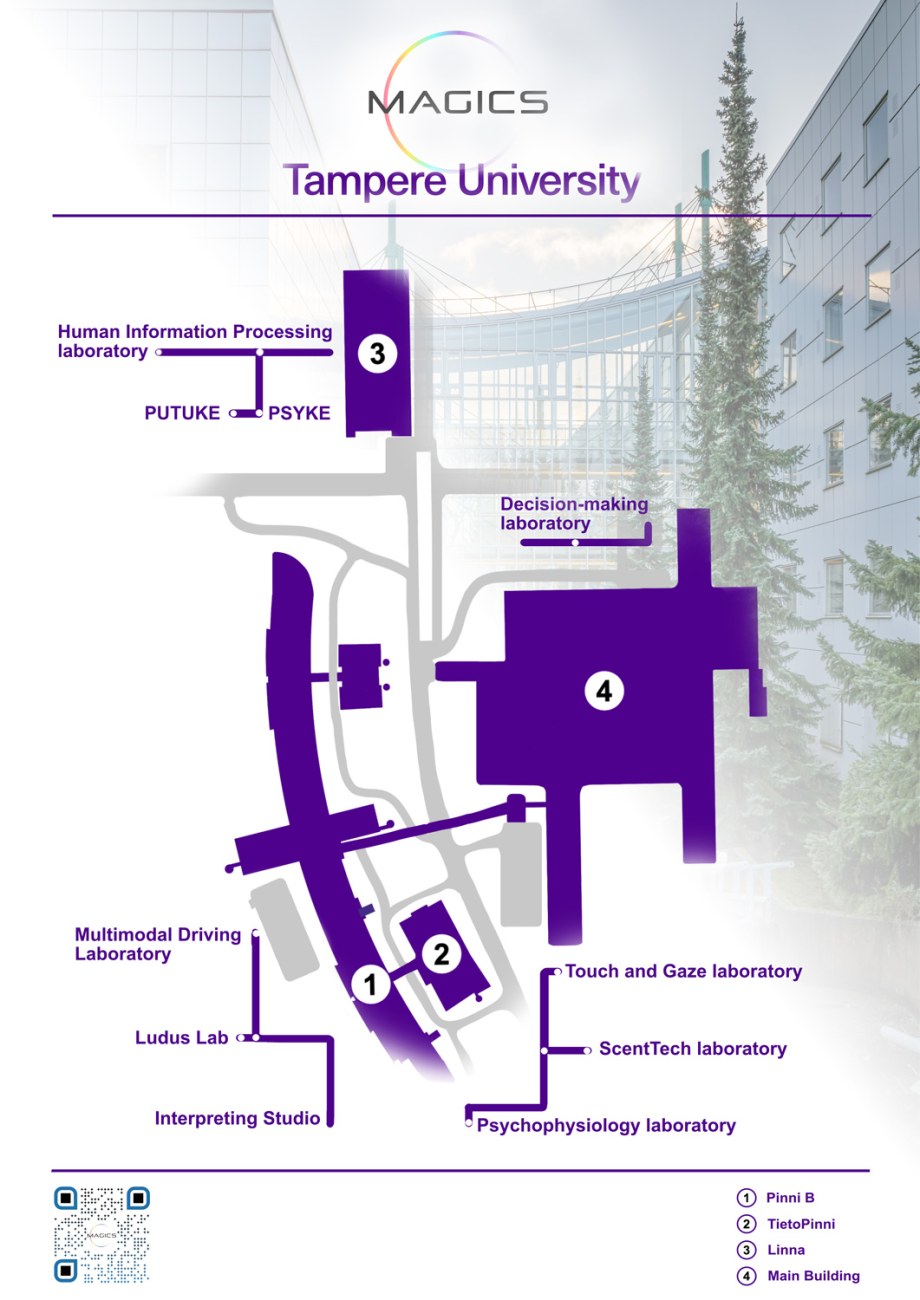
Paikka: TietoPinnin 4. kerroksen olohuone, Pinni B4168, Keskustakampus | Teams
Ilmoittautuminen:
Kannustamme osallistumaan seminaariin paikan päällä Pinni B4168:ssa. Jos osallistut seminaariin kampuksella, ole hyvä ja rekisteröidy etukäteen: NEXUS seminar registration (24.11.2026). Tämä auttaa meitä varaamaan sopivan määrän tarjoiluja.
Ohjelma:
14:00-14:15 | Jussi Rantala: Opening words & updates from NEXUS
14:15-14:30 | Chengyuan Li: Participant Recruitment at Tampere University
14:30-15:00 | Shivang Gupta & Xinyi Yang: Conducting VR Experiments
15:00-15:20 | Sebastiano Accardi: Integrating Physiological Measures with Psychometric Surveys
15:20-16:00 | Coffee & networking
Teeman esittely:
Laboratory experiments are a valuable research method for investigating how technologies, digital systems, and interactive artefacts influence human perceptions, experiences, and behaviours. By enabling researchers to manipulate experimental conditions and establish appropriate controls, laboratory experiments can strengthen internal validity and provide robust empirical evidence. They are widely used across disciplines, including such as human–computer interaction, information systems, business, behavioural economics, and psychology.
Despite their advantages, conducting laboratory experiments presents practical challenges, especially for early-career researchers. These include recruiting sufficient and appropriate participants, designing and implementing experimental procedures, managing technical setups, and collecting reliable data. Experiments involving immersive and interactive technologies introduce additional considerations related to usability, technological interaction, equipment configuration, and research ethics.
In this seminar, researchers from the XR Economies Lab within the Research Centre of Gameful Realities will share practical insights from research projects involving sensory VR, video, and streaming. Drawing on studies involving more than 500 participants, they will share practical insights into key aspects of laboratory experimentation, including participant recruitment at Tampere University, the design and implementation of between-subjects experiments, and the integration of self-reported psychometric surveys with physiological measures (e.g., EEG, eye tracking, GSR, and heart rate) to capture responses and processes that participants may not explicitly report. Using examples from experiments conducted with equipment such as haptic gloves and head-mounted displays (HMDs), as well as research environments including the XR Economies Lab and the Ludus laboratory, the speakers will highlight practical challenges and lessons learned throughout the experimental process.
The seminar aims to equip researchers, especially those beginning to conduct laboratory experiments, with practical knowledge to support rigorous experimental research and facilitate methodological exchange across disciplines.
Aiemmat seminaarit:
Seminaari #2: NoldusHub Luduksessa
Aika: Keskiviikko 28.10.2026 klo 10:00-12:00
Paikka: Ludus-laboratorio, Pinni B1065-72, keskustakampus | Teams
Tallenne seminaarista on katsottavissa täällä:
NEXUS seminar-20261028_100218-Meeting Recording.mp4
Ohjelma:
10:00-10:15 | Jussi Rantala: Avaussanat ja NEXUS:n esittely
10:15-10:30 | Poika Isokoski: NoldusHubin esittely
10:30-11:30 | Poika Isokoski: Demonstraatio NoldusHubin käytöstä
11:30-12:00 | Kahvi & verkostoituminen
Teeman esittely:
This seminar instance will introduce NoldusHub. It is a system for recording behavior and psychophysiological measurements in experiments. It has recently been installed in four Ludus cubicles. NoldusHub can record screen capture, video of the participant (or anything), audio, skin conductance and PPG (Shimmer) or ECG (Shimmer), Noldus FaceReader analysis results, and eye tracking data (Tobii Spark). All data are stored on our local NoldusHub server where the data can be later viewed or analyzed or exported for other analysis tools.
We will show the main functions of the system with the purpose of letting participants know what, in general terms, is possible with the system. NoldusHub is intended to be a low-threshold service for users with limited time budget for learning new research tools. It is perhaps not flexible enough for all possible uses, but for example master’s thesis workers and everybody else that needs a simple tool for recording multiple channels of data from one participant in synchrony is likely to benefit from it.
Seminaari #1: HIP Labin ja PSYKE:n tutkimus
Aika: Keskiviikko, 30.9.2026 klo 14:00-16:00
Paikka: TietoPinnin 4. kerroksen olohuone, Pinni B4168, Keskustakampus | Teams
Tallenne seminaarista on katsottavissa täällä:
NEXUS seminar-20260930_140240-Meeting Recording.mp4
Ohjelma:
14:00-14:10 | Jussi Rantala: Avaussanat ja NEXUS:n esittely
14:10-14:30 | Heini Saarimäki: LONE-MIND
14:30-14:50 | Anneli Kylliäinen: Katse taaperoon
14:50-15:10 | Mikko Peltola: TransParent
15:10-15:30 | Terhi Helminen: AS-Connection
15:30-16:00 | Kahvi & verkostoituminen
Teeman esittely:
This seminar will highlight current and upcoming research projects in the Human Information Processing Laboratory (HIP Lab) and the Psychology clinic (PSYKE). Research in the HIP Lab and PSYKE is focused on social information processing in both human and human-robot interaction, with the study populations ranging from infants to adults. The highlighted projects will showcase the methodology used in studies investigating the impact of loneliness on neural activity during social interaction (LONE-MIND), neural and physiological synchrony during social interaction in autistic children (Katse taaperoon, AS-Connection), and physiological responses to infant emotions across the transition to parenthood (TransParent).

 Kuva: BK